
Dates guide · sources checked 13 October 2026
Islamic Calendar 2027: Expected Hijri Dates and Holidays
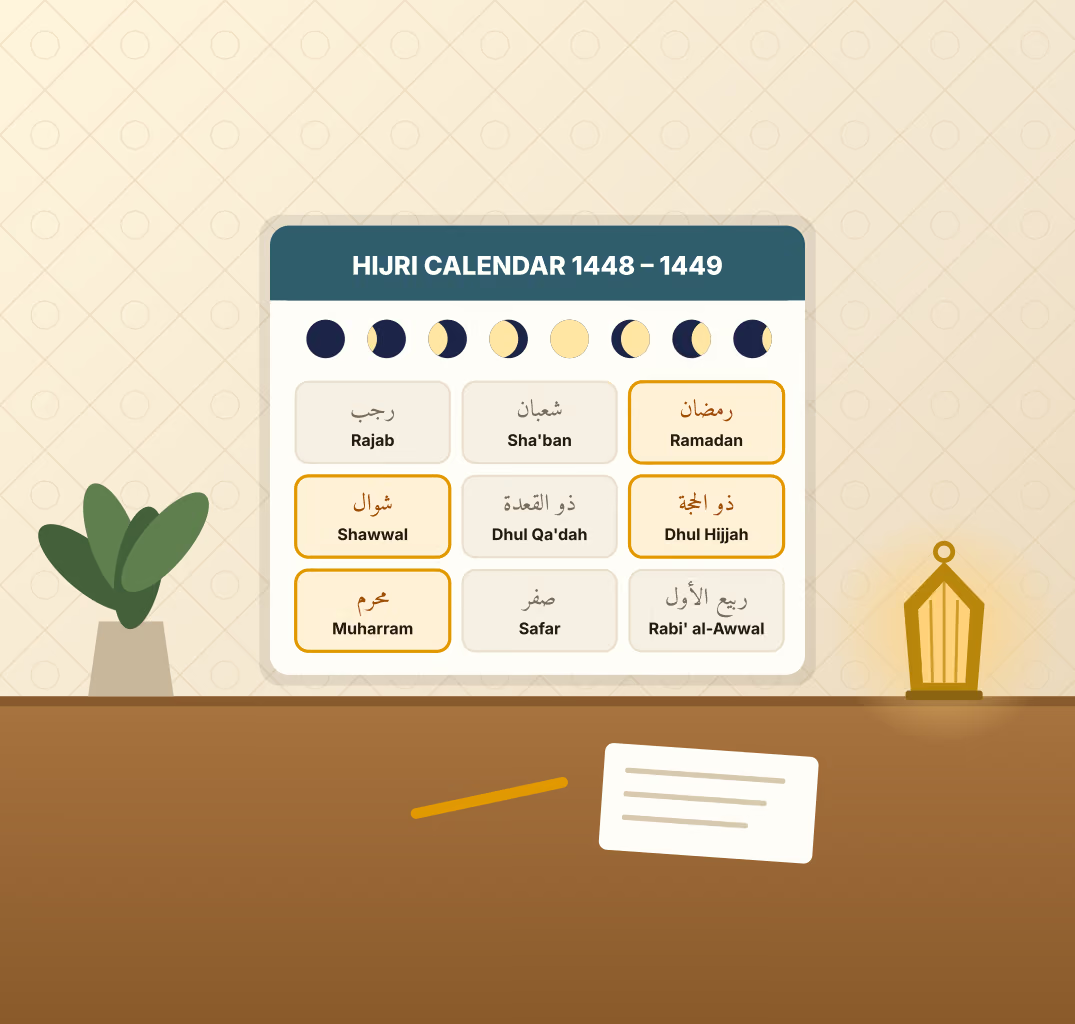
The key Islamic dates of 2027, from Rajab 1448 in December 2026 to 12 Rabi al-Awwal 1449 in August 2027, with the likely alternative wherever communities may differ by a day.
The short answer
The main Islamic holidays of 2027 are expected on these dates: Ramadan begins on Monday 8 February, Eid al-Fitr is on Tuesday 9 or Wednesday 10 March, Eid al-Adha on Sunday 16 or Monday 17 May, the Islamic New Year (1 Muharram 1449) on Sunday 6 June, and Ashura on Tuesday 15 June.
Every date here is expected, subject to moon sighting. Only the Fiqh Council of North America has fixed its 2027 month starts in advance, by calculation; everyone else will announce. The year 2027 spans two Hijri years: 1448 AH until early June, then 1449 AH.
- Ramadan begins
- Monday 8 February 2027
- Eid al-Fitr
- Tuesday 9 or Wednesday 10 March
- Eid al-Adha
- Sunday 16 or Monday 17 May
- Islamic New Year 1449
- Sunday 6 June
- Ashura
- Tuesday 15 June
- Quran lessons
- One-to-one, from $39 a month
1448 to 1449 AH
What are the Islamic holidays in 2027?
The dates most families plan around are the start of Ramadan, Eid al-Fitr, the Day of Arafah and Eid al-Adha, then the Islamic New Year and Ashura in June. Where two dates are shown, the first is the calculated one and the second is the realistic alternative.
- First day of RamadanMonday 8 February 2027Taraweeh begins the evening before.
- Eid al-FitrTuesday 9 March 2027 or A split between communities is likely.
- Day of ArafahSaturday 15 May 2027 or
- Eid al-AdhaSunday 16 May 2027 or
- Islamic New Year (1 Muharram 1449)Sunday 6 June 2027
- Ashura (10 Muharram)Tuesday 15 June 20279 Muharram is Monday 14 June.
Expected dates, subject to moon sighting.
The Hijri months
When does each Hijri month begin from December 2026 to August 2027?
Rajab 1448 is expected to begin on Thursday 10 December 2026 and Rabi al-Awwal 1449 on Tuesday 3 August 2027. The table gives the month starts in between, with the UK local-sighting prediction where it differs.
| Hijri month | Expected first day | Possible alternative |
|---|---|---|
| Rajab 1448 | Thursday 10 December 2026 | Saturday 12 December 2026 (UK local-sighting prediction) |
| Sha’ban 1448 | Saturday 9 January 2027 | Sunday 10 January 2027 (UK local-sighting prediction) |
| Ramadan 1448 | Monday 8 February 2027 | A day later only in rare cases |
| Shawwal 1448 | Tuesday 9 March 2027 | Wednesday 10 March 2027 |
| Dhul Qa’dah 1448 | Thursday 8 April 2027 (Umm al-Qura) | No prediction found |
| Dhul Hijjah 1448 | Friday 7 May 2027 | Saturday 8 May 2027 |
| Muharram 1449 | Sunday 6 June 2027 | Monday 7 June 2027, unlikely |
| Rabi al-Awwal 1449 | Tuesday 3 August 2027 | Wednesday 4 August 2027, where sighting decides |
When are Isra and Mi’raj, mid-Sha’ban, Ashura and 12 Rabi al-Awwal in 2027?
Isra and Mi’raj is expected on Tuesday 5 January 2027, mid-Sha’ban on Saturday 23 January, Ashura on Tuesday 15 June and 12 Rabi al-Awwal on Saturday 14 August. Each “night” begins at sunset on the evening before the date.
- Isra and Mi’raj, 27 Rajab 1448: Tuesday 5 January 2027, the night beginning on Monday 4 January. Where Rajab starts later, as the UK local-sighting prediction suggests, it may be Wednesday 6 or Thursday 7 January.
- Mid-Sha’ban (Laylat al-Bara’ah, Shab-e-Barat), 15 Sha’ban: Saturday 23 January, the night beginning on Friday 22 January; or Sunday 24 January, from the Saturday evening, where Sha’ban begins on 10 January.
- Ashura, 10 Muharram 1449: Tuesday 15 June 2027, with 9 Muharram on Monday 14 June. Many Muslims fast on Ashura, often together with the day before or after it; practice varies between communities.
- 12 Rabi al-Awwal 1449: Saturday 14 August 2027, or Sunday 15 August where the month begins after a sighting. Some Muslims mark the birth of the Prophet Muhammad ﷺ (Mawlid) on this date.
Isra and Mi’raj, mid-Sha’ban and the Mawlid are marked by some Muslims and not by others, and practice varies. We give the calendar dates only; families follow their own mosque or scholars.
US, UK, Canada, Australia
Do the 2027 dates differ between the US, UK, Canada and Australia?
Sometimes, by one day, and mostly at the two Eids. North American communities on FCNA’s calendar already have published month starts (their Eid al-Adha follows the Saudi announcement), UK mosques divide between a local sighting and Saudi Arabia, and Australia’s ANIC mostly calculates but followed Saudi Arabia for Dhul Hijjah in 2026.
| Country | Who usually sets the dates | Where a one-day split is likely |
|---|---|---|
| United States | FCNA and ISNA by calculation; some mosques use a local sighting or follow Saudi Arabia | Eid al-Fitr; possibly Eid al-Adha |
| Canada | ISNA Canada on FCNA’s calendar; the Hilal Council of Canada by local sighting | Eid al-Fitr; possibly Eid al-Adha |
| United Kingdom | Wifaqul Ulama by local sighting; other mosques follow Saudi Arabia | Both Eids; possibly Rajab and Sha’ban |
| Australia | ANIC, mainly by calculation; Saudi Arabia for Dhul Hijjah in 2026 | Eid al-Fitr, most likely Wednesday 10 March |
Each event has its own page with the country detail and sources: Ramadan 2027, Eid al-Fitr 2027 and Eid al-Adha 2027.
Hijri and Gregorian
How does the Islamic calendar work?
The Hijri calendar follows the moon: each month starts with the new crescent and lasts 29 or 30 days, so the year is about 11 days shorter than the Gregorian one.
Hijri (lunar) calendar
- Twelve months of 29 or 30 days
- A month begins with the new crescent, seen or calculated
- Each day begins at sunset
- Dates arrive about 11 days earlier each solar year
Gregorian (solar) calendar
- Months of a fixed length, 28 to 31 days
- Set by the sun, so the seasons stay put
- Each day begins at midnight
- Leap years keep it in step with the seasons
So Ramadan moves through every season over roughly 33 years: it began in mid-February in 2026, and is expected in early February in 2027.
Communities start each month in three main ways. FCNA calculates and publishes its dates years ahead. Saudi Arabia follows its pre-computed Umm al-Qura calendar from Safar to Sha’ban, while its Supreme Court sets Ramadan, Shawwal and Dhul Hijjah after a sighting. Local-sighting bodies, such as Wifaqul Ulama in the UK and the Hilal Council of Canada, wait for the crescent on the evening of the 29th.
For parents
Planning your child’s Quran year around the 2027 calendar
Three points in the calendar make natural planning dates for a child’s Quran lessons: January before Ramadan, the week after Eid al-Fitr, and the start of the long school holiday (July in the northern hemisphere, December in Australia).
- December to JanuaryStart or restart lessons and fix a weekly time while Rajab and Sha’ban run.
- February to early MarchRamadan: keep the lesson, perhaps at a new hour, with one small goal. See Ramadan Quran classes.
- Mid-MarchBack to the usual slot in the week after Eid al-Fitr.
- MayMove any lesson that falls on Eid al-Adha, and check the routine has lasted.
- June to AugustLighter weeks in the northern summer holidays, not a full stop. See keeping Quran going in the holidays.
For Ramadan itself, our Ramadan Quran plan for kids suggests daily targets by age. The subjects children can take, from Noorani Qaida to Islamic Studies, are on Islamic classes for kids.
Lessons are live and one-to-one, 30 minutes each, at any hour, seven days a week, with a male or female teacher and a female supervisor in every class. Two lessons a week cost $39 a month; three, four and five cost $49, $55 and $59 (fees). They need a steady weekly time, a quiet spot and, for younger children, a parent within earshot, so they are a poor fit for a family whose week changes every week.
After you book, we confirm a time on WhatsApp, your child has up to 3 free trial classes, and you choose a plan once you have seen the teacher at work.
Start the Quran year with a free trial class
Up to 3 free trial classes. No card, no obligation.
Frequently asked questions
When is Islamic New Year 2027?
The Islamic New Year, 1 Muharram 1449, is expected on Sunday 6 June 2027. FCNA has published that date, and the Umm al-Qura calendar agrees.
When is Ashura 2027?
Ashura, 10 Muharram 1449, is expected on Tuesday 15 June 2027, with 9 Muharram on Monday 14 June.
What Hijri year is it in 2027?
From January to early June 2027 it is 1448 AH. The year 1449 AH begins on 1 Muharram, expected on Sunday 6 June 2027.
Are there two Eids in 2027?
Yes, as every year: Eid al-Fitr is expected on 9 or 10 March 2027 and Eid al-Adha on 16 or 17 May 2027.
Why do Islamic dates move every year?
The Hijri year has twelve lunar months and is about 11 days shorter than the Gregorian year, so each Islamic date arrives about 11 days earlier than the year before.
Are these Islamic calendar dates final?
No. They are expected dates, subject to moon sighting. Most bodies announce each month as it begins; FCNA is the exception, with calculated dates published in advance.
Is Isra and Mi’raj in January 2027?
Yes, it is expected on Tuesday 5 January 2027 (27 Rajab 1448). Where Rajab begins later, it may fall on 6 or 7 January.
When is Shab-e-Barat 2027?
The night of 15 Sha’ban (Shab-e-Barat) is expected to begin at sunset on Friday 22 January 2027. Where Sha’ban begins on 10 January, it begins at sunset on Saturday 23 January, with 15 Sha’ban on Sunday 24 January.
Sources for the dates and facts on this page
- Fiqh Council of North America: Islamic calendar
- Umm al-Qura key dates (makkahlive)
- ICOUK (Moon Sighting UK): Rajab 1448 report
- ICOUK (Moon Sighting UK): Sha’ban 1448 report
- ICOP: Jumada al-Ula 1448
- US Naval Observatory: phases of the moon, 2027
- Wifaqul Ulama: 1448 declarations
- ANIC: Dhul Hijjah 1447 statement