
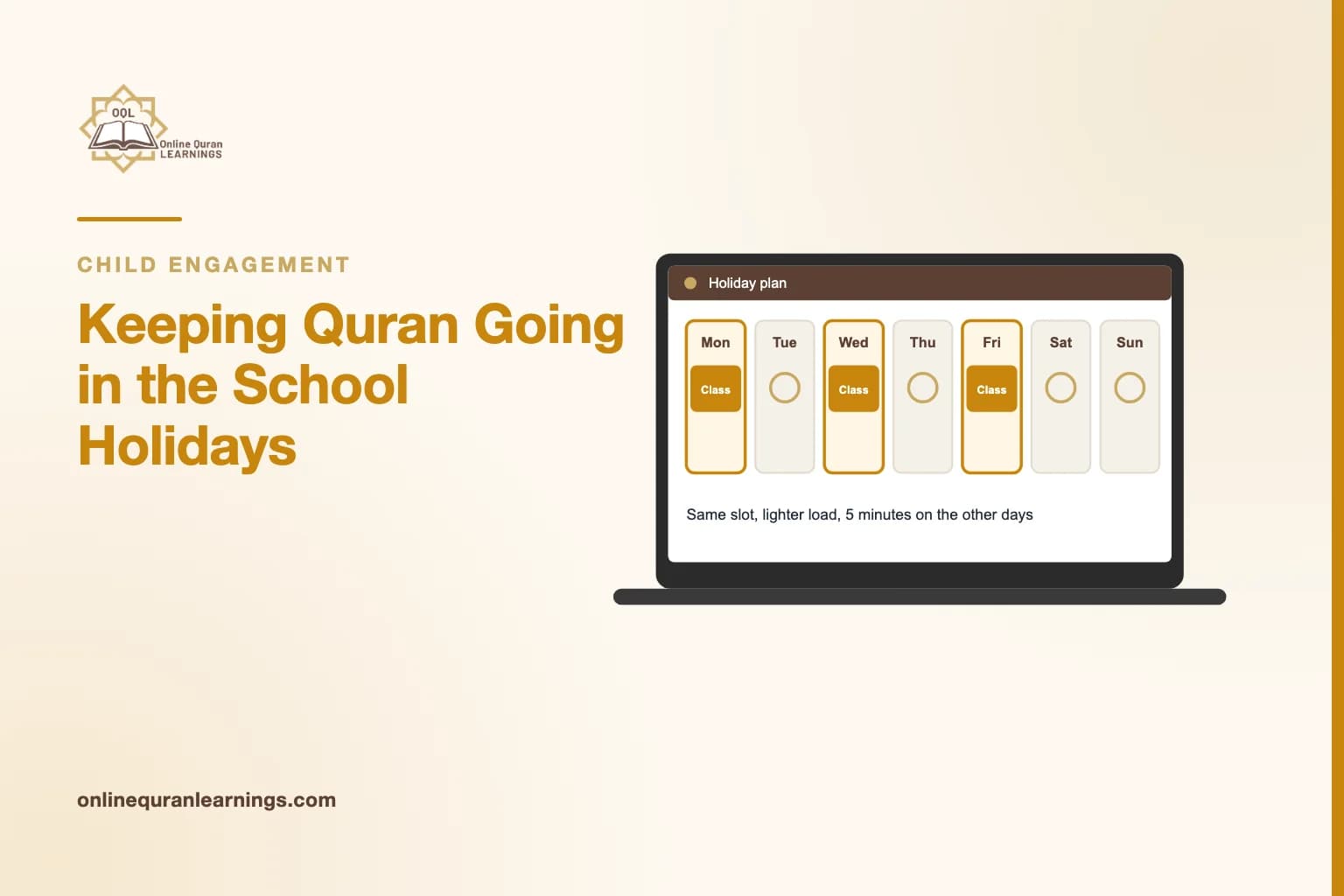
Short answer: keep at least one fixed lesson a week through every holiday, however short, and decide in advance whether this break is for maintenance, revision or a push forward. Stopping completely for a long summer usually costs more than the holiday gave back, because the first few weeks of the new term are spent recovering what faded.
What that looks like depends on the length of the break and whether you are going anywhere. A one-week half-term needs almost no planning. A ten-week American summer with three weeks at the grandparents' in another time zone needs quite a lot.
Three ways to use a holiday
Before anything else, pick one of these for the break ahead. Mixing them is where plans go vague.
| Approach | What it means | Suits |
|---|---|---|
| Light maintenance | One or two lessons a week, mostly revision | Travel, short breaks, tired children |
| Revision block | Normal number of lessons, no new material | Hifz students, children who rushed a stage |
| Holiday push | More lessons or more practice, new material | Long breaks at home, a clear goal such as finishing the Qaida |
Light maintenance is the default for most families. The point is to keep the thread. A child who reads to a teacher once a week through a three-week trip comes back where they left off.
A revision block is underrated. For a child memorising, the holidays are a chance to go back over earlier surahs without the pressure of new pages each lesson. For a reader, it can mean re-reading the last few Qaida lessons until they are fluent rather than just passed.
A holiday push works when the child is at home, rested and keen. It does not work if it turns the summer into a second school. Adding one or two lessons a week is usually enough; doubling them rarely is.
Short breaks: half-terms, Easter and mid-term weeks
For a week or two off, keep the usual lessons if you are at home, and move them to a calmer time of day if that helps. A 4:30 pm school-day slot can become 10:30 am in the holidays, when children are fresher.
If you are away for a short trip, one lesson in the week is enough. If even that is impossible, a daily five-minute read of the current page to a parent holds most of what was learned. Our guide on why children forget Quran lessons explains why small, frequent contact matters more than long sessions.
Long summers, by where you live
The length and timing of the main break differs a lot by country, and so does what makes sense.
- UK. Around six weeks, typically from late July to early September (Scotland starts and finishes earlier). Long enough for a proper revision block or push, short enough that keeping the normal timetable is easy.
- US and Canada. Often ten weeks or more, roughly June to early September depending on the district and province. This is the break where stopping does the most damage, and where a deliberate plan matters most.
- Australia and New Zealand. The summer break falls over December and January, usually around six weeks, and often includes family travel and Christmas-period closures. Many families use it as a light maintenance period and step up again in February.
- Gulf countries. The summer break is long, commonly around two months, and many families travel to Pakistan, India, the UK or elsewhere for much of it. Our guide for families in the Gulf covers timetables during the school year as well.
Travelling and visiting grandparents
Online lessons travel with you, which is one of the plain advantages of one-to-one Quran classes for kids over a local weekend class. A few things make it work.
- Tell the teacher the dates and the destination at least a week before you leave.
- Agree the lesson time in the clock where your child will be, not the clock at home.
- Check the internet at the destination; a phone hotspot can work for a 30-minute video lesson.
- Pack the Qaida or mushaf your child uses, or confirm the same edition is there.
- Find a quiet room before the first lesson, not during it. Grandparents' houses are often busy.
- Decide what happens on travel days. Usually that is no lesson, and a short read the next morning.
Time zones are where trips usually go wrong. A family from Toronto spending a month in Lahore is nine or ten hours ahead of home; a child from Sydney visiting relatives in London is between nine and eleven hours behind, depending on the time of year. The old slot will not land at a sensible hour. Because lessons with us can be booked at any hour, the answer is to pick a new local time that suits the trip, such as mid-morning before outings, and switch back when you return.
Grandparents are often delighted to sit in. If your child is comfortable with it, letting a grandparent listen to a lesson, or hear the day's reading afterwards, can make the trip a highlight rather than an interruption.
A sample six-week summer plan
This is for a nine-year-old part-way through the Qaida, at home for most of the break, with one week away. It assumes 30-minute lessons. Adjust the weeks to your own dates.
| Week | Lessons | Focus |
|---|---|---|
| 1 | 3 a week, mid-morning | Settle into the new time; revise the last stage covered |
| 2 | 3 a week | New material at the usual pace |
| 3 | 4 a week | Holiday push: an extra lesson while energy is high |
| 4 | 1 lesson, from the trip | Light maintenance; daily five-minute read to a parent |
| 5 | 3 a week | Revise everything from weeks 2 and 3 |
| 6 | 3 a week, moving towards the term-time slot | Back to the school-day time, so term starts without a change |
Week 6 is the one families forget. Moving the lesson back to its school-day time before term starts means the first week back is about school, not about relearning a routine as well.
For a Hifz student, the same structure works with a different emphasis: new memorisation in weeks 2 and 3, revision of older surahs in weeks 4 and 5, and a final week testing the whole portion. Teachers often have strong views here, so ask yours.
What to do between lessons
Holidays are long and unstructured, and that cuts both ways. There is more time, and there is also no school bell to hang anything on. Attach the short daily practice to something that does happen every day:
- after breakfast, before screens go on
- after Dhuhr or Asr, if your family prays together
- before the bedtime story
Five to ten minutes is enough. The aim is that a day without a lesson is still a day with Quran in it.
Coming back after a gap anyway
Some breaks do end up as a full stop: an unplanned trip, a sick child, a summer that slipped away. If that happens, expect the first two or three lessons back to be revision, and do not judge progress until the fourth or fifth. Our guide to restarting Quran after a break goes through how teachers rebuild without making a child feel behind.
And when term starts again, it helps to rebuild the school-week timetable deliberately rather than slotting lessons back into the old gaps. Our guide on fitting Quran classes around school has sample weeks to start from.
Frequently asked questions
Can my child take online Quran lessons from a relative's house abroad?
Usually yes, if there is a stable internet connection and a quiet corner. Tell the teacher the new time zone in advance and agree the lesson time in the local clock where your child will be sitting.
Is it worth starting Quran lessons during the summer holidays?
It can be a good time to start, because the first weeks of letters and sounds go better without school fatigue. Plan from the start how the lessons will continue once term begins, so the timetable does not collapse in September.
Should a Hifz student keep memorising new pages over the holidays?
That depends on the child and the length of the break. Many teachers keep new memorisation light and use the extra time to strengthen revision, because a solid revision base makes the next term easier.
What if we have no internet for part of the trip?
Tell the teacher which days are affected and leave a short offline task, such as reading the current page aloud to a parent each day. A few days without lessons is fine if something small is still happening.