
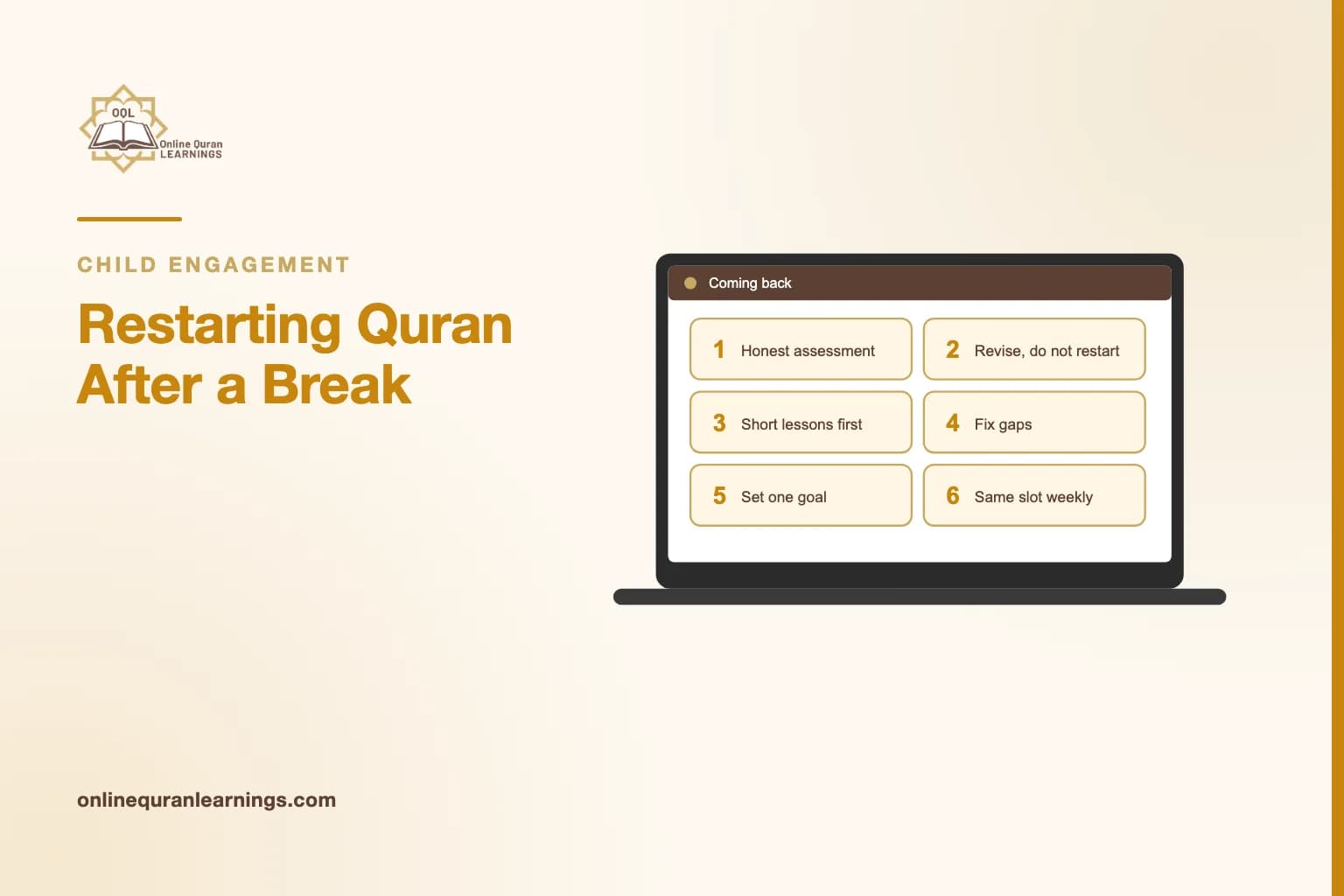
Short answer: when a child or teenager comes back to the Quran after months or years away, start with an honest check of what they can still do, restart slightly below that point, and expect the first two or three weeks to feel slow. Most returning learners recover lost ground much faster than they learned it the first time, so going right back to the beginning is rarely necessary.
What causes the trouble is usually not the gap itself. It is the shock of finding things harder than expected, which leads either to giving up again or to starting from page one and getting bored.
What a break actually does to Quran reading
Skills do not vanish evenly. After a long gap, teachers typically see the same pattern.
| Skill | What usually survives | What usually slips |
|---|---|---|
| Letter recognition | Most letters, especially common ones | Similar shapes and the heavy letters such as ص ض ط ظ |
| Joining and harakat | The basic idea | Speed, and the less common combinations |
| Reading from the mushaf | Short, familiar surahs | Fluency on unfamiliar pages |
| Tajweed rules | A sense that rules exist | Consistent application while reading |
| Memorised surahs | The first lines and the most-recited surahs | Middles, endings and anything not used in salah |
The general rule is that the more automatic something was before the break, the more of it comes back. A child who was reading the Quran comfortably at ten and stopped at eleven will often be reading again within a few weeks. A child who stopped halfway through the Qaida at six may have kept less, simply because less was secure. Our article on why children forget Quran lessons explains why half-finished stages fade faster.
Finding out where they really are
Before any new teaching, spend one session finding the real level. A teacher can do this in a trial or first lesson, but you can get a rough picture at home in fifteen minutes, even if you do not read Arabic yourself.
- Ask them to read a page they used to know well. Notice whether they recognise it or are decoding letter by letter.
- Open the mushaf at an unfamiliar page and ask for three lines. This shows real reading, not memory of a familiar shape.
- Ask for the last few surahs they had memorised. Note where they hesitate, not just where they stop.
- Ask them what they remember finding hard before. Children are often surprisingly accurate about this.
- Write down what you saw, without judging it, and share it with the teacher.
Sort the results into three piles: comes back easily, comes back with a prompt, and genuinely gone. The middle pile is usually the biggest, and it is the most encouraging, because prompted recall returns quickly with practice.
Start from where they are secure, not where they stopped
The instinct is either to pick up exactly where the child left off or to start from the beginning to be safe. Both tend to go wrong.
Picking up where they stopped means building new material on top of skills that have gone rusty. Every lesson is a struggle and the child concludes they are bad at it.
Starting from page one wastes weeks on things they still know, and older children find it humiliating.
The better approach is to restart one step below the point where reading becomes shaky, then move up quickly. If a child can read short surahs but stumbles on longer pages, they do not need the Qaida again. They need a few weeks of slow, corrected reading with attention to the specific rules that slipped. If the joining stages have gone, a short Qaida refresher covering only those stages is usually enough. The Noorani Qaida course is built in stages, which makes it easy to re-enter at the right one.
For older children and teenagers who feel they have lost almost everything, a structured refresher such as Quran basics for beginners gives them a clear route back without pretending they are seven.
The first four weeks
This plan assumes two or three 30-minute lessons a week. Adjust the pace to your child; the order matters more than the exact timing.
| Week | Lesson focus | Between lessons |
|---|---|---|
| 1 | Level check, then easy reading the child can succeed at | Five minutes of reading aloud on most days |
| 2 | Targeted repair of the weakest skill found in week 1 | Re-read what was corrected in the last lesson |
| 3 | Mix of repair and a little new material | Add one short surah back into daily revision |
| 4 | Mostly new material, brief revision at the start | Recite a surah in salah or to a parent each day |
By the end of the first month, most returning learners know where they stand and have had several lessons that felt like progress. That feeling is what keeps them going.
How many lessons a week to restart with
Fewer than you might think. Two or three lessons a week with short daily practice usually beats four or five lessons with nothing in between. Our guide to how many Quran classes a week sets out the trade-offs by age and goal.
Memorised surahs that have faded
Do not try to rebuild every surah at once. Bring back the shortest ones first, recite them in salah where possible, then add longer ones one at a time. For children who were doing Hifz before the break, a structured revision routine matters even more than new memorisation, and our page on memorisation with murajaah explains how that balance is usually set.
Rebuilding the motivation, not just the skill
A child returning after a break often carries some feeling about why they stopped. Maybe lessons became a fight, or they felt behind, or life just got busy. That feeling walks into the first lesson with them.
Talk about the break honestly. "We stopped for a while and that's fine. Now we're starting again, and it'll come back faster than you think." Avoid blame, including self-blame from you.
Set a short, visible goal. "Read a full page without help by the end of the month" is better than "get back to where you were."
Mark the first wins. Notice out loud when something comes back: "You remembered that rule straight away."
Change what caused the break, if you can. If lessons stopped because they clashed with school, pick a slot that does not. If they stopped because your child was refusing, our guide on what to do when a child refuses Quran class is worth reading before restarting.
For teenagers, let them shape it. A fourteen-year-old returning after two years should be part of choosing the goal, the times and possibly the teacher. Our article on teaching Quran to teenagers goes into how that conversation usually goes well.
Signs the restart is working
After four to six weeks, look for these rather than counting pages:
- Your child reads unfamiliar lines more smoothly than in the first lesson.
- They correct some of their own mistakes before the teacher does.
- The start of each lesson is calmer than it was in week one.
- At least one memorised surah is back and being used.
- They can tell you what they are working on next.
If none of these are happening after six weeks, the starting point may still be too high, the timing may be wrong, or the teacher may not be the right fit. Change one thing and give it another month.
The gap is not wasted
Parents often feel guilty about the months lost. It helps to remember that a child returning at twelve brings things a seven-year-old does not have: longer attention, better general reading, and the ability to understand why a rule matters. Many returning learners end up reading more carefully than they did before the break, precisely because they are now learning on purpose.
Frequently asked questions
How much Quran reading does a child forget in a year off?
It varies a lot. A child who read fluently usually keeps letter recognition and loses speed and some rules, while a child who stopped midway through the Qaida may lose the later joining stages. Memorised surahs fade fastest unless they were recited regularly in salah.
Should my child restart with the same teacher as before?
If the break happened for practical reasons such as a move, exams or a family event, returning to a familiar teacher can make the first weeks easier. If the break happened because lessons had become a struggle, a new teacher is often the cleaner restart.
Is it embarrassing for a teenager to go back to the Qaida?
It can feel that way, so frame it as a short refresher with a clear end rather than starting again. Most older children who return to Qaida pages move through them quickly, and the speed itself rebuilds confidence.
Can we restart in the middle of the school year?
Yes. There is no term structure to wait for with one-to-one lessons. Pick two slots that survive a normal school week, start there, and add a third once the routine has held for a month.