
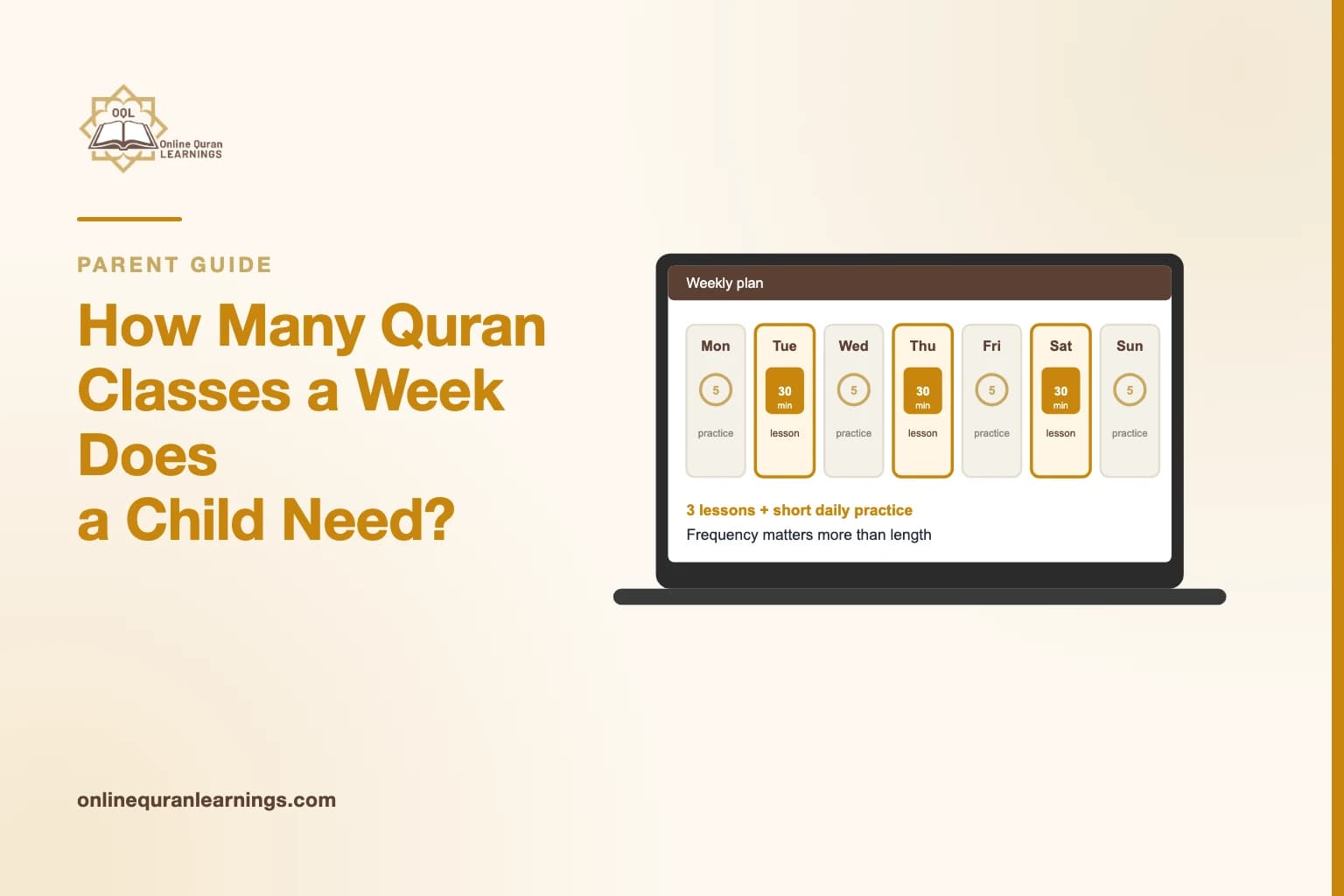
Parents usually ask this expecting a number. The more useful answer is that frequency and total hours are not the same thing, and frequency is the one that matters.
Two half-hour classes a week beats one hour-long class, reliably. Three thirty-minute classes beat two forty-five-minute ones. Language and memorisation both respond to repeated contact more than to duration, so spreading the same time across more days produces more progress.
What each frequency actually achieves
One class a week
Enough to maintain a relationship with a teacher and keep the habit alive. Not enough for steady progress, because seven days is long enough for new material to fade, so much of the lesson is recovery.
Reasonable if the alternative is stopping, or during a period — exams, travel, Ramadan — when the schedule cannot hold more.
Two classes a week
The most common choice, and sufficient for Quran reading and Qaida if there is short daily practice between them.
A child of six at two classes a week with practice will usually finish the Qaida in around a year. The same child without practice will take considerably longer, because each lesson starts by rebuilding the last one.
Three classes a week
Noticeably faster, and the point at which the gap between classes is short enough that little is lost. This is our usual recommendation for a child starting Qaida, and for anyone learning Tajweed, where frequent correction matters.
The practical advantage is that a missed class still leaves two that week rather than one.
Five or six classes a week
Standard for Hifz, and generally necessary rather than optional. Memorisation requires daily recitation to a teacher, because a page memorised with an error and revised for a week is much harder to correct than one caught the next day.
For reading rather than memorisation, five classes a week is rarely the best use of the budget. Three classes plus daily practice usually achieves as much.
How long should a class be
| Age | Class length | Classes a week |
|---|---|---|
| 3–5 | 15–20 minutes | 2–3 |
| 5–8 | 30 minutes | 2–3 |
| 8–12 | 30–45 minutes | 2–3, or 5 for Hifz |
| 13+ | 45–60 minutes | 2–3, or 5–6 for Hifz |
| Adults | 45–60 minutes | 2–3 |
The commonest mistake is booking an hour for a seven-year-old on the reasoning that more is better. A young child's useful attention runs out well before the hour does, and the last twenty minutes tend to undo some of the first thirty by making the class something to be endured.
The practice between classes matters more than the classes
This is the part most schedules leave out.
Five to ten minutes on non-class days roughly doubles what a child gets from the same number of lessons. It does not need to be supervised teaching — reading the current page aloud to a parent is enough. What it does is convert the lesson from something that happens twice a week into something the child is doing continuously.
If you are choosing between adding a third class and establishing daily practice, establish the practice first. It costs nothing and does more.
Choosing the time of day
More children stop because of a badly chosen slot than because of the number of classes.
- Avoid the hour after school. Children are tired and hungry, and the class competes with decompressing.
- After dinner, before it gets late, works for most families.
- Weekend mornings are the most reliable slot of all, and the least likely to be displaced by something else.
- Keep it fixed. A class that moves around the week is the one that eventually stops happening.
Because most online Quran teachers work across time zones, confirm the slot in your local time and ask what happens when clocks change. Families in Australia, the UK, Canada and the US all shift relative to a teacher in a fixed zone at different points in the year, and a class that quietly moves by an hour in October is a class that gets abandoned by December.
Adjusting over time
The right frequency is not fixed for years.
Increase when a child is progressing well and enjoying it, when starting Hifz, or when working towards a specific goal such as finishing the Qaida before Ramadan.
Decrease during heavy exam periods, or when a child is clearly saturated. Dropping to one or two classes for a term is much better than stopping.
Keep it steady the rest of the time. Changing frequency often is its own disruption.
A reasonable default
If you want a single answer: three thirty-minute classes a week, plus five minutes of practice on the other days. That fits most children between five and twelve, progresses at a rate parents can see, and is sustainable across years rather than months.
Adjust from there once a teacher has seen your child. Our guides on what age to start and why lessons do not stick cover the two questions that usually follow.
Frequently asked questions
Are two classes a week enough?
For Qaida and Quran reading, yes, provided there is short daily practice in between. Two classes with no practice between them progresses slowly, because much of each lesson is spent recovering the previous one.
Is one class a week worth doing?
It maintains contact and it is much better than stopping, but expect slow progress. Seven days is long enough for new material to fade, so a weekly class tends to spend its first half revising.
How long should each class be?
Thirty minutes suits most children aged five to twelve. Under five, fifteen to twenty minutes is more realistic. Older students and Hifz students often want forty-five to sixty.
Do more classes cost proportionally more?
Broadly yes, since the cost is teacher time. Our plans start at $39 a month for two classes a week, with additional days priced accordingly. Full details are on the schedule and fees page.