
The honest answer is that there is no single right age, and the question parents are really asking is usually a different one: am I leaving it too late, or pushing too early?
Both worries are reasonable. Starting too late means competing with school, homework and a child's growing sense of what they do and do not want to do. Starting too early, badly, can put a child off the Quran in a way that takes years to undo — and that is the more expensive mistake of the two.
Here is what actually changes as children get older, and what a start looks like at each stage.
Ages 3 to 5: listening, not lessons
At this age a child is not learning to read. They are building familiarity — with the sounds of Arabic, with the rhythm of recitation, and with the idea that this is a normal part of the week.
What works:
- Ten to fifteen minutes, no more, two or three times a week.
- Recognising and naming letters, in no particular order, as a game.
- Hearing short surahs recited aloud, repeatedly, without any requirement to reproduce them.
- An adult in the room. At four, a child on a video call alone will drift within minutes.
What does not work is a formal thirty-minute lesson with a Qaida open on the screen. A child of four can be taught at that length, but they cannot attend for it, and the lesson turns into a negotiation.
The single biggest advantage of starting here is phonetic. Young children reproduce unfamiliar sounds — the heavy letters, ع, ح, ق — far more accurately than older beginners, and they do it without effort. That window narrows.
Ages 5 to 7: the natural starting point
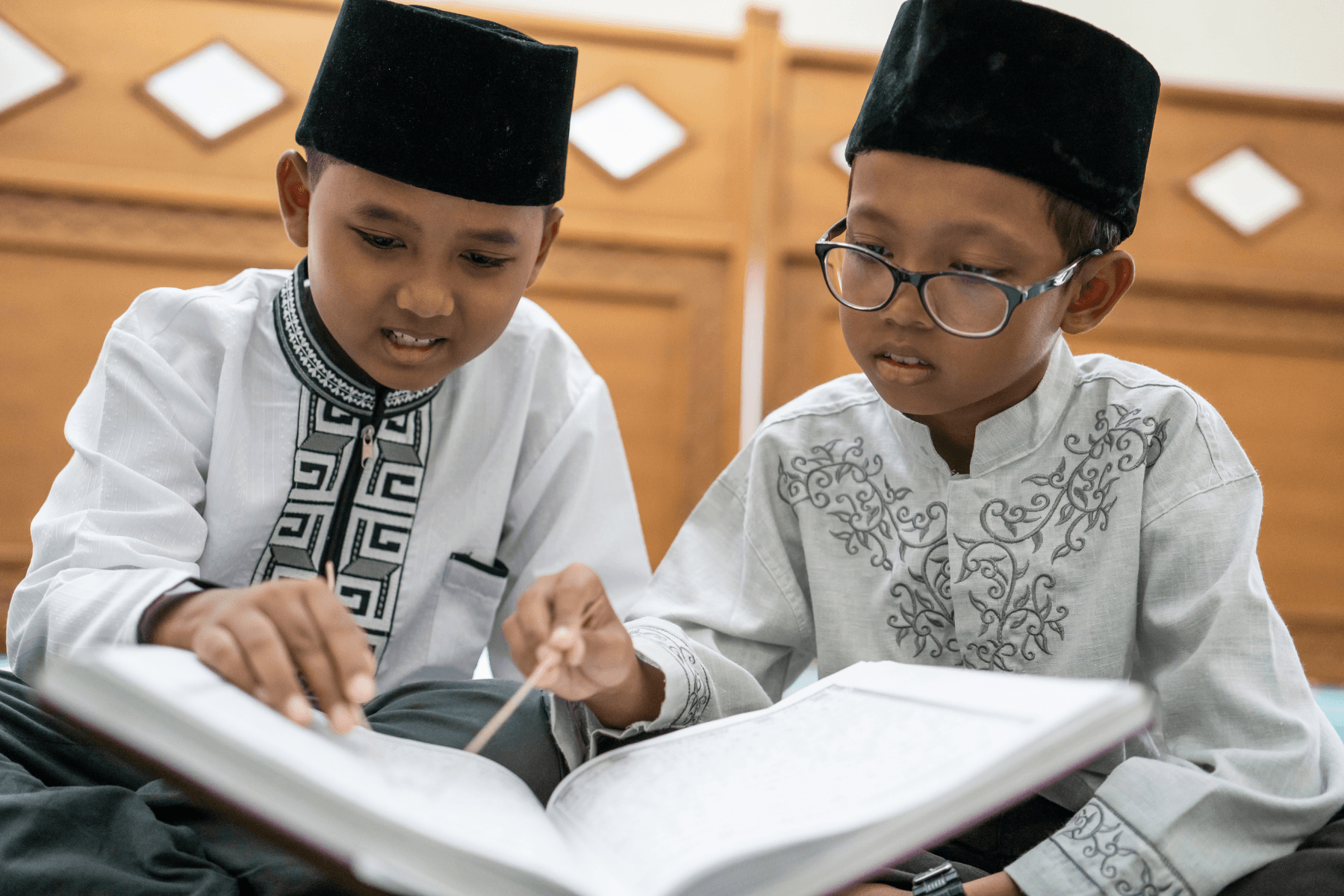
Most children we teach begin here, and it is the age at which formal Quran classes for children genuinely start to work.
By five or six, a child can usually sit for a focused twenty to thirty minutes, follow an instruction given over video, and hold a rule in mind long enough to apply it twice. That is enough to work systematically through Noorani Qaida — letters, then vowel marks, then joining, then simple words.
A realistic shape at this age:
- Two or three classes a week, thirty minutes each.
- Five to ten minutes of practice on non-class days. Short and daily beats long and weekly, by a wide margin.
- Steady, unglamorous progress. Qaida usually takes somewhere between six months and eighteen months at this age, depending on frequency and practice, and comparing your child to someone else's is not useful.
Ages 8 to 12: faster, but with more to negotiate
Older children learn the mechanics considerably faster. They already read fluently in English, they understand what a rule is, and they can be told why something is pronounced a certain way rather than simply copying it.
An eight-year-old beginner will often move through the Qaida in half the time a five-year-old takes.
What gets harder is everything around the lesson. School is more demanding, evenings are more crowded, and a child of ten has opinions about how their time is spent. This is the age at which classes are most often started with enthusiasm and quietly dropped by the second term.
Two things help more than anything else:
- A fixed slot that never moves. Not "sometime after dinner" — the same two evenings, treated like a fixture rather than a plan.
- A visible finish line. "Complete the Qaida by Ramadan" or "read Surah Al-Mulk without help" gives a child something to be finished with. Open-ended study is much harder to sustain at this age.
This is also the age at which Tajweed becomes properly teachable, because a child of nine or ten can hold an abstract rule and apply it deliberately.
Teenagers and older beginners
It is not too late, and the assumption that it is stops more people than anything else does.
Teenagers and adults progress through the foundations quickly. The real obstacle is embarrassment — a fifteen-year-old who cannot read a page that a seven-year-old can read will often avoid the situation rather than sit in it.
One-to-one classes matter more here than at any other age, precisely because there is nobody else in the room. It is also the point at which understanding starts to motivate more than duty: pairing reading with Tafseer or Quranic Arabic gives an older learner a reason of their own.
What matters more than the age
After a few thousand trial classes, the pattern is fairly clear. The children who progress are not the ones who started earliest. They are the ones where:
- The class happens at the same time every week. Consistency outperforms intensity, and it is not close.
- Someone at home listens occasionally. Not to teach — just to hear it. A child who recites to a parent once a week practises differently.
- The pace is set by the child, not the calendar. Pushing a struggling child to keep up with a syllabus produces gaps that reappear years later.
- The first year is not made unpleasant. How a child feels about Quran class at seven substantially predicts whether they are still learning at fourteen.
"And We have certainly made the Qur'an easy for remembrance, so is there any who will remember?" — Qur'an 54:17
The ease referred to there is real, but it is not the same thing as speed. A child who reaches ten reading slowly, accurately and willingly is in a far better position than one who was rushed to finish and now avoids it.
A practical starting point
If your child is four or five, start with short, informal sessions and treat the first year as familiarisation. If they are six to nine, start properly with two or three classes a week and expect the Qaida to take most of a year. If they are older, start anyway, and start one-to-one.
If you are unsure which of those describes your child, that is a reasonable thing to ask a teacher in a trial class rather than decide alone. Our guides on choosing a teacher and how many classes a week cover the two decisions that follow this one.
Frequently asked questions
Is four too young to start Quran classes?
Not if the sessions are short. A four-year-old can manage ten to fifteen minutes of letter recognition and listening. What does not work at four is a thirty-minute lesson with a book open, which is why some children start and stop before they ever really begin.
My child is eleven and has not started. Is it too late?
No. Older beginners move through Noorani Qaida considerably faster than five-year-olds because they already read in another language and can hold a rule in mind. The obstacle at that age is usually self-consciousness, not capacity.
Should a child learn to read the Quran or memorise it first?
Reading first, in almost every case. A child who memorises before reading correctly memorises their mistakes too, and those are difficult to unpick later. Short surahs learned by ear alongside Qaida are a normal exception.
How do I know my child is ready?
Two practical tests: can they sit with an adult and follow a shared activity for ten minutes, and can they repeat a sound back to you accurately when asked. Neither depends on age exactly, which is why two children of the same age can be a year apart in readiness.