
Most parents choose an online Quran teacher the same way: they search, they see a dozen academies that all promise qualified tutors and flexible timings, and they pick one that feels reasonable. A few months later they are quietly wondering whether their child is actually progressing.
The problem is not that parents choose carelessly. It is that the things academies advertise are not the things that predict whether a child will learn. This guide is about what actually distinguishes one teacher from another, written from what we see in trial classes every week.
Start with the goal, not the teacher
A teacher who is excellent for one goal can be wrong for another. Before you look at anyone, decide which of these you are asking for:
- Learning the Arabic letters and how to join them. This is Noorani Qaida, and it is the foundation for everything after it. It needs a teacher with enormous patience for repetition.
- Reading the Quran fluently and correctly. This is Quran reading with Tajweed. It needs a teacher with precise articulation, because your child will copy exactly what they hear.
- Memorisation. Hifz is a long-term commitment with its own discipline of daily revision. It needs a hafiz who can build and hold a revision schedule.
- Understanding. Tafseer and Arabic are separate tracks again, and are usually taken alongside reading rather than instead of it.
An academy that answers "we do all of it" without asking what your child needs is not listening yet.
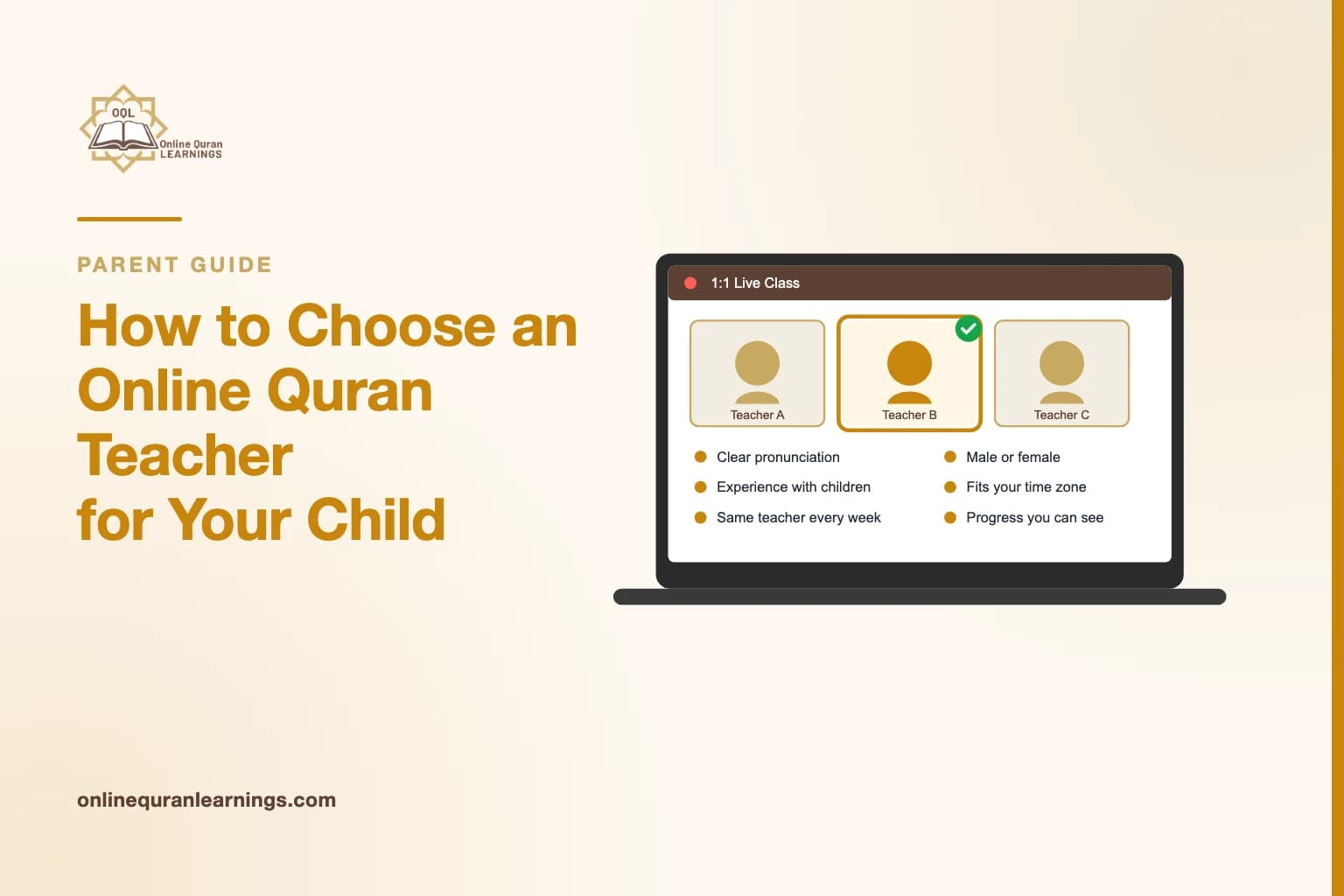
The five things that actually matter
1. Clear, correct pronunciation
Your child will reproduce the teacher's mouth. This is the single most consequential quality, and the hardest to reverse later. In a trial class, listen to how the teacher pronounces the heavy letters — ص, ض, ط, ظ, ق. If those sound indistinct or blurred into their lighter counterparts, your child will learn them that way.
You do not need to be an Arabic scholar to hear this. Play a recitation by a well-known qari and listen for the same letters. You will notice the difference.
2. Experience with children specifically
Teaching an adult and teaching a seven-year-old are different jobs. Adults tolerate a dull lesson because they chose to be there. Children do not.
Watch for whether the teacher checks understanding or only checks output. A teacher who says "repeat after me" for thirty minutes is not teaching, they are drilling. A teacher who asks "which letter is this?" and waits, then gives a hint rather than the answer, is teaching.
3. A method you can see
Ask the teacher what your child will be able to do in three months. A good answer is specific: finish the first section of the Qaida, read short surahs independently, master a particular set of Tajweed rules. A vague answer — "they will improve, insha'Allah" — usually means there is no plan behind it.
4. Reliability across time zones
Most online Quran teachers are in a different time zone from the family. That is fine when it is planned around and corrosive when it is not. Ask directly: what time is this class in my time, will it be the same teacher every week, and what happens when the clocks change?
A class that keeps drifting by an hour will be abandoned within a term, regardless of how good the teaching is.
5. Progress you can actually see
You will not sit in on every lesson, and you should not have to. But you should know, without asking, whether last week went well. Whether that is a short message after class, a shared progress sheet, or a monthly summary matters less than whether it exists at all.
What to do in the trial class
Sit within earshot for the first one. You are not supervising your child, you are assessing the teacher. Specifically:
- Does the teacher greet your child by name and ask them something? A lesson that opens with a question rather than an instruction tends to keep the child present.
- What happens when your child gets something wrong? The useful response is to model the correct sound and have the child try again immediately. An unhelpful response is to move on, or to repeat the correction with visible impatience.
- Does the teacher's screen work, and do they know how to use it? Shared Qaida pages, a highlighted line, a pointer following the text — small things, but a lesson conducted entirely by voice is much harder for a young child to follow.
- How much of the half hour is your child actually speaking? For reading and Qaida, the child should be producing sound for a substantial part of the lesson. If the teacher is talking for most of it, the balance is wrong.
- Ask one question at the end: "What did my child find hardest today?" A teacher who was paying attention will answer immediately and specifically.
Warning signs worth acting on
- The teacher changes every few weeks. Continuity matters more in Quran learning than in almost any other subject, because so much of the teacher's job is remembering exactly where your child's weak spots are.
- You cannot get a straight answer about the teacher's background. You are not entitled to a life story, but "who taught you, and what have you been certified in?" is a fair question.
- Group classes sold as one-to-one. Ask explicitly. A child in a group of six gets roughly five minutes of individual attention in a thirty-minute class.
- Pressure to pay for a long block up front. A monthly arrangement is normal. A steep discount for twelve months paid immediately is a retention strategy, not a saving.
- No trial, or a trial that is really a sales call. The trial should be a lesson.
How much should it cost
Prices in the US, UK, Canada and Australia cluster between roughly $30 and $60 a month for two half-hour classes a week, with one-to-one teaching. Our own plans start at $39 a month.
Be careful at both ends. Substantially below that range usually means larger groups, less experienced teachers, or high turnover. Substantially above it should come with something specific attached — a named scholar, an ijazah pathway, a formal curriculum with assessments — and if nobody can tell you what you are paying extra for, you are not paying extra for anything.
A note on what you are really choosing
Parents often frame this as choosing an academy. In practice you are choosing a person your child will speak to twice a week for years, about something you care about more than almost anything else you will pay for.
That is worth two or three trial classes and a few direct questions. It is also why our Quran teacher pages list what each teacher actually teaches rather than a single blanket claim about the whole academy. It is also worth changing your mind early if the fit is wrong, which is far easier at week two than at month eight.
Frequently asked questions
Should my child have a male or a female Quran teacher?
It is a family decision, not a quality one. Many parents prefer a female teacher for daughters and for younger children of either gender, and some prefer a male teacher for older boys. We offer both, so the choice does not force a compromise on experience or scheduling.
How many trial classes do I need before deciding?
One class shows you the teacher's manner. Two or three show you whether your child is actually retaining anything and whether the pace suits them, which is the part that matters. We give up to 3 free trial classes for that reason.
What if my child does not get along with the teacher?
Ask to change. A mismatch of temperament is common and is nobody's fault, but a child who dreads the lesson will not progress. Any academy that makes changing a teacher difficult is telling you something about how it is run.
Does the teacher need to be a hafiz?
For Hifz, yes, and ideally one with a formal sanad. For Qaida and Quran reading with Tajweed, what matters far more is clear articulation, patience, and experience teaching children specifically.