
Some children are ready for online Quran classes at four. Some are not ready at six. The difference is rarely intelligence or how many Arabic letters they know. It is whether they can manage the specific format: a live teacher on a screen, for half an hour, with someone at home helping.
This is a different question from what age to start. If you want to know when children are generally ready to begin learning the Quran at all, our guide to what age to start Quran classes covers that. This article is about whether your child, now, can learn well in an online lesson.
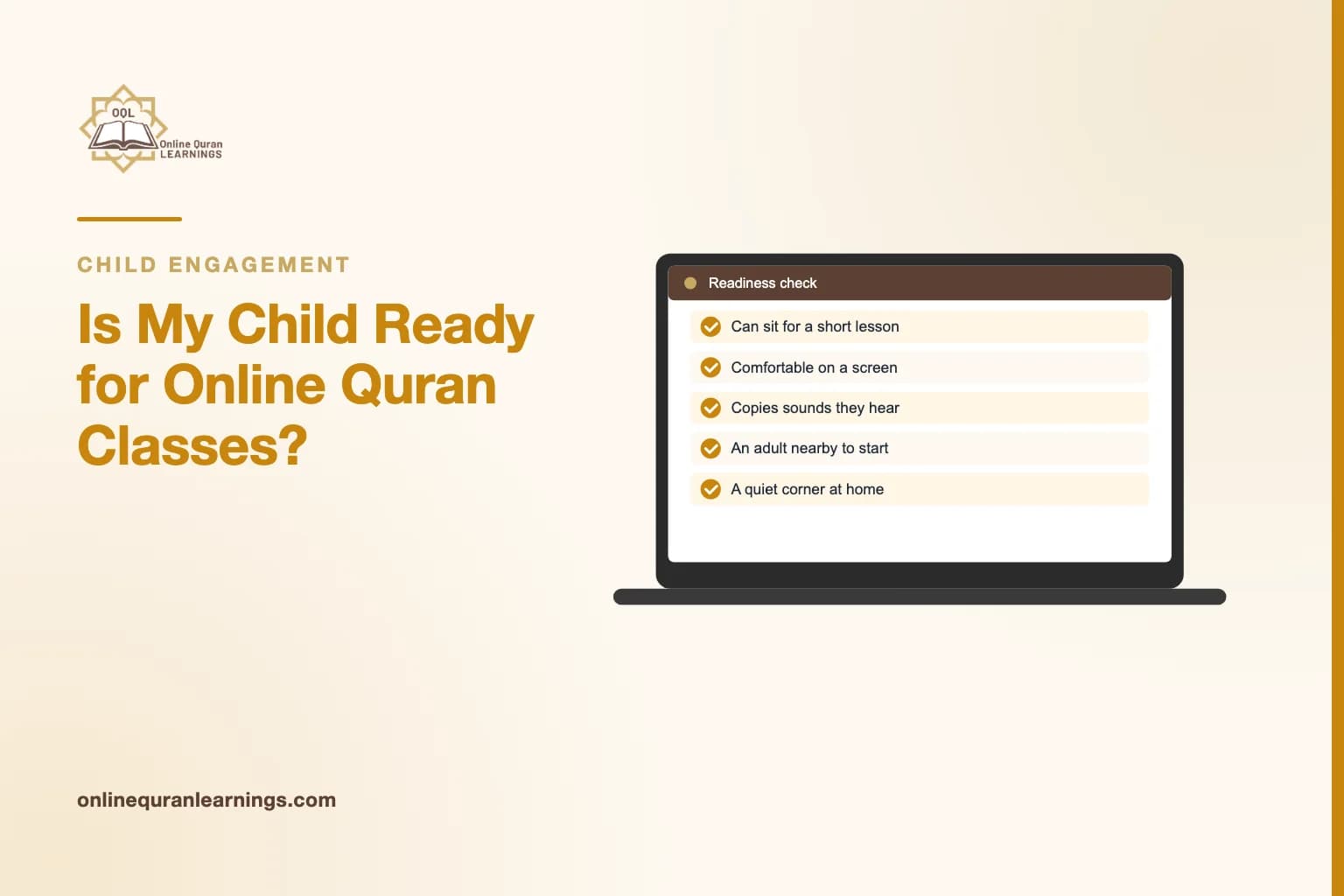
A quick readiness check. If you can tick most of these, your child is very likely ready to try:
- They can sit with an adult and stay with one activity for about ten minutes.
- They will look at a face on a screen and respond, for example on a video call with a grandparent.
- They can repeat a short sound back to you when asked.
- They can follow a simple instruction such as "point to the red one".
- Someone at home can be nearby for at least the first few weeks.
- You have a device with a reasonably sized screen and a quiet corner.
Notice what is not on the list: knowing the alphabet, reading in English, or sitting still for thirty minutes without help.
What online lessons ask of a child
An in-person class asks a child to sit with a teacher. An online class asks a little more, and it is worth being clear about what.
Attention through a screen. The teacher cannot tap the page or move closer when attention drifts. A good teacher compensates with voice, questions and variety, but the child needs to be willing to stay with the screen.
Listening carefully. Arabic sounds are learned by hearing and copying. Audio quality and the child's willingness to listen matter more online than in a room.
A helper at home. For young children, a parent or older sibling nearby is part of the format, not an optional extra. They keep the device steady, help point to the right line and encourage a shy child to answer.
Comfort with being seen. Some children freeze on camera at first. That usually passes, but it is worth knowing in advance.
Readiness by age
Age is only a rough guide, but these are the patterns teachers see most often.
| Age | What readiness usually looks like | What to expect | Parent's role |
|---|---|---|---|
| 4-5 | Copies sounds, enjoys songs, sits for short bursts | Letters and sounds in short varied steps | Beside them the whole lesson |
| 6-8 | Follows instructions, can focus for 15-20 minutes | Steady Qaida progress, first short surahs | Nearby, stepping back over time |
| 9+ | Reads in another language, can focus for the full lesson | Faster Qaida or straight into reading | Sets up, then mostly out of the room |
Ages 4 to 5
At this age, readiness is mostly about attention and imitation. A four-year-old who loves repeating words, joins in with nasheeds and will sit on your lap for a story is often ready, even with no letters at all.
What they cannot do yet is manage a long stretch of the same activity. A 30-minute lesson for a four-year-old should feel like several small pieces: a greeting, a few letters, a sound game, a short surah to listen to, and a goodbye. Your presence makes that work. Our article on teaching Noorani Qaida to young children explains how teachers pace this stage.
Signs to wait a few months: your child refuses to look at the screen at all, cannot separate from play even with you beside them, or becomes distressed rather than just restless.
Ages 6 to 8
Most children in this range are ready, and many do especially well online because there is no group to keep up with. The questions here are practical rather than developmental. Is the child too tired after school? Are they comfortable reading aloud to an adult? Do they understand what the teacher says in the language of instruction?
A six-year-old who reads well in English but has never seen Arabic letters is a normal beginner. Starting the Noorani Qaida at this age is very common.
Age 9 and older
Children of nine and above are almost always ready in terms of attention. The more common hurdles are self-consciousness, especially if they feel they are starting late, and busy schedules. Older beginners usually move through the early stages faster than young children because they already know how reading works.
Readiness is not about knowing letters
Parents often delay starting because they want to teach the alphabet first. There is no need. Teachers expect beginners with no Arabic at all.
There is even a small downside to teaching letters yourself if you are not confident: children can pick up a slightly wrong sound early, and correcting it later takes longer than learning it right the first time. Listening to recitation together, or learning a short surah by ear, is a gentler way to prepare.
How to test readiness with a trial
The most reliable test is not a checklist. It is a real lesson, with you watching. That is what free trial Quran classes for kids are for.
- Pick a time when your child is fed, rested and not missing something they love.
- Set up the device on a stand at eye level, with sound checked, ten minutes before.
- Tell the teacher in advance about your child: age, any letters they know, whether they are shy.
- Sit beside your child for the whole trial. Say little; let the teacher lead.
- Watch for three things: do they look at the teacher, do they try to copy sounds, and do they seem okay at the end.
- Afterwards, ask your child one question: "Would you like to do that again?"
If you get two out of three, plus a yes or even a shrug, your child is ready. If it was a struggle, try a second trial at a different time of day before deciding; tiredness explains a lot of difficult first lessons. Our guide to what happens in a first online Quran lesson shows what a typical first session covers so you know what to expect.
If your child is not ready yet
A trial that does not go well is not a failure. It is information.
For a four-year-old, wait two or three months, keep listening to recitation together, and try again. A few months makes a big difference at this age.
For a child who was shy or frozen, a second trial with the same teacher often goes much better than the first. Familiarity helps more than anything else. Our page on Quran classes for shy children describes how teachers usually warm up a quiet child.
For a child who was restless, look at the set-up before deciding they are not ready. Device position, noise and timing matter a great deal, and our article on keeping kids focused in an online Quran class has a simple checklist.
For a child who was distressed, take a longer break and introduce the Quran in other ways first: recitation in the car, a short surah at bedtime, sitting with you while you read.
The first month, if they are ready
Once a child is ready and starts, the first four weeks are mostly about settling in. Expect the first lessons to be short on content and heavy on getting comfortable. By the third or fourth week, most children know the routine, recognise their teacher and look forward to at least part of the lesson.
Two or three lessons a week usually suits a beginner. Classes are supervised and recorded, and parents can follow progress through the monthly progress report. Above all, keep the slot consistent. A young child who knows that Quran happens every Monday and Wednesday after dinner settles much faster than one whose lesson moves around.
Frequently asked questions
Does my child need to know the Arabic alphabet before online classes?
No. Teachers start from the very first letters with complete beginners. Knowing a few letters can help a child feel confident, but it is not a requirement and some children who have half-learned letters at home need to unlearn mispronunciations.
Can a four-year-old manage a 30-minute online lesson?
Many can, if a parent sits with them and the lesson is broken into short varied parts. Those who cannot yet manage it are often ready a few months later, and a trial class is the simplest way to find out.
Is a phone screen big enough for a child's Quran class?
It works in a pinch, but small screens make Arabic letters harder to see and tire young eyes faster. A tablet on a stand or a laptop is noticeably easier for children, especially in the Qaida stage.
Does my child need their own device for online Quran classes?
Not necessarily. A shared family laptop or tablet works well as long as it is free and charged at lesson time. What matters is a reliable screen in a quiet spot, not who owns it.