
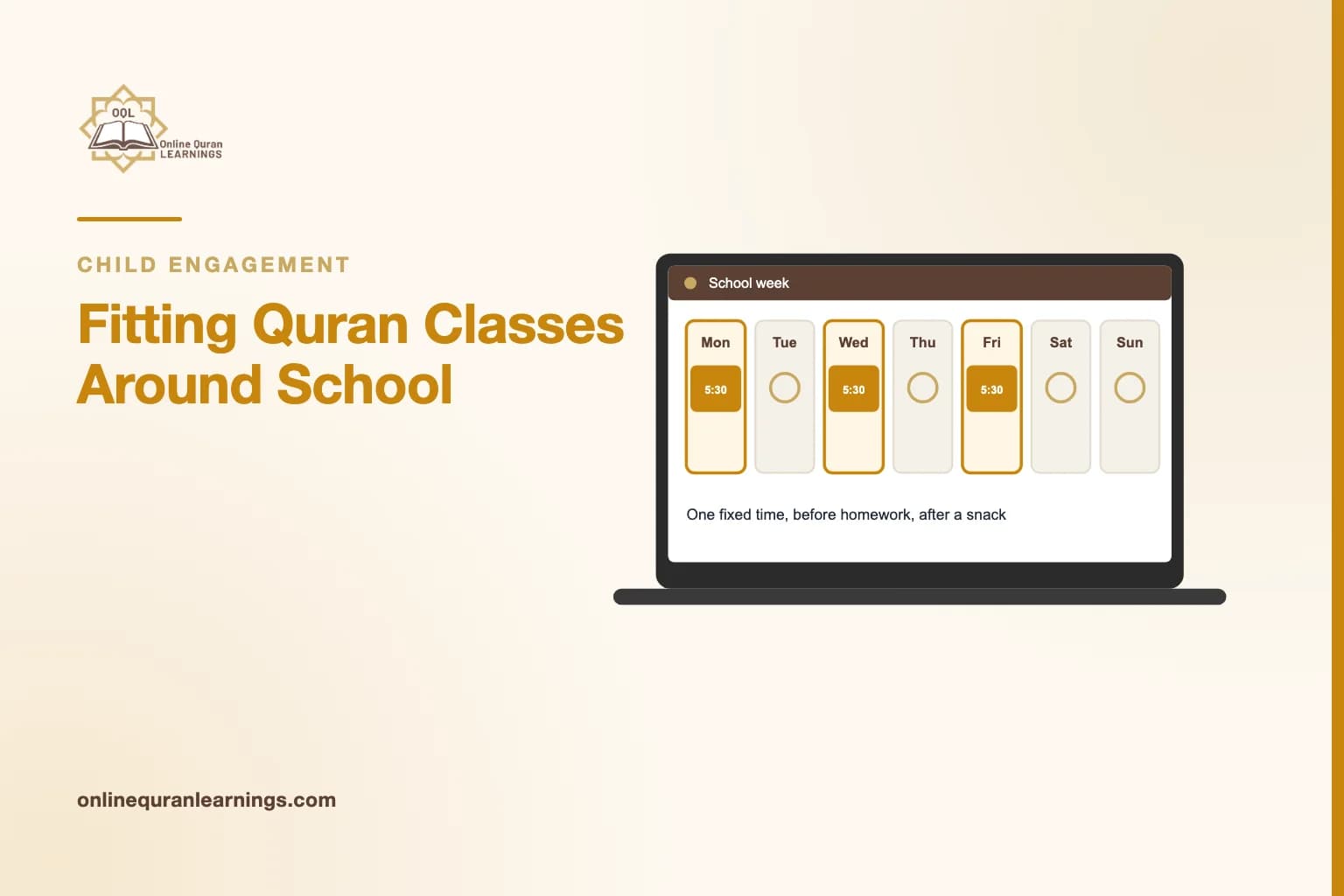
Most families do not have a time problem. They have a planning problem: the Quran lesson gets booked into whatever gap exists in September, and by November the gap has been eaten by football, a reading log and a younger sibling's bedtime.
The fix is to plan the week as a whole, once a term. Decide which commitments never move, put two or three 30-minute Quran slots in the calmest spaces that remain, and drop something rather than stacking the lesson on top of an already full afternoon.
This guide is for doing that planning. It works through sample timetables for three common family shapes, how to choose between the before-school, after-snack and before-bed slots, and what changes between term time and holidays. If you already know roughly when you want lessons and are looking for a teacher who can take that slot, our page on after-school Quran classes covers the service side.
Start with the fixed points, not the gaps
Before choosing a time, write down the week as it actually is. Not the ideal week, the one you lived last Tuesday.
- School start and finish times, including the drive or walk.
- Meals, especially dinner, which tends to be the least movable thing in the evening.
- Bedtime for each child.
- Clubs, sport and tuition, with a note of which ones change by term.
- Prayer times in your city for the current season, since Maghrib and Isha shift a lot between June and December.
- Any adult commitment that decides when someone is home to settle the child.
Now look for spaces of at least 45 minutes with nothing either side that is likely to overrun. A 30-minute lesson needs a few minutes before it to get the laptop open and the Qaida on the table, and a few minutes after for the child to come back down. A slot that runs straight into swimming will be cut short every second week.
Choosing the slot: before school, after snack or before bed
Each of the three common slots suits a different child. There is no single right one.
| Slot | Works well for | Watch out for |
|---|---|---|
| Before school | Early risers, older children, families with busy evenings | Rushed mornings; one late night can wipe it out |
| After a snack | Primary children with energy left, homework-light days | Coming straight from school without food or a break |
| After dinner, before bed | Teenagers, children with afternoon clubs | Tiredness in under-eights; homework spilling over |
Before school is underused. A 7:00 am lesson for a ten-year-old who is up anyway can be the most focused half hour of the day, and it is done before anything else can displace it. It suits families where the evenings are chaotic. It is a poor choice for a child who struggles to wake, and it collapses if the household runs late.
After a snack is what most primary families land on, typically 45 minutes to an hour after getting home. The child has eaten, has had a short break, and is not yet tired. Skipping the snack and break is the most common way this slot goes wrong.
Before bed suits older children better than younger ones. A thirteen-year-old may be sharper at 7:30 pm than at 4:30. A six-year-old usually is not.
Lessons with us can be booked at any hour, so all three are possible. The question is which one your child is actually present for.
Three sample weeks
These are examples to adapt, not prescriptions. Times assume a school day ending around 3:15 pm.
A primary child with two clubs
Aisha is eight, learning Qaida, and has football on Tuesday and swimming on Thursday.
| Day | Quran | Everything else |
|---|---|---|
| Monday | 4:30 pm lesson | Homework after, then play |
| Tuesday | Five minutes after dinner | Football 4:00 to 5:30 pm |
| Wednesday | 4:30 pm lesson | Reading log after |
| Thursday | Five minutes after dinner | Swimming straight after school |
| Saturday | 10:00 am lesson | Free afternoon |
Three lessons, none on a club day, and short reading practice on the two club days so there is no four-day gap. Saturday morning is the anchor that rarely fails.
A secondary child with homework
Yusuf is thirteen, reading the Quran with Tajweed, and gets around an hour of homework a night plus a heavier load before tests.
| Day | Quran | Everything else |
|---|---|---|
| Monday | 7:30 pm lesson | Homework 5:00 to 6:30 pm |
| Wednesday | 7:30 pm lesson | Homework 5:00 to 6:30 pm |
| Sunday | 11:00 am lesson | Weekend homework in the afternoon |
The evening slot comes after homework, not before, because a teenager who has finished their work can actually concentrate. Two weekday lessons and one weekend lesson leaves Tuesday and Thursday for sport or catching up. When assessments arrive, this is the timetable that gets thinned rather than abandoned, which we cover in Quran classes during exam season. Teenagers also need more say in when lessons happen than younger children do; our piece on teaching Quran to teenagers goes into why.
Two children, one evening
Maryam is six and Ibrahim is ten. Both have lessons three times a week, on the same days, back to back.
| Time | Maryam (6) | Ibrahim (10) |
|---|---|---|
| 4:15 pm | Lesson, 30 minutes | Snack, then homework |
| 4:45 pm | Play | Lesson, 30 minutes |
| 5:15 pm | Dinner prep starts | Homework finishes |
The younger child goes first because her concentration fades faster as the afternoon goes on. The older one can start homework while he waits. Booking both on the same days means the parent sets up the quiet room three times a week rather than six. More on running lessons for several children is in our guide to Quran classes for siblings.
How many lessons fit a school week
Two or three lessons of 30 minutes is a realistic range for most school-age children learning to read, with Hifz students typically needing more contact. Fewer lessons with short practice in between often beat more lessons with none. Our guide to how many Quran classes a week breaks this down by age and goal.
When you are building the timetable, the useful rule is to avoid any gap longer than three days with no Quran contact at all. A Monday and Friday pattern leaves a long midweek stretch where new letters fade. Monday, Wednesday and Saturday spreads the same three lessons more evenly.
Term time, holidays and the weeks in between
A timetable that works in October may not survive January. Plan to revisit it at three points.
- Start of each term. Clubs reshuffle, and a new teacher at school can mean more homework. Rebuild the week from the fixed points.
- When the clocks change. If your family is in the UK, US, Canada or southern Australia, a lesson tied to Maghrib or to the teacher's evening may shift by an hour. Confirm your times in your own local clock.
- Holidays. Many families keep the same slots, others move them to mid-morning when there is no school run. Our guide to keeping Quran going in the school holidays covers that in detail.
The weeks that cause the most trouble are not the holidays. They are the first two weeks back, when everyone is tired and the old timetable feels like too much. Hold the lessons through those weeks, even if they feel ragged. A child who skips the first fortnight of term often takes another month to settle back in.
What to drop when the week is too full
If the week will not fit, something has to give. Some honest options, roughly in the order families find least painful:
- Move one weekday lesson to the weekend, where it is less likely to clash.
- Drop from three lessons to two for a term, and add five minutes of home practice on the other days.
- Pause one club for a term rather than squeezing the lesson between two activities.
- Swap an after-school slot for a before-school one on the busiest days.
- Shorten screen time on lesson days, which often frees more time than parents expect.
What tends not to work is keeping everything and fitting the lesson into a 30-minute hole between football and dinner. The child arrives flustered, the lesson gets cut short, and after a few weeks the class starts to feel like the activity that always loses.
A one-page plan to fill in
Once a term, sit down with your child and fill this in together. It takes ten minutes.
- Our fixed points this term are:
- Our Quran days are:
- The lesson time on each day is:
- The longest gap between lessons is:
- On non-lesson days, practice happens after:
- If a lesson is missed, we will:
- We will look at this again on:
Children are more likely to keep a timetable they helped write. If yours is not keen on lessons at all right now, start with our guide on what to do when a child refuses Quran class before worrying about the timetable.
Frequently asked questions
Is it better to have Quran classes on the same days every week?
Yes, for most children. Fixed days let the lesson become part of the week rather than a decision, and they make it obvious when something else starts creeping in. Change the days at the start of a term, not week by week.
What if my child's club changes every half term?
Plan the Quran slots around the one or two commitments that never move, such as school finish time and dinner, and treat clubs as the variable. Then review the timetable each time the club schedule changes rather than squeezing the lesson in wherever it fits.
Can a teenager take the lesson later in the evening?
Often that works well. Many secondary students are more alert at 7 or 8 pm than straight after school, as long as the slot sits before screens and late homework take over. Keep it at least an hour before bedtime.
Should my child do Quran practice on days without a class?
A few minutes on most non-class days makes a noticeable difference. Reading the current page aloud to a parent once is enough, and it is easiest to attach to something that already happens, like the end of dinner.