
It is ten minutes before class. Your eight-year-old has disappeared upstairs, or is crying at the table, or has said, very clearly, "I'm not doing it." Most parents in that moment either give in or get angry, and both feel bad afterwards.
Refusal before Quran class is almost always a message about the class, not about the Quran. Something in the lesson has become tiring, boring, embarrassing or frightening for your child, and the job tonight is to stay calm and find out which.
This guide is for that moment and the two weeks after it. If your child has been drifting away from lessons slowly over months rather than digging in their heels now, our page on Quran classes for kids who have lost interest covers the bigger picture and what a fresh start can look like.
First, work out which refusal you are looking at
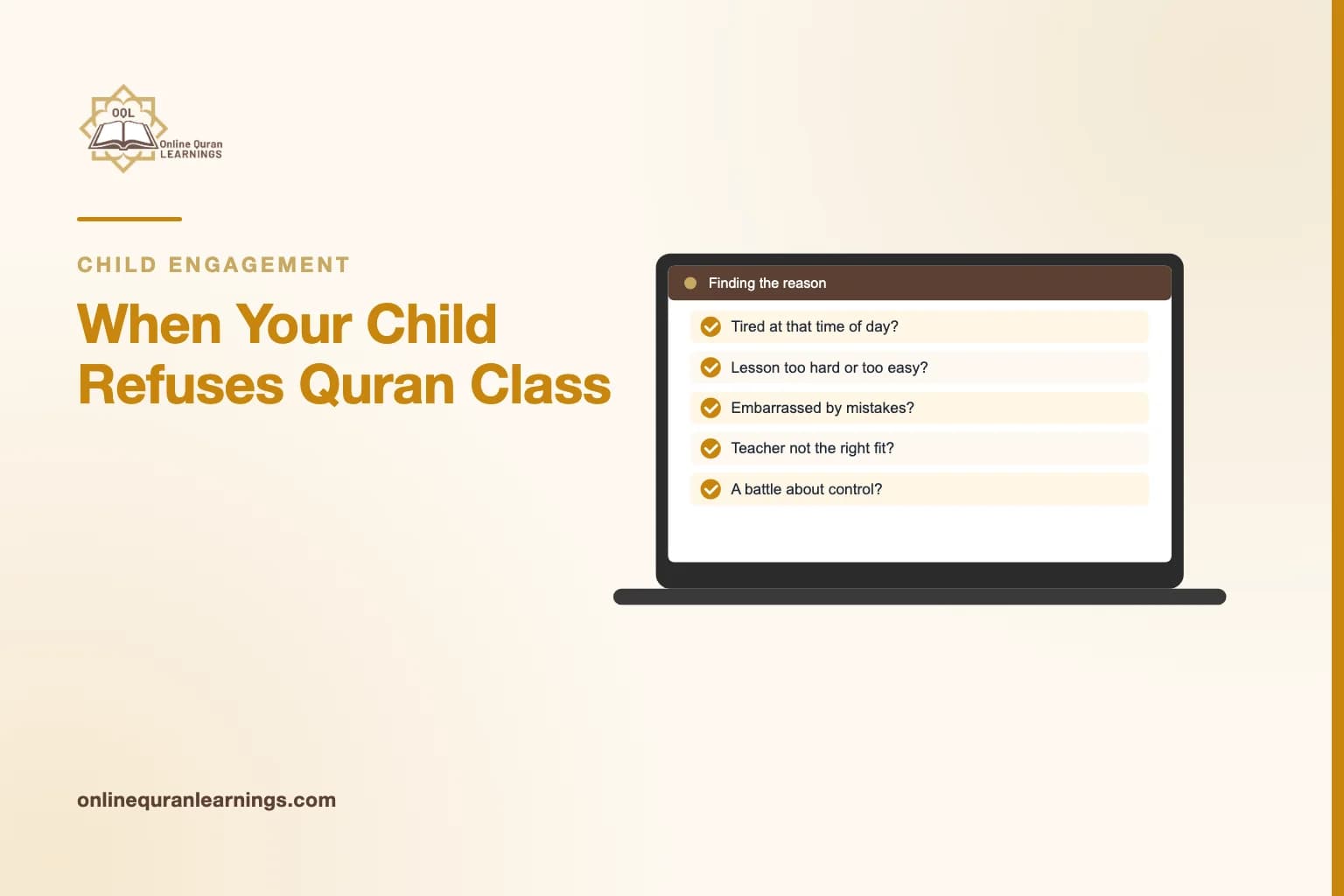
Children rarely say the real reason the first time. "It's boring" can mean "I don't understand", and "I'm tired" can mean "the teacher corrected me six times last lesson and I felt stupid." The behaviour around the refusal is usually more informative than the words.
| What you see | What it often means | First thing to try |
|---|---|---|
| Yawning, slumped, grumpy only on certain days | Tired; the slot is at a bad time | Move the lesson, even by an hour |
| "It's boring", rushing through, fidgeting | Too easy, too repetitive, or no sense of progress | Ask the teacher what is new each week |
| Hiding, going quiet, tummy aches before class | Embarrassed or anxious, often about mistakes | Sit with them; tell the teacher privately |
| Fine with you, refuses with the teacher | Teacher fit, or a specific bad moment | Ask gently what happened |
| Agrees, then stalls, then argues | A power struggle about control, not Quran | Offer choices inside a fixed routine |
| Tears when reading, not before | The work is too hard right now | Ask for a step back to secure ground |
Tired
A class at 7:30 pm after school, homework and a sports club is asking a lot of a young child. If the refusals cluster on long days, that is your answer. Our article on fitting Quran classes around school has some realistic slot patterns for school-age children.
Bored
Boredom usually means the child cannot see themselves moving forward. Reading the same Qaida page for three weeks feels like standing still, even when the teacher has good reasons. Ask what the next milestone is and how far away it is, and tell your child.
Embarrassed
This one hides well. A child who used to read confidently and now freezes may have had a run of corrections they took as criticism, or may be self-conscious about being watched on camera by siblings. Shy children in particular need a slower warm-up, which our page on classes for shy kids describes in detail.
Teacher fit
Some children need a softer manner, some need more energy, and some simply do not click with a particular person. That is nobody's fault. If the refusal is specific to the teacher, read how to change your child's Quran teacher before deciding.
Too hard
If tears come during reading rather than before class, the material may have moved ahead of what the child has secured. This often traces back to a rushed earlier stage, which we cover in why children forget Quran lessons.
Power struggle
From around six or seven, some refusals are about having a say. The child is not rejecting the Quran. They are testing whether "no" works. These are best handled by giving real choices on small things while keeping the lesson itself non-negotiable.
What to say tonight
You do not need to solve it before this evening's class. You need to get through the moment without making Quran the battleground. Here is a script that works for most children from about five to twelve. Adjust the words to sound like you.
- Get down to their level and lower your voice: "I can see you really don't want to do Quran today."
- Name the feeling without arguing with it: "It sounds like something about it feels hard right now."
- Ask one open question, then wait: "What's the worst bit?"
- Accept whatever comes, even "everything": "Okay. Thank you for telling me."
- Hold the routine, soften the shape: "We're still going to do class, and I'll sit with you for the first part."
- Offer a small choice: "Do you want to sit on the chair or on the cushion today?"
- Promise a follow-up you will keep: "After class, you and I will work out what to change."
If your child is genuinely distressed, crying hard or frightened, it is fine to message the teacher, explain, and either shorten the lesson or skip it once. The rule is that a skipped lesson is your decision, made calmly, not the prize for the loudest protest.
Things worth avoiding in the moment:
- Threats tied to faith, such as "Allah will be angry with you." These attach fear to the Quran and tend to last far longer than the argument.
- Comparisons with siblings or cousins who "never complain."
- Long lectures. A child who is upset hears none of it.
- Bribes negotiated on the spot. A reward planned in advance is different from one extracted at the door.
- Discussing the problem with the teacher in front of the child.
The two-week reset plan
Once the moment has passed, give yourself two weeks to test one or two changes. Changing everything at once makes it impossible to tell what helped.
| Days | What you do | What you are watching for |
|---|---|---|
| 1-2 | Talk to your child at a calm time, not before class. Message the teacher with what you heard. | A specific reason: time, a moment, a page, a person |
| 3-5 | Make the single most likely change: earlier slot, an easier starting point, or you sitting in. | Is the protest shorter? Does it start later? |
| 6-7 | Keep everything else the same. Praise attendance and effort, not accuracy. | Any lesson that ends with your child chatting |
| 8-10 | If things are better, step back a little: sit in for ten minutes, not thirty. | Can they manage the start without you? |
| 11-14 | Review with your child: "What's better? What's still hard?" Decide the next change, if any. | Refusal gone, reduced, or unchanged |
Most children whose problem was timing or difficulty settle within a week or two of the right change. A child whose problem is the teacher usually does not improve much until the teacher changes, which is useful information in itself.
A few habits that make the next refusal less likely
Start with a win. Ask the teacher to open each lesson with something your child already reads well. Two easy minutes at the beginning change how the remaining time feels.
Make the end predictable. Children cope with effort better when they know exactly when it finishes. "Thirty minutes, then we have dinner" is easier to accept than an open-ended class.
Get the room right. Siblings watching, a TV in the next room or a tablet that keeps sliding off the table all add friction. Our guide to keeping kids focused in an online Quran class covers the set-up in more detail.
Separate Quran from correction at home. If you also practise with your child, keep it short and warm. A child corrected by the teacher at five o'clock and by a parent at seven may start to feel the Quran is mainly a place where they get things wrong.
Let them see you read. Children copy what they watch far more than what they are told.
When refusal means it is time to change something bigger
Two weeks of calm changes will settle most refusals. It is worth looking at bigger changes if your child is still distressed after the reset, if they describe the teacher as frightening or unkind, if they have lost so much ground that every lesson feels like failure, or if the refusal began after a break and they now feel far behind. In that last case, our article on restarting Quran after a break explains how to find a sensible starting point without going back to page one.
Sometimes the answer is a different format altogether: shorter one-to-one lessons at a better hour, at the child's real level, with a teacher picked for them. A trial is a low-pressure way to see whether a fresh setting changes how your child reacts.
The long view
A child who refuses Quran class at eight is not a child who will reject the Quran at twenty. What shapes the long term is how the adults respond: whether refusal is met with fear and shouting, or with patience, a firm routine and real changes to what was not working. Hold the slot, soften the shape, fix the cause, and most children come back to their lessons well before the parent has finished worrying.
Frequently asked questions
Should I cancel the class when my child is in tears?
Cancel once if you need to, but do not let tears become the way a class gets cancelled. A better option is to join the lesson with your child for the first ten minutes, or ask the teacher for a lighter session that day.
Is it wrong to make my child attend Quran class?
Keeping a regular slot is part of ordinary parenting, the same as school or bedtime. What causes harm is using threats, shame or anger around the Quran itself, so hold the routine firmly and keep the tone gentle.
Should I tell the teacher that my child does not want to come?
Yes, and before the next lesson rather than during it. A teacher who knows can open with something easy, slow the pace and keep the child out of the spotlight, which is hard to do if they are guessing.
Can rewards help a child who refuses Quran class?
Small, predictable ones can help for a few weeks, such as a sticker for each lesson attended or choosing the family dessert on Friday. Keep the reward for turning up and trying, not for perfect reading, and phase it out once the routine is steady.
What if my child refuses every activity, not only Quran?
Then the class is probably not the cause. A child who resists school, clubs and meals alike may be tired, worried or going through something else, and it is worth speaking to their school or doctor before changing the Quran lessons.