
Most Ramadan plans for children are written with the best intentions on the first night and abandoned by the tenth. The usual reason is that the target was set for the child parents hoped to have, not the one who is tired after school and up late for iftar.
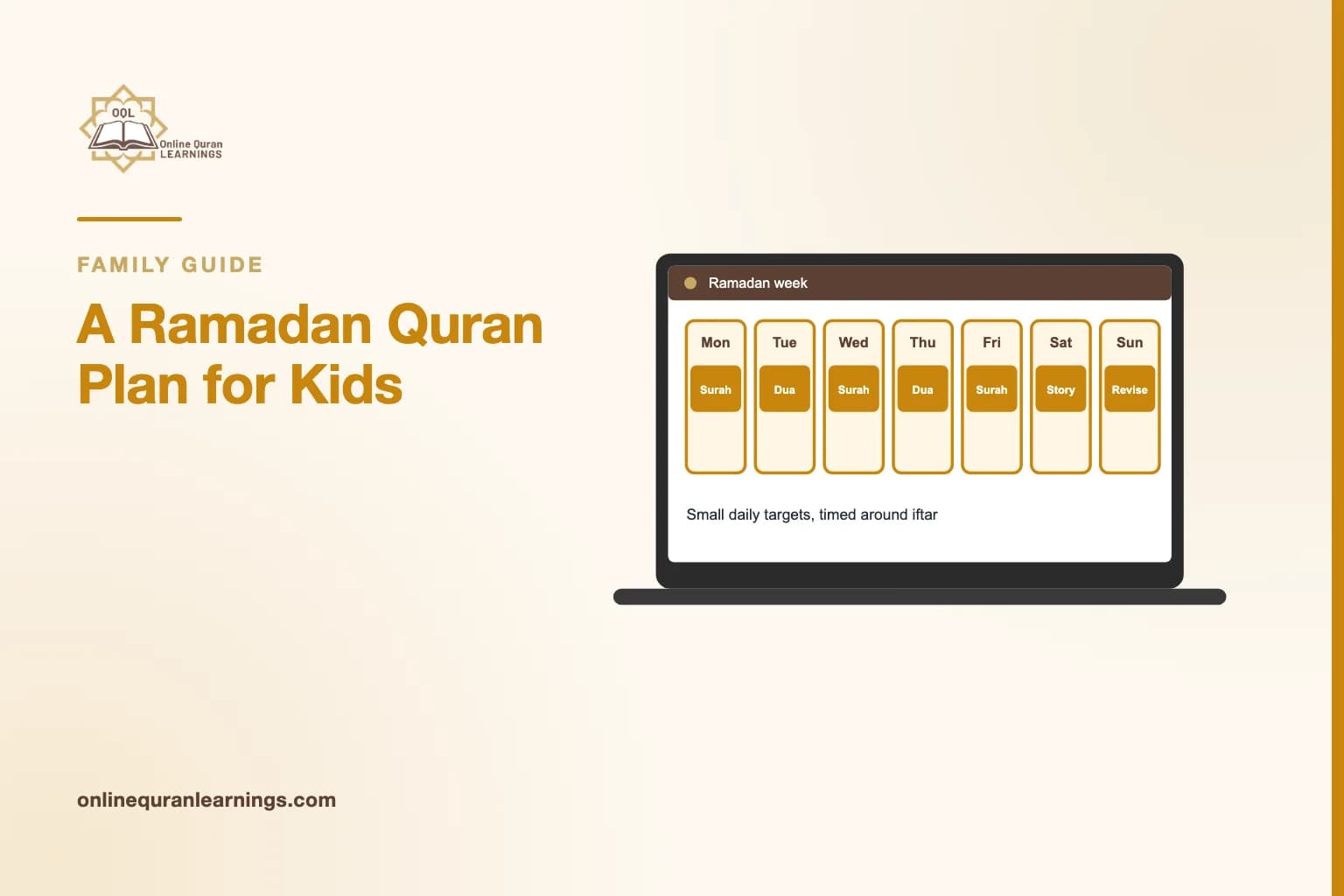
A good plan picks a small daily target the child can meet even on a bad day, keeps it at a fixed time, and saves the stretch goals for the last ten nights. Here is what that looks like by age:
| Age | Daily Quran target | Whole-month goal |
|---|---|---|
| 4 to 6 | 5 minutes: listen and repeat one short surah or dua | Learn 1 or 2 short surahs and 2 or 3 duas |
| 7 to 10 | 10 to 15 minutes: read or revise a few lines to a parent | Finish a Qaida stage, or memorise 2 to 4 short surahs |
| 11 plus | 15 to 30 minutes, depending on reading level | A fixed portion, such as a few pages a day, or a share of a family khatm |
These are starting points. A fluent twelve-year-old may manage much more; a struggling one may need less. Adjust in the first week, then hold steady.
Ramadan falls about eleven days earlier each year. The next one is expected to begin in early February 2027, depending on the moon sighting, which means short fasts and normal school days for families in the northern hemisphere, and the first weeks of the new school year for families in Australia and New Zealand.
Before Ramadan starts
The week before is when plans are won or lost. Three things to settle:
- The daily slot. Pick a time that will work on school days, not just weekends. For many families that is after Asr or straight after iftar.
- The target. Write it on a chart the child can see, in their own words: "one surah a week" or "two lines every day".
- The class timetable. If your child has regular lessons, agree any time changes with the teacher before the first fast, not during it.
It also helps to talk to the child about what Ramadan is for. A five-year-old does not need a lecture, but knowing that this is the month the Quran was first revealed gives the daily reading a reason.
Plans by age
Ages 4 to 6: listening, repeating, small wins
At this age, the Quran in Ramadan is mostly heard rather than read. Five minutes a day of listening to a short surah and repeating it, line by line, is plenty.
Good choices are the very short surahs most children start with: Al-Fatiha, Al-Ikhlas, Al-Kawthar, An-Nas and Al-Falaq. Our guide to short surahs for kids to memorise suggests an order. One new surah over the month, plus revising ones they already know, is a perfectly good outcome.
Add two or three duas the child will actually use, such as the dua before eating and the dua at iftar. Saying the iftar dua with the family each evening is one of the simplest ways to make a young child feel part of the fast without fasting.
Ages 7 to 10: a short daily reading habit
Children in this range can usually manage ten to fifteen minutes. If they are on the Qaida, the goal can be finishing a stage, or reading the current lesson to a parent each day. If they are reading the Quran, a few lines a day, read properly, is better than a page rushed.
This is also a good age to learn the meaning of what they recite in prayer. Short, plain explanations of Al-Fatiha or Al-Ikhlas make the month about understanding as well as reading. Our piece on when a child reads Quran but does not understand it has ideas for that.
Some children of this age are starting to pray regularly. Ramadan, with the whole household more focused on prayer, is a natural time to build that; our guide on how to teach namaz to kids has a home plan.
Ages 11 and over: a portion of their own
Older children can take on a real portion, but it should match their reading speed. A fluent reader might manage two to four pages a day. A slower reader might do one page carefully, which is still thirty pages over the month.
This is the age where a family khatm works well. Divide the thirty juz between parents, older children and grandparents, and give the eleven-year-old a share they can genuinely finish. They complete the Quran as part of the family, without carrying a target meant for an adult.
About finishing the whole Quran
Many parents feel their child should complete a khatm in Ramadan. For most children it is not realistic, and setting it up as the goal often ends in a sense of failure by the third week.
Some options that keep the spirit of it:
- a shared family khatm, with the child reading a fixed share
- completing a defined portion, such as the last ten surahs of Juz Amma
- listening to the whole Quran over the month, a little each day, alongside the family
- a personal khatm for a fluent teenager who chooses it and has the time
Any of these is a real achievement for a child. The best one is the one they finish.
Moving class times around iftar and taraweeh
Ramadan reshapes the evening, and a lesson that sat comfortably at 6 pm may land right on iftar. Some patterns that work:
- For young children who are not fasting: keep the after-school slot, but move it earlier if it creeps towards iftar.
- For older children who are fasting: the hour before iftar is usually the worst time. Late morning at the weekend, or 30 to 45 minutes after iftar, tends to go better.
- If the family goes to taraweeh: a lesson between iftar and Isha can be tight. Weekend mornings are often the calmest option for the month.
- In the Gulf, where school hours are commonly shortened in Ramadan, an early afternoon lesson may suddenly be possible.
Lessons with us can be booked at any hour, so it is usually possible to find a Ramadan slot and move back afterwards. Our Islamic classes for kids page describes what children can study with a teacher, from Qaida and Quran reading to duas and Islamic Studies.
The last ten nights
The last ten nights are where children can be given something special to do, without staying up all night. Ideas that suit different ages:
- learn the dua for Laylat al-Qadr, reported in Sunan at-Tirmidhi from Aisha: Allahumma innaka afuwwun tuhibbul afwa fafu anni
- choose one night to stay up a little later and read or listen with a parent
- give a small amount from their own money in charity on one of the odd nights
- revise every surah they learned over the month, one each night
For teenagers, this is a good time to step up: an extra page, joining part of a night prayer, or completing their share of the family khatm.
After Eid
The week after Eid is when most Ramadan habits quietly disappear. Two suggestions:
- Keep the daily slot, but halve the target. If a child read ten minutes a day in Ramadan, five minutes after Eid keeps the thread.
- Pick one Ramadan surah or dua to keep revising every week, so the month's work is not lost.
If your child's regular lessons moved for Ramadan, put them back to the normal time within a week of Eid. A month away from the old slot is long enough for the new one to settle in. Leaving it longer usually means renegotiating the whole timetable.
Frequently asked questions
Do young children have to fast in Ramadan?
No. Fasting is not obligatory before puberty. Many families let children try part-day fasts as practice when they are ready, but the Quran plan should not depend on whether a child is fasting.
Should my child try to finish the whole Quran in Ramadan?
For most children, no. Reading the whole Quran in a month means about a juz a day, which is beyond most fluent young readers. A shared family khatm, or finishing a set portion such as part of Juz Amma, is a better target.
Can a child who is still on Noorani Qaida take part?
Yes. Their Ramadan goal can be finishing a Qaida stage, learning a short surah by listening, or learning two or three duas. Reading from the mushaf is not the only way to take part.
What if we fall behind the plan halfway through the month?
Drop the target, not the habit. Halve the daily amount and keep the time of day, rather than trying to catch up with long sessions that make the second half of the month harder.