
Picture a Tuesday at six: a nine-year-old halfway through a Juz, a six-year-old on page twelve of the Qaida, a four-year-old who wants to do whatever the others are doing, and one laptop. That is the reality of Quran lessons in many homes, and it works far better with a plan than with goodwill.
Here is the plan most families settle on, in four rules:
- Separate lessons for each child, even if they are close in age or level.
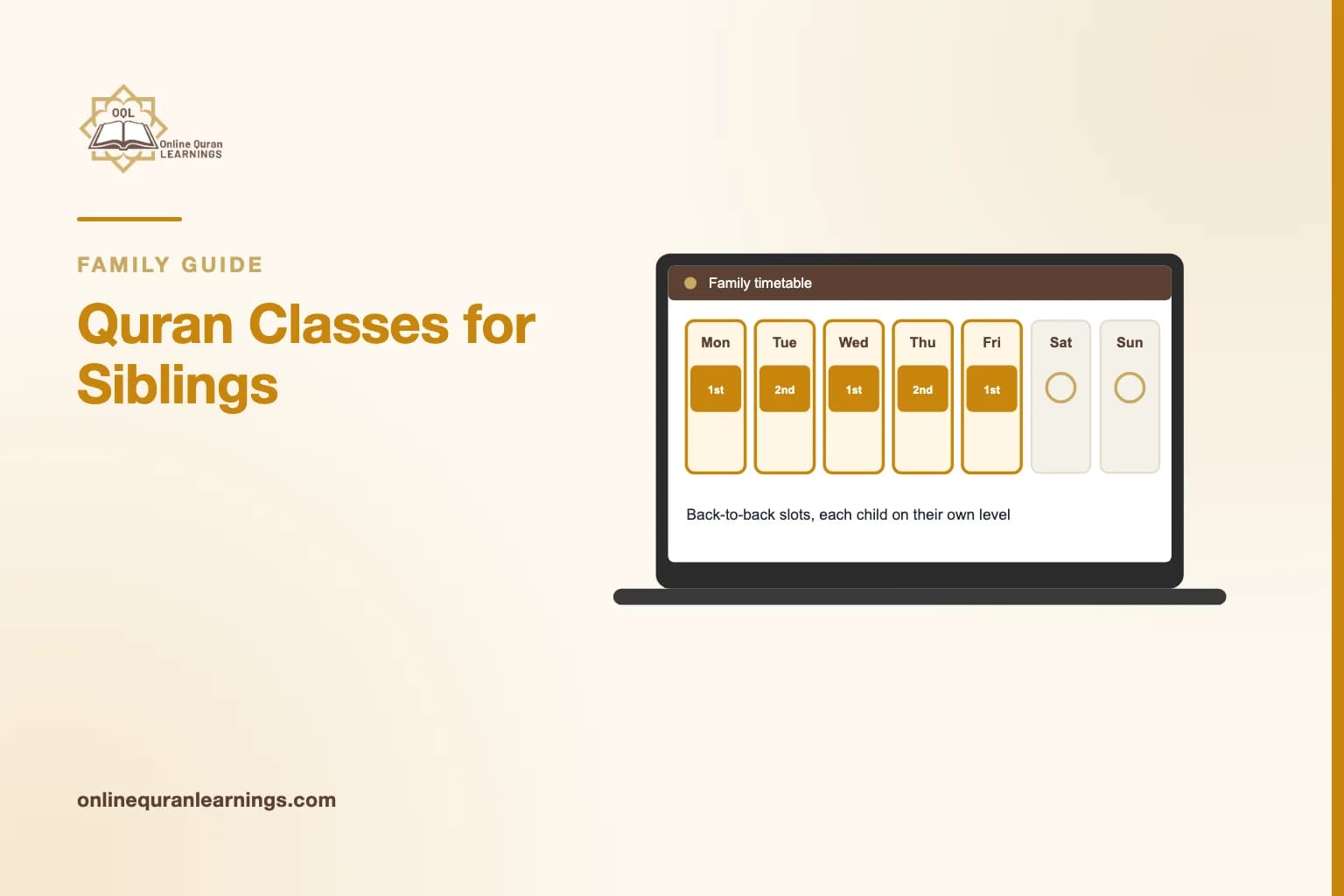
- Back-to-back slots, so the device comes out once and the evening has one "Quran hour".
- Youngest first, while their attention is freshest.
- Progress stays private, between each child, their teacher and you.
The rest of this guide explains why, and how to handle the awkward bits: different levels, rivalry, a shared device, and who should be in the room.
Why separate lessons beat a shared one
It is tempting to put two siblings in one lesson. In practice they rarely stay at the same level for long. One reads faster, the other waits; or one makes the same mistake repeatedly while the other sighs. Within a few weeks the quicker child is bored and the slower one is embarrassed.
Separate lessons also stop siblings answering for each other, which younger children are very good at. At Online Quran Learnings every lesson is one-to-one for exactly this reason. Our page on one-to-one Quran classes for kids shows what that looks like in a 30-minute lesson, and if you are still weighing the formats, see whether one-to-one or group classes suit your child.
Building the timetable
Two children
Two 30-minute lessons back to back give you a single hour. Most families do this two or three evenings a week. If the children are far apart in age, the older one can take a later slot on some days so the younger one is not kept up.
Three children
Ninety minutes in a row is a lot for a household. Many families split across two time blocks: the youngest two back to back after dinner, the eldest later or on alternate days.
Four children
At this point a single block usually becomes too long. Split across two evenings, or use weekend mornings for one or two of the children. Because classes can be scheduled at any hour, seven days a week, the timetable can follow your week rather than the other way round.
A sample week for three children
| Day | Youngest (Qaida) | Middle (Quran reading) | Eldest (Hifz) |
|---|---|---|---|
| Monday | 5:30pm | 6:00pm | 7:30pm |
| Tuesday | - | - | 7:30pm |
| Wednesday | 5:30pm | 6:00pm | 7:30pm |
| Thursday | - | - | 7:30pm |
| Saturday | 9:30am | 10:00am | 10:30am |
The eldest here is doing Hifz and has more lessons; the younger two have three each. That kind of unevenness is normal, and our guide to how many Quran classes a week helps set the right number for each child. For fitting it all around homework and clubs, see fitting Quran classes around school.
Different levels, different goals
Each child should have a target that belongs to them, not a place in a family league table.
- The beginner: finish the next Qaida lesson, or read a row without help.
- The reader: read a page with fewer corrections than last week.
- The memoriser: keep revision solid, not just add new lines.
- The teenager: something they chose, such as a particular surah or a Tajweed rule.
Children notice when goals are tailored. A six-year-old who is praised for reading her row smoothly does not need to know that her brother finished a surah the same day.
Rivalry and comparison
This is the part most families underestimate. Comparison creeps in through small comments: "Your brother was on that page at your age." "Why can't you read like your sister?" Each one costs more than it seems.
What helps:
- Never compare pages or levels aloud, even as encouragement.
- Celebrate each child separately, at a different moment, so praise is not a ranking.
- Keep reports private. Each child's monthly progress report is about that child; share it with them, not with siblings.
- Watch the younger child. Younger siblings often feel permanently behind. Mark their milestones as loudly as the older child's.
- Let the older one help, carefully. An older sibling can listen to a younger one read at home. They should not correct; that is the teacher's job, and corrections from a sibling feel very different.
One device, three children
A single laptop or tablet is fine if the changeover is planned.
- Set the device up in one quiet spot, charged, before the first lesson.
- Have the next child ready, with their book open, five minutes before their slot.
- Use headphones for the child in the lesson if the house is noisy.
- Keep the waiting children away from the screen. Hovering siblings are the biggest single distraction in a lesson.
- If the internet is shaky, ask others in the house to pause streaming during lessons.
Our guide to keeping kids focused in an online Quran class has more on setting up the space.
When the age gap is wide
A fifteen-year-old and a five-year-old in the same evening need very different things. The teenager may resent being slotted in around a little one's bedtime, and may not want younger siblings to hear them read at all.
Give the eldest a slot that is clearly theirs, later in the evening or on a different day, and let them choose it where you can. Our guide to teaching Quran to teenagers covers what tends to keep older children engaged once lessons stop being a family routine and start being their own.
Who should be in the room
For under-sevens: a parent nearby, ideally in the room, at least for the first few weeks.
For seven to twelve: a parent within earshot is usually enough.
For teenagers: give them privacy if they want it, while staying aware of what is going on. Lessons are recorded and supervised, which reassures many parents.
Siblings: ideally not in the room at all. Even a well-behaved sibling changes how a child reads; few children like being heard making mistakes by a brother or sister.
One child, a different teacher
Different children sometimes need different teachers: a daughter who needs a female teacher, a son who connects better with a male one, or simply a style that suits one child but not another. That is fine. Back-to-back lessons still work with two teachers. Our guide to choosing a male or female Quran teacher for your child covers how age and stage affect that choice.
Frequently asked questions
Should the youngest or the oldest child go first?
Usually the youngest, because their energy drops fastest in the evening. Older children cope better with a later slot and can finish homework while they wait.
Can twins share a teacher?
They can have the same teacher in separate lessons, which many families like. Separate lessons matter even more for twins, because they are compared constantly elsewhere.
What if one child wants to stop and the others want to carry on?
Treat it as that child's issue, not the family's. Find out why, perhaps adjust their lesson time or teacher, and avoid letting their reluctance set the pattern for the others.
Do siblings get separate progress reports?
Yes. Each child has their own lessons, so each child's monthly progress report covers only their own work, which makes it easier to keep progress private.