
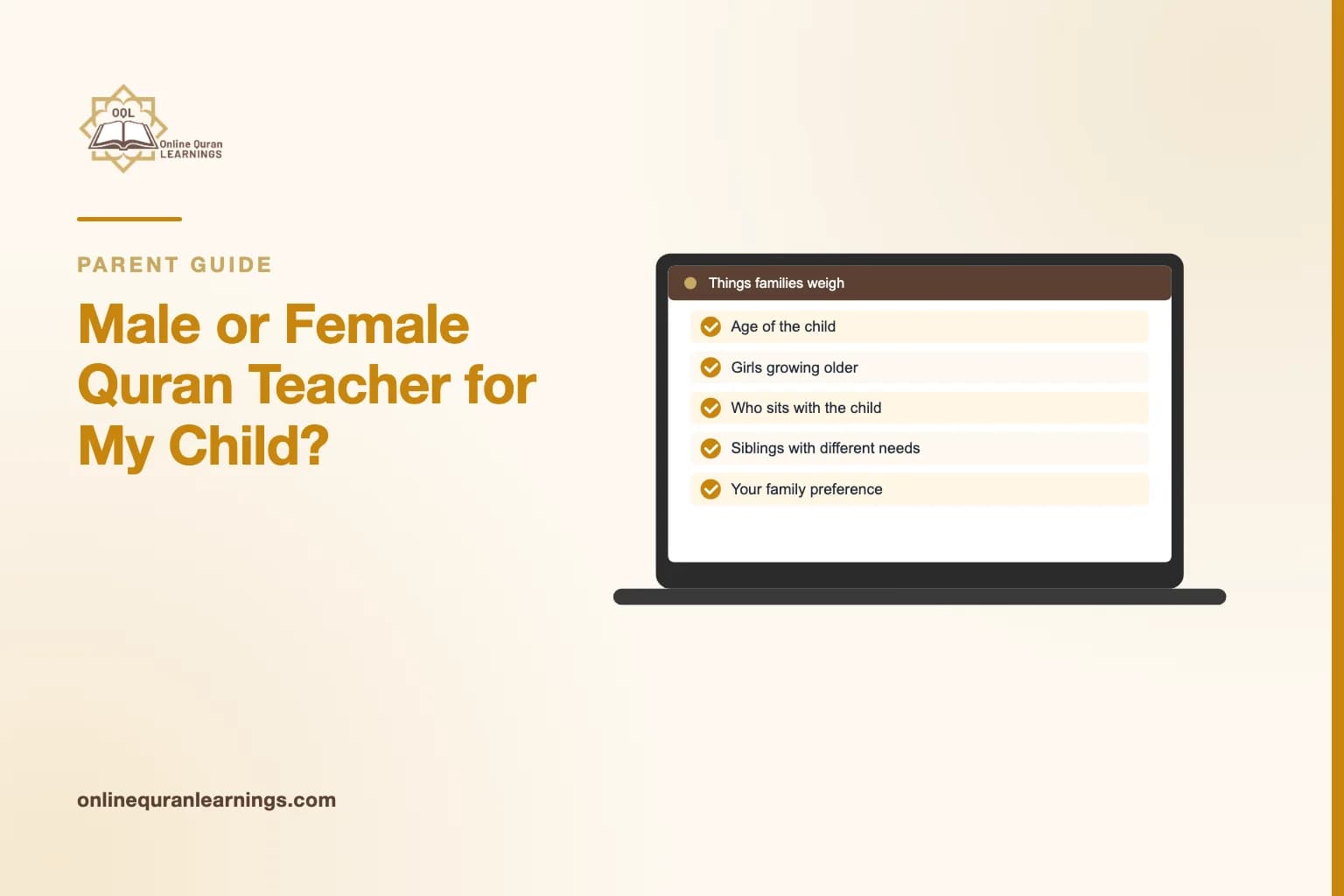
For most young children, either a male or a female teacher works well, and the teacher's patience and skill matter more than their gender. The decision tends to matter more as children grow, especially for girls approaching puberty, and it is one families are free to make, and remake, at each stage.
That is the short version. The rest of this guide is about the practical side: how to decide for your particular child now, how to ask them what they think, what to do when siblings need different teachers, and how to switch later without fuss. For the broader overview of how families choose and how supervision works, see our main page on choosing a male or female Quran teacher.
Start with your child's stage
Under 7
At this age most children respond to warmth and patience rather than to who the teacher is. Many families choose a female teacher for very young children, often because the child is used to women in early-years teaching, and the softer start can help a shy four-year-old settle. But a gentle, encouraging male teacher can do just as well.
Practical test: does your child light up, or at least relax, by the end of the first lesson? That tells you more than any rule.
7 to 10
Children now have clearer preferences, and the relationship with the teacher starts to drive motivation. Some boys at this age respond well to a male teacher they can look up to, particularly if they are starting Hifz or learning to lead a short prayer at home. Some girls are already more comfortable with a woman. Many children do not mind at all.
Approaching puberty
This is the stage where many families revisit the choice, especially for daughters. Some families switch a girl to a female teacher at this point; others chose a female teacher from the start so there is no change to manage. Views on whether, and when, a man may teach a girl past puberty differ between schools of thought and between families. Follow your family's understanding, and if you are unsure, ask your local scholar rather than an academy.
For boys, the stage matters less in religious terms, but some teenage boys prefer a male teacher for Tajweed corrections that touch on voice and confidence.
Teenagers
Teenagers should have a real say. A fourteen-year-old who chose their teacher has a stake in the lessons; one who was assigned a teacher has a complaint ready. Our pages on our female Quran teachers and male Quran teachers are useful to show an older child before you book.
Three situations that change the answer
A mother learning too. If you want to learn alongside your daughter, or take your own lessons, a female teacher for both keeps things simple.
A child with a past bad experience. If a child was frightened or shamed by a teacher before, the gender of that teacher can matter to them more than it should. Choosing the opposite for a fresh start is reasonable.
A strong preference in the wider family. Grandparents or a parent may feel strongly. It is usually better to settle the family's view before the trial than to change teacher after your child has bonded with one.
How to ask your child
Children often say what they think you want to hear. Ask in a way that makes either answer safe.
For a younger child, after a trial lesson:
"What was the best bit of today's lesson? Was there anything that felt strange or hard? Would you like the same teacher next time, or try someone new?"
For an older child, before booking:
"We can choose a brother or a sister to teach you. Some people feel more relaxed with one or the other, and some don't mind. What would you prefer, and why?"
Listen for comfort words (relaxed, easy, kind) more than for the gender itself. If your child says "I don't mind", believe them and pick on other grounds, such as lesson time or teaching style.
When siblings need different teachers
This is common, and it is not a problem. A ten-year-old daughter may need a female teacher while her six-year-old brother is happy with either. Because every lesson is one-to-one, each child can have their own teacher.
A few things make it easier:
- Book the lessons back to back so the device comes out once, even if two teachers are involved.
- Ask both teachers to use the same Qaida edition so the younger child is not confused by a sibling's different book.
- Avoid comparing teachers in front of the children. "Your teacher is stricter" becomes a reason to complain.
- Keep one parent as the point of contact for both, so messages about timing do not get crossed.
Our guide to Quran classes for siblings covers timetables for several children in more detail, and if you are still deciding whether siblings should share a format at all, see whether one-to-one or group classes suit your child.
A decision checklist
- What does our family believe is appropriate at this child's age and stage?
- Is anyone else learning (a mother, an older sister) who would share the teacher?
- Has my child had a good or bad experience with a teacher before?
- Is my child shy, confident, or easily embarrassed when corrected?
- What does my child say, when asked in a way that makes any answer safe?
- Will this choice still suit them in two years, or are we likely to switch?
If question 6 points to a change in a year or two, some families choose the later option from the start to avoid a second settling-in period.
Switching later without starting over
Switching is normal, and children usually adapt within a few lessons. To keep the progress:
- Tell the team what you want and why. You can ask for a male or female teacher at any point.
- Ask the new teacher to start from where your child is. Lessons are recorded and you receive monthly progress reports, so share the latest one.
- Tell your child in advance. A short, positive explanation ("you're growing up, so you'll have a new teacher") is better than a surprise.
- Allow a settling-in period. Expect the first two or three lessons to feel slower while the new teacher learns your child's habits.
Our guide to changing your child's Quran teacher covers the wider reasons for a change, and how to check an online Quran teacher lists what to look for in any new teacher, whoever they are.
Frequently asked questions
Does a child learn faster with a teacher of the same gender?
Not in itself. Speed depends far more on the teacher's patience, the lesson frequency and practice at home. Gender matters mainly for comfort, family preference and religious considerations.
My child has asked for a different teacher. Should I always agree?
Listen first and ask what exactly they dislike. If it is the teacher's manner, a change often helps. If it is the work getting harder, a new teacher may not fix it, so talk to the current teacher before switching.
Can I sit nearby during lessons whichever teacher we choose?
Yes, and for young children it is a good idea. Lessons are online, so a parent can stay in the room or within earshot, and lessons are also recorded.
Is there a right age to move a daughter to a female teacher?
Families and scholars differ on this. Many move around the approach of puberty, some much earlier, some choose a female teacher from the start. Follow your family's own understanding and, if unsure, ask your local scholar.