
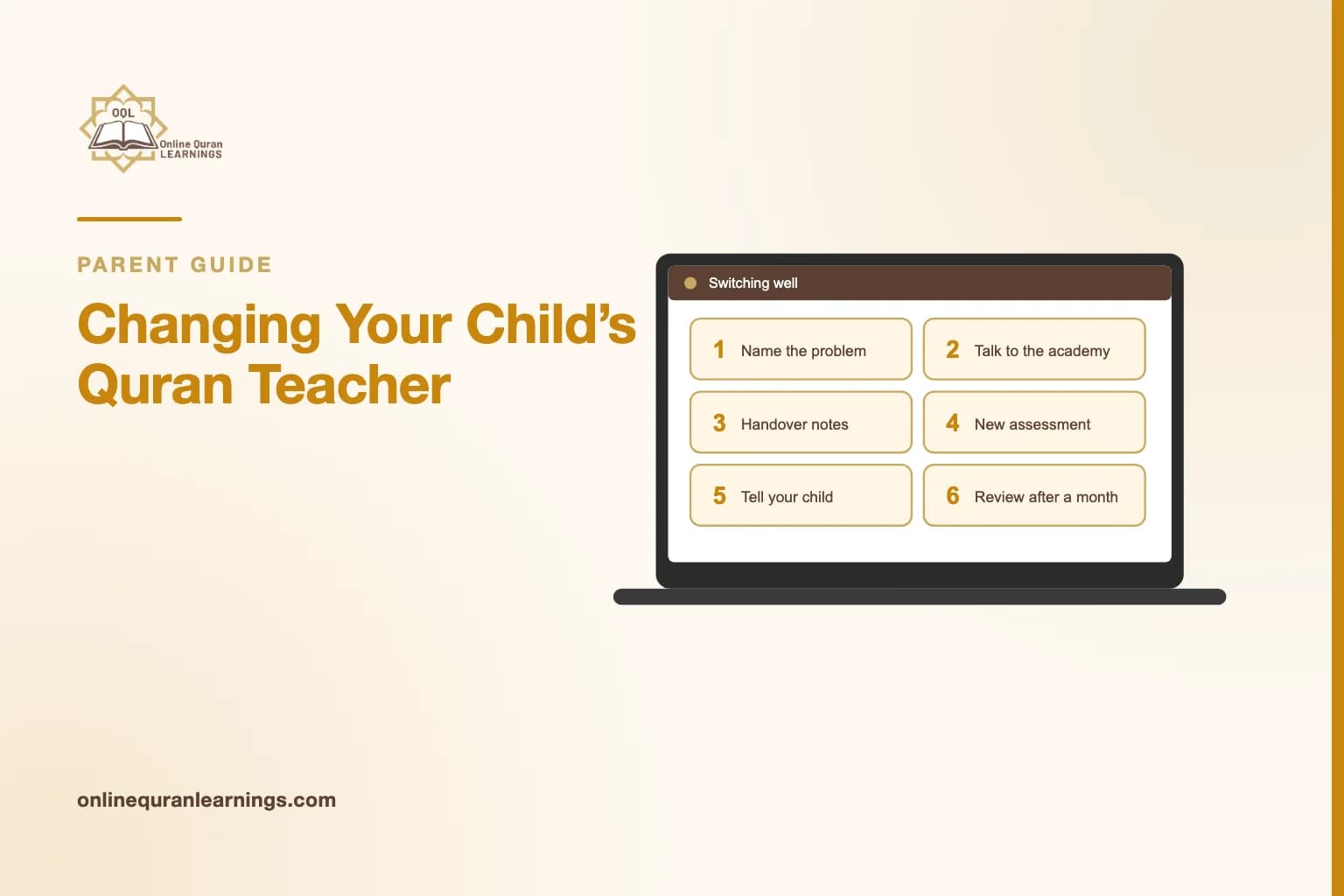
Most parents who are thinking about changing their child's Quran teacher have been thinking about it for a while. The child has gone from chatty to monosyllabic. The page they were on in spring is the page they are on in autumn. Nobody has done anything wrong, exactly, but something is not working.
Change the teacher when a specific, persistent problem has survived one honest conversation and a few weeks to fix it. Do not change because of one bad week, a tired patch at school, or a child who simply prefers screen time. And when you do change, do it with a proper handover, so your child's new teacher starts where the old one stopped rather than at the beginning.
Signs it really is the teacher
These are worth acting on, especially when two or more appear together.
- Progress has stalled for six to eight weeks despite regular classes and some practice at home.
- Your child is dreading the class, not just grumbling, and the dread is about the teacher specifically.
- Corrections are harsh or absent. Either your child is told off for mistakes, or mistakes slide past uncorrected.
- The teacher cannot tell you where your child is. Ask what they are working on and what is hard. A vague answer after months of lessons is telling.
- Reliability has slipped. Late starts, early finishes, frequent cancellations.
- The level is wrong and stays wrong. A confident reader still on the alphabet, or a struggling child pushed into joined letters regardless.
- Anything at all that worries you about safety. This one does not wait for weeks. Raise it with the academy the same day.
If you are not sure how to judge the teaching itself, our guide on how to check an online Quran teacher has a scorecard you can fill in from a single recorded lesson.
Signs it probably is not the teacher
Switching for the wrong reason costs a child continuity and does not fix the actual problem.
| What you see | Often really about |
|---|---|
| Child is grumpy before every class | The time slot, hunger, tiredness after school |
| Slow progress, but no practice at home | The week between lessons |
| Child forgets last week's work | Revision habits, not teaching |
| Resistance after a holiday | Restarting is hard for anyone |
| Child wants to stop altogether | Motivation, which a new face may not fix |
If the pattern looks like forgetting, our guide on why children forget Quran lessons is the better place to start. If your child is refusing class outright, read what to do when a child refuses Quran class first, and if the spark has gone more generally, see our page on Quran classes for children who have lost interest. Coming back after a long gap is its own situation, covered in restarting Quran after a break.
Try one honest conversation first
Before asking for a change, tell the teacher or the academy what you are seeing, specifically. Many problems are fixable in a fortnight once someone names them.
A short message works better than a long one:
Assalamu alaikum. Zara has been finding the lessons hard lately. She gets upset when she is corrected several times in a row, and I am not sure she is retaining much. Could we try shorter drills and a bit more praise for the next few classes, and see how she goes?
Then give it three or four weeks. If things improve, you have kept a teacher who now knows your child well, which is worth a great deal. If nothing changes, you have your answer, and the request for a change will not come as a surprise.
How to ask for a different teacher
Ask the academy, not the teacher, and keep it brief and kind. Teachers are people, and in a good academy a change is routine rather than a complaint.
Something like:
We would like to try a different teacher for Yusuf. Ustadh has been kind, but Yusuf needs a slower pace than he is getting. Could the new teacher see the current notes so they know where he is?
That message does three useful things. It is not an accusation, it gives the reason in one line, and it asks for a handover.
This is also the moment to reconsider the teacher's gender if that matters to your family. Some children open up more with a female Quran teacher, particularly younger ones and girls approaching their teens. Some older boys do better with a male Quran teacher. Our guide on choosing a male or female Quran teacher for your child covers how families weigh it.
Switching without losing progress
The biggest fear parents have is that the child will be sent back to page one. With a proper handover, they should not be.
- Ask for handover notes. Where your child is in the book, which letters or rules are still shaky, and any habits the teacher has been correcting.
- Note it yourself too. Write down the page number and what your child can read alone today. Record them reading a few lines on your phone.
- Expect a short assessment. The new teacher will listen to your child read in the first lesson. This is not a restart, it is how a teacher confirms the notes match reality.
- Accept a small step back if needed. If the assessment shows gaps, going back a few pages to firm them up is a repair. It usually saves time within a month.
- Keep the same slot if you can. Changing teacher and time at once is two changes. Hold the time steady and let the teacher be the only new thing.
- Give it four weeks. The first few lessons with anyone new are slightly awkward. Judge the trend, not the first class.
At Online Quran Learnings, lessons are recorded and parents receive a monthly progress report, which gives a new teacher a clear record to start from.
Telling your child
Children read the mood more than the words. Keep it simple and positive, and do not run the old teacher down.
- For younger children: "You're going to have a new Quran teacher. She's going to help you with your letters."
- For older children: "We think a different teacher might suit you better. You can tell me after a couple of lessons what you think."
- For a child who liked the old teacher: acknowledge it. "I know you liked Ustadha. This isn't because you did anything wrong."
Older children often appreciate being asked. A twelve-year-old who has some say in the change is more likely to give the new teacher a fair chance.
When staying is the better choice
Sometimes the right answer is not to switch. If the teacher is skilled, kind and reliable, and the problem is a hard term at school, a new sibling, or a child who is simply in a phase of finding everything difficult, a new teacher means losing someone who already knows exactly where your child stumbles. Adjust the schedule, add practice, or drop a class for a few weeks. Teachers who have watched a child for a year are hard to replace.
Frequently asked questions
Will my child have to start the Qaida again with a new teacher?
They should not. A new teacher assesses where your child actually is and starts there. Sometimes that means going back a few pages to firm up something shaky, which is a repair rather than a restart.
Do I have to tell the old teacher why we are changing?
You do not owe a long explanation, but one honest, kind sentence helps everyone. Something like saying your child seems to need a different style is enough, and it lets the teacher improve.
How many teacher changes is too many?
If you have changed more than twice in a year and the same problem keeps appearing, the cause is probably not the teacher. Look at the time slot, the level, or practice at home before changing again.
Can we switch from a male to a female teacher partway through?
Yes. Families choose a male or female teacher, and many change as a child gets older or as family preferences shift. Ask the academy to pass on the current teacher's notes so the new teacher starts informed.