
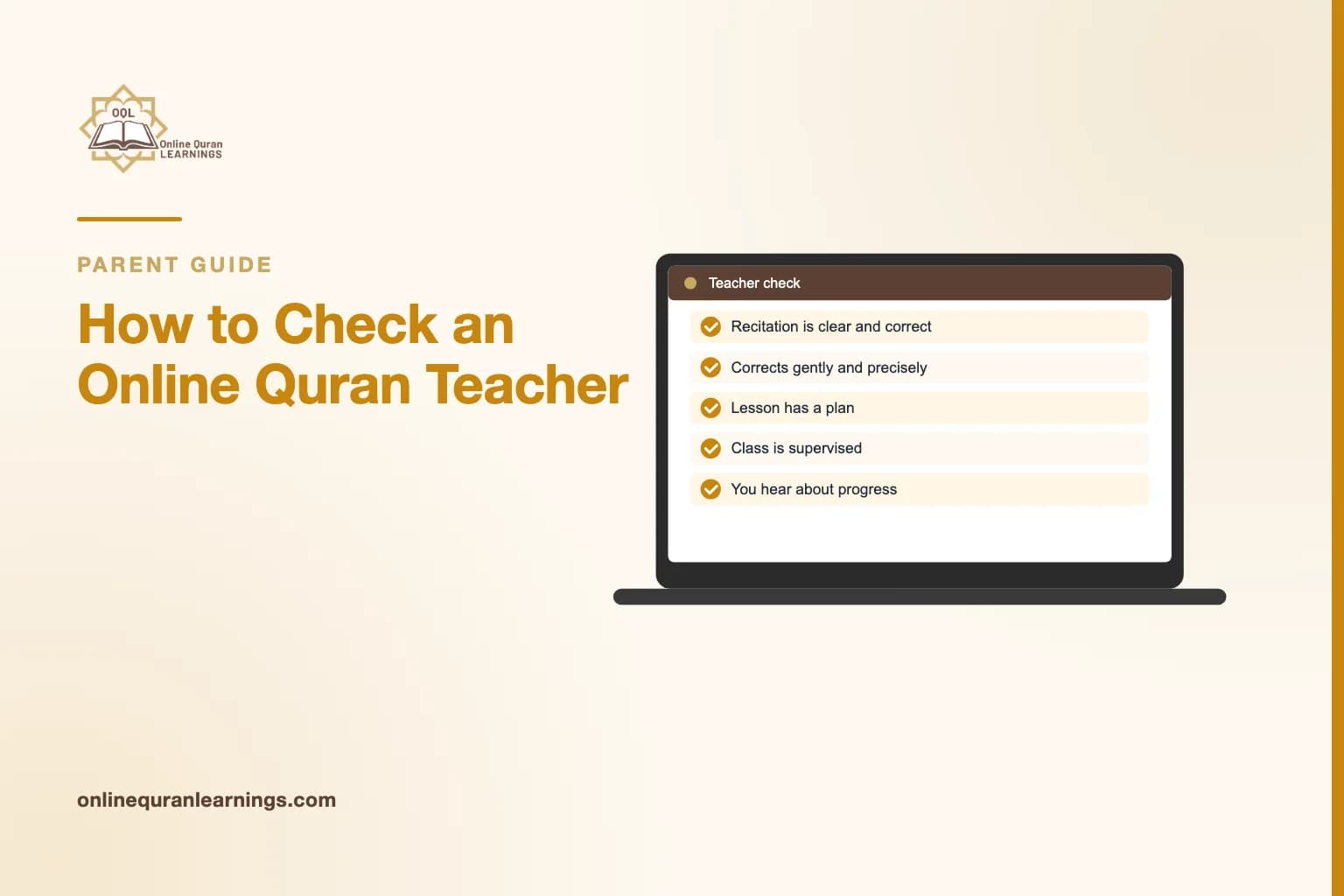
Short answer: check three things, in this order. Can the teacher recite correctly? Can they teach a child, rather than just recite at one? And is the lesson set up so that nobody is ever alone with your child out of sight? Then keep checking after you start, because the first month tells you far more than the first lesson.
Choosing a teacher and checking one are different jobs. Our guide on choosing an online Quran teacher covers matching a teacher to your goal. This one is about verification: how a parent who may not read Arabic fluently can tell whether the teaching is sound and the setup is safe.
Check the recitation, even if you do not read Arabic
Your child will copy the teacher's sounds exactly, and early habits are slow to undo. You can test this without being an expert.
- Ask the teacher to recite Al-Fatiha at the start of a trial. Most will gladly.
- Play the same surah from a well-known reciter afterwards and listen to both.
- Listen for the heavy letters. ص, ض, ط, ظ and ق should sound full and deep, not like their lighter cousins س, د, ت, ذ and ك.
- Listen for the long vowels. Elongations should be held for a steady, consistent length rather than clipped or stretched at random.
- Listen to the stops. Pausing mid-phrase to breathe and then carrying on as if nothing happened is a habit you do not want copied.
You are not grading Tajweed. You are listening for whether the teacher's recitation sounds like the reference, and whether it is clear enough for a child to imitate. Our guide to common Tajweed mistakes explains what the usual slips sound like if you want to train your ear.
It is also fair to ask, politely, who the teacher learned from and what they have studied. You are not owed a life story. A plain, specific answer is a good sign. Vagueness is not.
Check the teaching, not just the knowledge
A beautiful reciter can still be a poor teacher of seven-year-olds. Watch how the lesson works, not only how it sounds.
- Who is speaking? For reading and Qaida, your child should be producing sound for much of the lesson.
- What happens after a mistake? The useful pattern is: teacher models the sound, child tries again straight away, teacher confirms. Moving on without correcting, or correcting with a sigh, are both problems.
- Is there a sequence? Ask what comes after this page and why. A teacher with a method can tell you the next three steps.
- Is the child's level respected? A reader made to repeat the alphabet is bored. A beginner rushed into joined letters is lost. Both stall.
- Does the teacher adjust? By the third class the teacher should be doing something slightly different based on what they have learned about your child.
If any of this is new to you, our checklist of questions to ask in a trial class gives you the exact wording.
Check the safeguarding, every time
This is the part parents most often assume rather than check. It is also the part where a single bad answer should end the conversation.
Ask the academy, not just the teacher:
- Are classes monitored by someone other than the teacher?
- Are lessons recorded, and can I see them?
- Is every class held on the academy's platform, at the scheduled time?
- Is the teacher allowed to contact my child directly, outside class? The right answer is no. Contact goes through the parent.
- Who do I tell if I am uncomfortable, and how quickly will they respond?
At home, a few habits help regardless of the academy:
- Keep the device in a shared room, not a closed bedroom.
- Stay within earshot, especially for younger children and early lessons.
- Keep messaging between parent and academy. A child should not have a teacher's personal number.
- Tell your child, simply, that they can always tell you if anything in class felt strange, and that they will not be in trouble for it.
For reference, at Online Quran Learnings every class is one-to-one, classes are supervised and monitored, lessons are recorded, and families choose a male or female teacher. If the teacher's gender matters to your family, the considerations are covered in male or female Quran teacher for my child.
Red flags that should not wait
Some concerns are worth watching for a few weeks. These are not.
- A teacher asks to move lessons to a personal app or account.
- A teacher messages your child directly, or asks them to keep anything from you.
- The academy cannot tell you who else can see the lesson.
- Lessons are quietly shared with other students when you paid for one-to-one. Our explainer on one-to-one versus group Quran classes covers why that matters.
- Shouting, shaming, or telling a child that mistakes anger Allah.
- Repeated late starts or early finishes, with no explanation.
Raise any of these with the academy the same day, in writing.
A scorecard you can actually use
Score each line 0, 1 or 2 after the trial, and again after a month. It takes two minutes and turns a vague feeling into something you can compare.
| What to check | 0 | 2 |
|---|---|---|
| Recitation matches a known reciter | Clearly different | Clear and close |
| Child speaks for much of the lesson | Teacher talks throughout | Child reads a lot |
| Mistakes corrected calmly | Ignored or sharp | Modelled, retried |
| Clear next steps | Vague | Specific |
| Teacher knows your child's weak spots | Cannot say | Names them at once |
| Lessons monitored and recorded | No | Yes |
| No direct contact with your child | Personal contact | Through parent only |
| Starts and ends on time | Often not | Reliably |
| Child's mood about class | Dreads it | Neutral or keen |
A 1 sits between the two. Treat any 0 on the safeguarding lines as a deal-breaker on its own. Otherwise, roughly 14 or more out of 18 is a teacher worth keeping, and 10 or below is a conversation worth having.
Keep checking after you start
The trial shows you manner. The first two months show you whether your child is learning.
At four weeks
Ask your child to read you the last thing they learned without help. Then look at the same page from a few weeks earlier. You should hear a difference, even a small one. Watch a recorded lesson if you can, ideally one you did not sit through.
At the first progress report
Compare what it says with what you have heard at home. A report that says "excellent progress" while your child cannot read last month's page is a report written without listening. At Online Quran Learnings parents get a monthly progress report, and it should match what your child can actually show you.
At three months
Progress should be visible to you, not just described to you. Most children at three lessons a week with short daily practice move through a recognisable chunk of the Qaida in this time, though age, starting point and practice change the pace considerably. No movement at all is worth a frank conversation.
If the checks keep coming back weak, our guide on changing your child's Quran teacher explains how to do it without losing the progress already made.
You can see how teachers are matched to families on our online Quran teacher page, including the choice between a male and a female teacher.
Frequently asked questions
Can I ask to watch a recording of my child's lesson?
You should be able to, and it is one of the easiest checks available. At Online Quran Learnings lessons are recorded, so a parent can look back at a class rather than relying on memory.
Is it rude to ask a Quran teacher who taught them?
No. It is a normal question in Quran teaching, where the chain of learning matters to many families. A confident teacher answers it simply and without offence.
How long before I can fairly judge a teacher?
Manner shows in one lesson. Method and progress take four to six weeks of regular classes with practice at home. Safety concerns should be acted on immediately, whatever the timeline.
Should I worry if the teacher corrects my child constantly?
Frequent correction is normal at the start, especially for Tajweed. What matters is the tone and whether the child is given time to try again. Correction with no praise at all is the part to raise.