
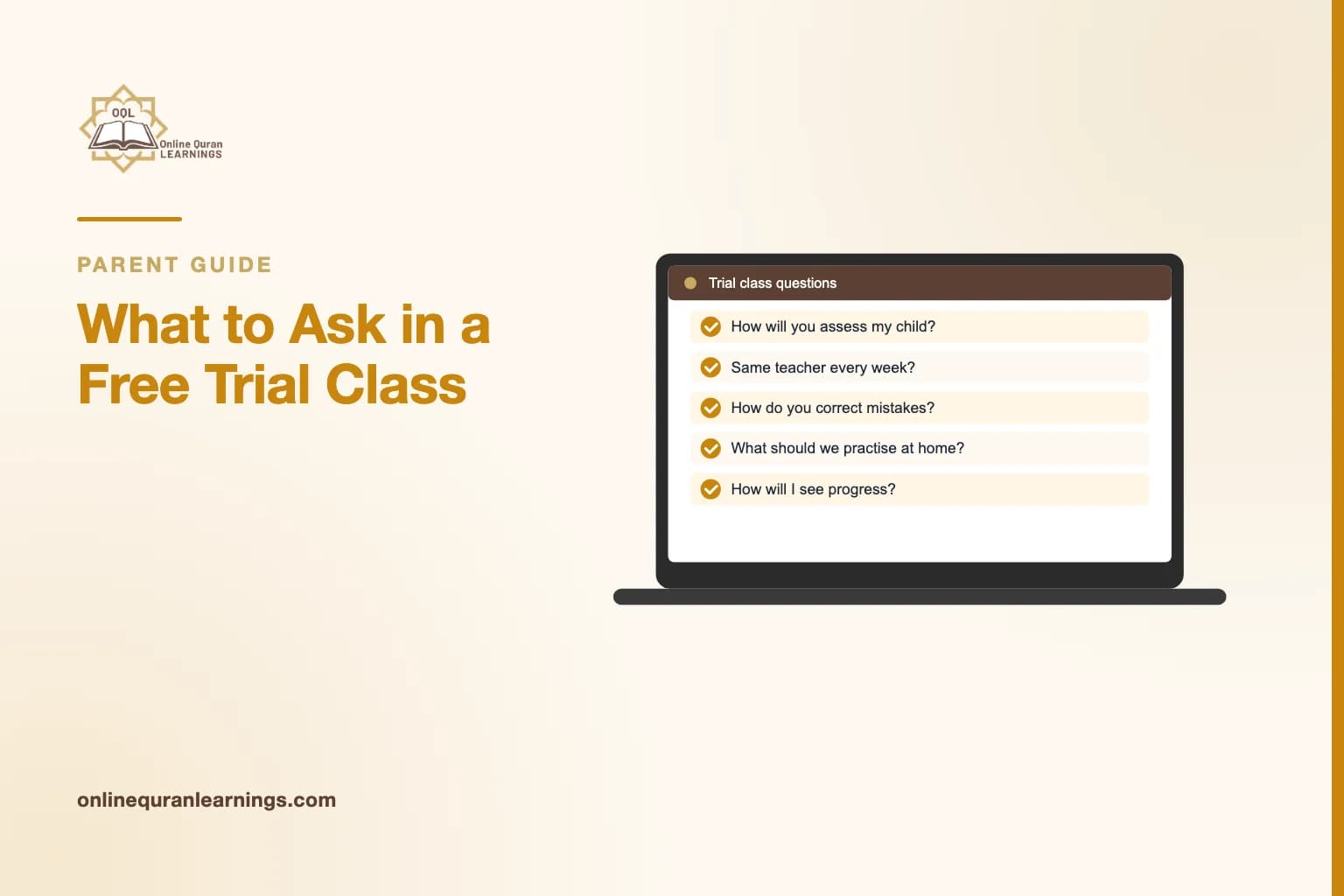
A trial class is the one point where you hold all the cards. You have not paid, nothing is booked, and the academy wants your yes. Most parents spend it sitting quietly in the next room and come away with a feeling rather than information.
Ten minutes of direct questions changes that. If you only have time for five, use these.
| Ask this | What it tells you |
|---|---|
| Where would you start my child, and why there? | Whether the teacher actually assessed them |
| What did they find hardest today? | Whether the teacher was paying attention |
| What should we practise before the next class? | Whether there is a plan beyond the half hour |
| Will it be the same teacher every week? | How the academy handles continuity |
| Who else can see or hear the lessons? | How seriously safeguarding is taken |
The rest of this guide covers what good answers sound like, what to ask the academy as opposed to the teacher, and what to watch in your child, which is often more telling than anything an adult says.
Decide three things before the trial starts
Questions land better when you know what you are asking for.
- The goal. Letters and joining, fluent reading, memorisation, or Islamic studies. A teacher cannot tell you whether your child is on track if you have not said what the track is.
- The slot you could actually keep. Book the trial at the time you would use every week. A trial on a calm Saturday morning tells you little about a tired Tuesday evening.
- Where you will sit. Within earshot, out of your child's eyeline. Close enough to hear the teacher's corrections, far enough that your child is not performing for you.
Questions for the teacher, at the end of the lesson
Keep these for the last two or three minutes. Asking mid-lesson pulls the teacher away from your child.
Where would you start my child, and why there?
A good answer names a specific place and a reason. Something like: "She knows most of the letters but mixes up the ones with dots, so I would start at the lesson on similar shapes and move quickly through what she already knows."
A weak answer is "from the beginning" with no reason, for a child who clearly already reads. Starting a reader at Alif is not caution, it is a sign nobody listened.
What did they find hardest today?
A teacher who was attending to your child will answer straight away and name a sound, a letter or a habit. "He rushes the long vowels" is a useful answer. "He did very well, mashaAllah" is pleasant and tells you nothing.
What should we practise before the next class?
You want something small and concrete: one line, three letters, five minutes a day. If the answer is "nothing, I will handle it in class", the teacher is either not thinking about the week between lessons or does not expect you to be involved. Neither helps a young child.
What will they be able to do in three months at this frequency?
Ask it with the number of classes a week you are actually considering. A thoughtful teacher gives a range and the conditions behind it: "If she practises most days, probably the end of the joined letters section. Without practice, less." A teacher who promises a specific finish line before knowing your child well is guessing.
Questions for the academy, not the teacher
Some questions belong to whoever runs the classes. Ask them on the call or message thread after the trial, and notice how quickly and plainly they are answered.
| Question | A good answer sounds like | Worth pausing if you hear |
|---|---|---|
| Will it be the same teacher every week? | Yes, and here is what happens if they are ill | Whoever is free |
| Can we change teacher later? | Yes, tell us and we will arrange it | Changes are difficult |
| Who else can see the lessons? | Classes are monitored and recorded | Only the teacher |
| How will I know how my child is doing? | A regular written progress report | Ask the teacher whenever |
| What time is this for us, all year? | Your local time, adjusted when clocks change | It is fixed in our time |
| What happens with a missed class? | A clear, written rule | It depends |
For reference, at Online Quran Learnings classes are one-to-one, lessons are monitored and recorded, and parents get a monthly progress report. You choose a male or female teacher, and if you are unsure which suits your child, our page on choosing between a male and a female Quran teacher sets out how families usually decide.
Billing questions are worth asking now too, before you are emotionally committed. Our guide to what online Quran classes should cost covers the maths and the hidden extras to ask about.
Watch your child, not just the teacher
Adults can give polished answers. A child's behaviour in the half hour is harder to fake.
- How much of the lesson was your child's voice? For Qaida and reading, the child should be making sounds for a good share of the time. Thirty minutes of the teacher talking is a lecture.
- Where were their eyes? A child who keeps looking at the screen is following. A child who keeps looking at you or the door has lost the thread.
- What happened after a mistake? Did they try again willingly, or go quiet? Repeated quiet is a sign the correction style is too heavy for them.
- How did they leave? Wandering off cheerfully is fine. Wanting to tell you about the teacher is better. Dreading the next one is the clearest signal you will get.
Then ask your child one question an hour later: "Show me something you learned." A six-year-old who can point to one letter and say it correctly had a useful lesson, even if the rest felt chaotic from the next room.
If your child is quiet with new adults, do not read too much into the first class. Our page on Quran classes for shy children explains what a teacher should do differently, and what a slower start looks like when it is going well.
Make each trial class answer a different question
Our free trial Quran classes for kids include up to 3 free trial classes, and they are most useful when you treat them as three different tests rather than three repeats.
- First class: manner. Is the teacher warm, clear, and patient? Does your child engage at all?
- Second class: memory. Did anything from the first class survive? A good teacher opens by checking.
- Third class: adjustment. Has the teacher changed anything based on what they learned about your child? Shorter drills, more praise, a different pace?
If the answer to the first is clearly no, ask for a different teacher for the second. You lose nothing, and the remaining trials tell you something new. If you want a fuller list of what to look for before and after you sign up, our guide on how to check an online Quran teacher goes further.
A short script, if asking feels awkward
Many parents feel it is impolite to question a Quran teacher. It is not. Good teachers welcome it, because a parent who asks is a parent who will help at home. If it helps, say something close to this:
Thank you, that was lovely to listen to. Before you go, can I ask three quick things? Where do you think she should start, what did she find hardest today, and what can we practise before next time?
That is under a minute, and it gets you more than the whole lesson did.
When the answers are good but you still are not sure
Sometimes everything checks out and something still feels off. Usually it is one of two things: the slot is wrong, or the match is wrong. Try the same teacher at a different time before deciding the teacher is the problem. If your child is still flat, try someone else.
If you have not booked yet and want to know what the lesson itself will look like, read what happens in a first online Quran lesson. And if you are earlier still, comparing academies rather than teachers, our guide on choosing an online Quran teacher is the better starting point.
Frequently asked questions
Should I tell my child it is only a trial?
It usually helps to present it simply as their first Quran class with a new teacher. Children who are told they are being tested tend to perform rather than learn, and you want to see the ordinary version of them.
Can I ask for a different teacher before the trial classes are finished?
Yes, and the trial is the best time to do it. If the first teacher is clearly not the right fit, ask for the next class to be with someone else so the remaining trials tell you something new.
What if my child cries or refuses during the trial?
Stay calm, sit closer, and let the teacher try a lighter approach for a few minutes. One difficult trial says little on its own. How the teacher responds to it says a great deal.
Do I need to buy a Qaida book before the trial?
Usually not, because most online teachers share the page on screen. Ask the academy afterwards whether a printed copy would help your child practise between classes.