
Monthly prices for online Quran classes are hard to compare at a glance, because every academy packages them differently. Do this sum first:
Monthly fee ÷ number of lessons a month = price per lesson. Then check the lesson length, and whether it is one-to-one.
A plan at $40 for eight 30-minute one-to-one lessons is $5 a lesson. A plan at $30 for four 45-minute group lessons is $7.50 a lesson, for a fraction of the individual attention. The cheaper headline is the more expensive class.
Below is what drives the price, what a sensible range looks like, the costs that are easy to miss, and our own fees, stated plainly.
Why prices vary so much
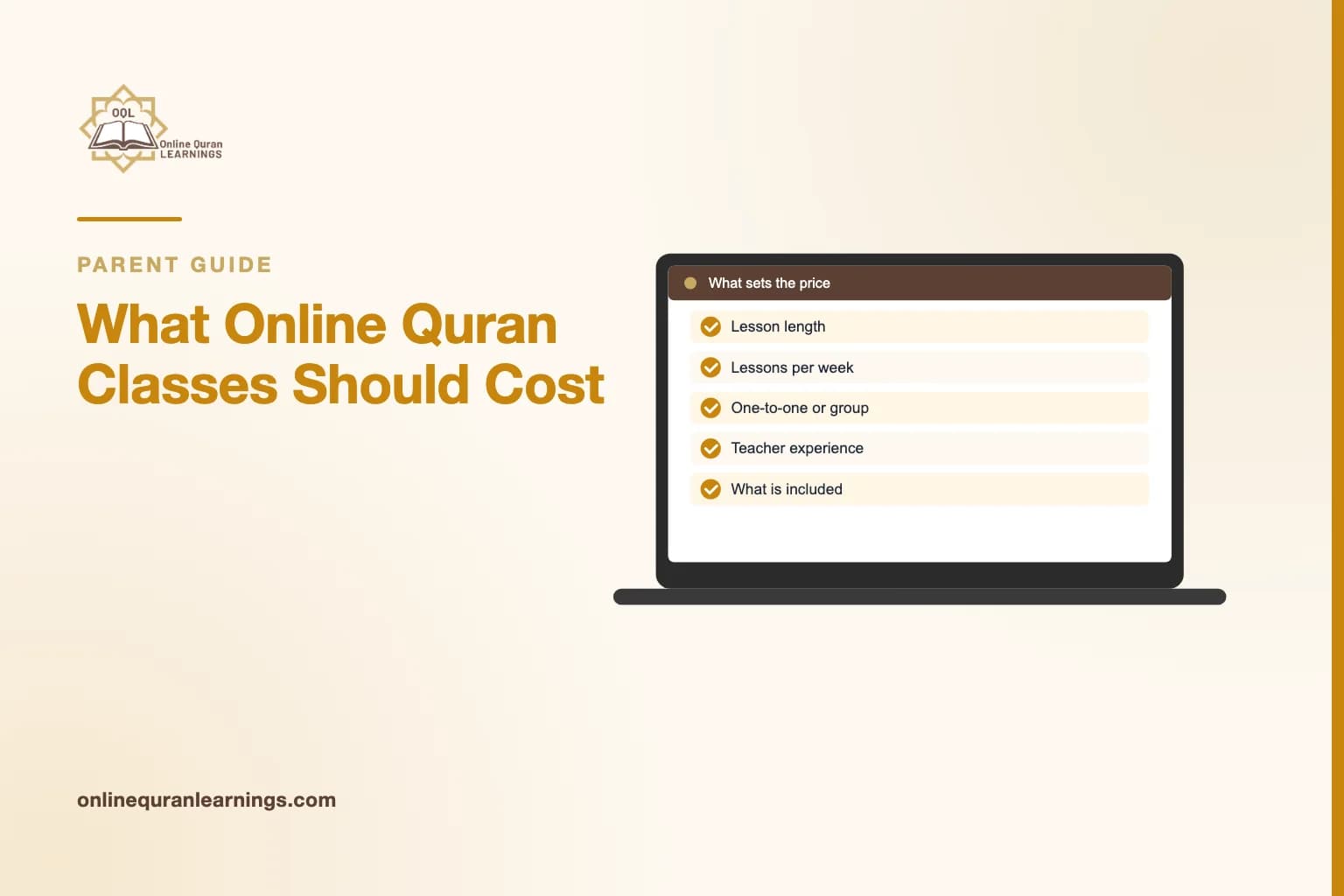
Online Quran teaching is sold across many countries by everything from individual tutors to large academies, so the spread is wide. Five things account for most of it.
Lesson length
A 45- or 60-minute lesson costs more than a 30-minute one, but it is not automatically better value. For children of five to twelve, 30 minutes is usually the useful limit of attention.
How many lessons a week
Monthly price rises with frequency, though the price per lesson often falls on larger plans. Frequency also changes the rate of progress more than any other choice you make. Our guide on how many Quran classes a week a child needs covers the trade-off.
One-to-one or group
Group classes look cheap per month and are often expensive per minute of your child actually reading to a teacher. If six children share 30 minutes, each gets roughly five. The comparison of one-to-one and group Quran classes goes through when each format makes sense, and our guide on whether to choose one-to-one or group classes looks at it from the child's side.
The teacher's profile
A specialist Hifz teacher, an advanced Tajweed teacher, or a well-known local tutor with a long waiting list will cost more than a teacher for beginners' Qaida. That is reasonable, as long as the academy can tell you specifically what the higher price buys.
Where the teacher and the family are
Teacher pay and living costs differ hugely between countries, and so do local tutoring norms. A face-to-face tutor visiting your home in London, Toronto or Sydney is a different cost base from an online academy, and is usually priced several times higher per hour.
What a fair price looks like
We will not quote other providers' prices as facts, because they change and packaging varies. What you can do is put every plan you are considering on the same footing: the monthly price divided by the number of one-to-one minutes it buys. Once three or four academies are side by side in that form, the outliers in either direction are obvious.
The per-lesson figure is the one to compare. Work it out for every option on your shortlist and put them side by side.
| Example plan (illustrative) | Lessons a month | Price per lesson |
|---|---|---|
| $40 for 2 x 30 min a week | 8 | $5.00 |
| $60 for 3 x 30 min a week | 12 | $5.00 |
| $30 for 1 x 45 min a week, group of 6 | 4 | $7.50, about 7 minutes each |
| $25 an hour, private, 2 x 30 min a week | 8 | $12.50 |
These are worked examples to show the method, not quotes from anyone. Notice how differently they rank once you divide.
Costs that are easy to miss
The monthly figure is not always the whole bill. Ask about each of these before you pay anything.
- Registration or admission fees. Ask whether there is one, and whether it is refundable.
- Books and materials. Some academies charge for a digital Qaida or course pack.
- Missed-class rules. If your child is ill, is the lesson rescheduled, credited, or lost? A strict no-makeup rule can quietly raise your real cost per lesson.
- Teacher absence. If the teacher misses a class, what happens? It should never cost you.
- Minimum terms. A three- or six-month minimum turns a monthly price into a larger commitment.
- Currency conversion. If you are billed in a currency other than your own, your card provider may add a charge.
- Refund terms. Know the window and how to ask, before you need it.
When cheap is too cheap
A very low price has to come from somewhere. It usually comes from one of these:
- Classes that are not truly one-to-one, or a teacher juggling several screens.
- Lessons that run short, or a teacher who changes every few weeks.
- No monitoring, no recordings, no reports. Nobody checks the teaching.
- Teachers paid so little that turnover is constant, so your child keeps starting over.
The real cost of a poor class is not the fee. It is six months of a child learning sounds incorrectly, then six more unlearning them. Our guide on how to check an online Quran teacher covers what to listen for, whatever you pay.
At the other end, a high price should come with something you can name. If nobody can explain what the extra buys, it is not buying anything. Our roundup of the best online Quran academies sets out the features worth comparing.
What Online Quran Learnings costs
Our fees are billed in USD. Every plan is one-to-one live teaching in 30-minute lessons, with a male or female teacher you choose, classes that are monitored and recorded, and a monthly progress report for parents.
| Plan | Classes | Per month | Per lesson |
|---|---|---|---|
| Starter | 2 a week, 8 a month | $39 | about $4.88 |
| Regular | 3 a week, 12 a month | $49 | about $4.08 |
| Comprehensive | 4 a week, 16 a month | $55 | about $3.44 |
| Intensive | 5 a week, 20 a month | $59 | $2.95 |
Classes can be scheduled at any hour, so evenings after school and weekend mornings work in any time zone. Full details are on our schedule and fees page.
Refund requests must be made within 5 calendar days of the first paid class, and the full terms are in our refund policy.
Choosing a plan without overspending
Most families do not need the biggest plan to start. A sensible approach:
- Start with what you can keep up. Two or three lessons a week, held at the same time, beat five that keep getting cancelled.
- Add daily practice before adding lessons. Five minutes a day at home does more than an extra class with no practice around it.
- Move up for a reason. Starting Hifz, a goal before Ramadan, or a child who is flying and wants more.
- Move down rather than stopping. In exam season, two lessons a week keeps the thread. Stopping usually costs more in lost ground.
Before your first trial, it is worth having a short list of questions ready, including the money ones. Our guide on what to ask in a free trial class includes them.
Frequently asked questions
Why do some tutors charge by the hour and academies by the month?
Hourly pricing suits occasional or irregular lessons. Monthly plans suit a fixed weekly schedule, which is how most children make steady progress. Convert both to a price per 30 minutes to compare them fairly.
Is paying for several months upfront ever worth it?
Only once you are confident in the teacher, and only if the refund terms are clear. For a new family, paying month by month keeps the decision open while you find out whether the match works.
Are Online Quran Learnings fees charged in US dollars everywhere?
Yes, plans are billed in USD wherever you live. Your bank or card provider may add its own currency conversion charge, so check that with them.
What is the refund rule at Online Quran Learnings?
Refund requests must be made within 5 calendar days of the first paid class. The full terms are on the refund policy page.