
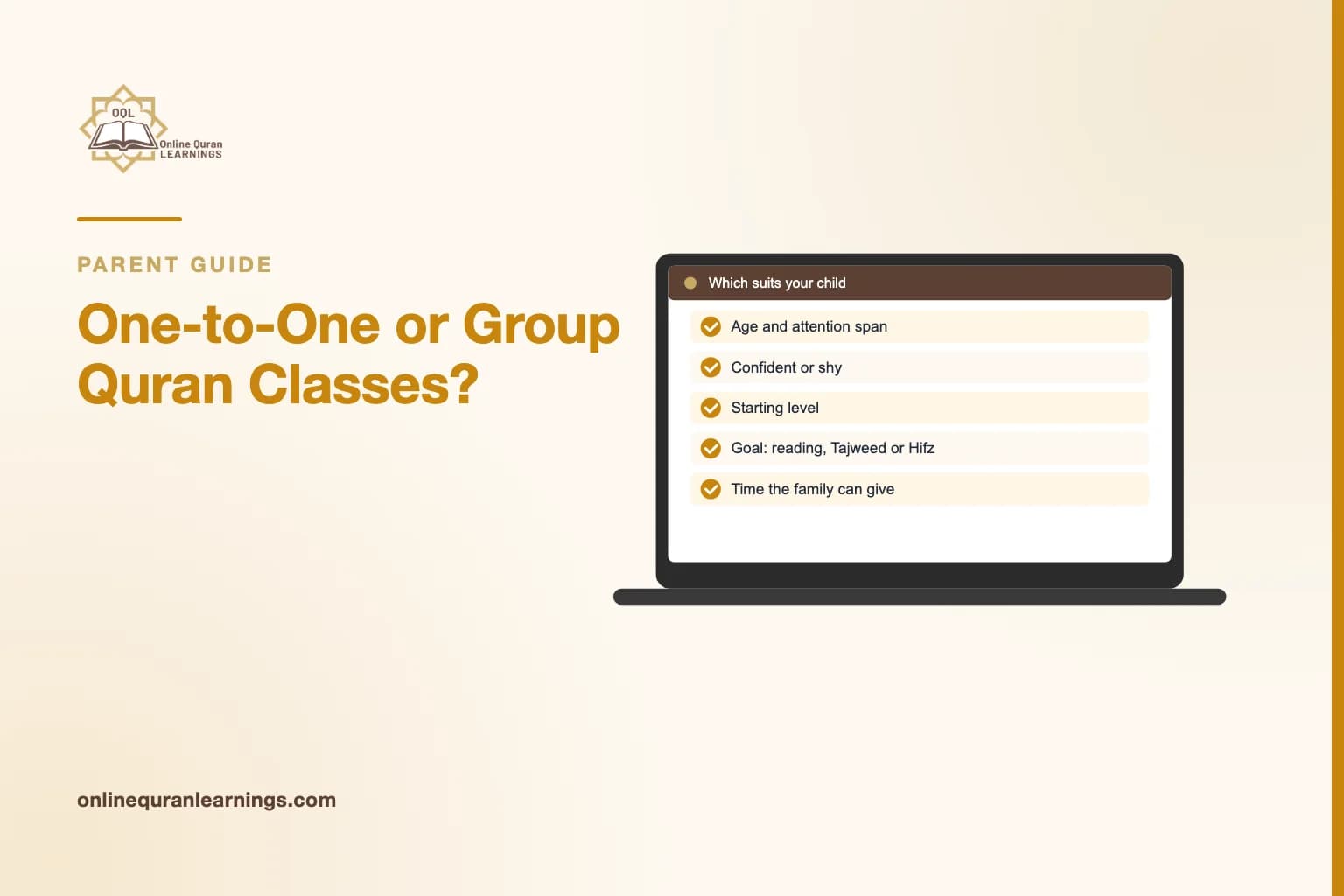
Most parents who ask this already know the general arguments. One-to-one gives more attention; a group gives company and usually costs less. What they actually want to know is which one suits their child: the seven-year-old who reads beautifully at the kitchen table and goes silent in front of others, or the ten-year-old who only works when there is somebody to race.
So this guide starts from the child, not the format. Find the row closest to yours, then use the self-check further down to test your instinct.
| If your child is... | Usually leans | Why |
|---|---|---|
| 4 to 6 and starting the Qaida | One-to-one | Letter sounds need correcting the moment they slip |
| Shy or easily embarrassed | One-to-one | They read more when nobody else is listening |
| Confident, social, a steady reader | Either can work | Company keeps them turning up |
| Starting or doing Hifz | One-to-one | Daily recitation to a teacher is the work |
| Well ahead of, or behind, their age group | One-to-one | A group moves at one pace |
| Easily distracted | One-to-one, short lessons | There is nobody to hide behind |
| Lacking Muslim friends | Group for belonging, plus one-to-one for progress | Both needs are real |
A word on where we stand, so you can weigh what follows: Online Quran Learnings teaches one-to-one only. We do not run group classes, which gives us an obvious interest. For the side-by-side comparison of the formats themselves (time per child, pace, cost), see our page on one-to-one vs group Quran classes. This article is about matching a format to a particular child.
Reading your child by age
Ages 4 to 6
At this age nearly everything is pronunciation and attention span. A child learning to tell ث from س needs to hear the difference, try it, and be corrected straight away, many times in one lesson. In a group, most of that time is spent listening to other children, and a mistake repeated quietly for weeks becomes a habit.
Young children also tire fast. A 30-minute lesson that switches activity every few minutes tends to hold a five-year-old better than a longer session spent waiting for a turn.
Ages 7 to 11
This is where the choice genuinely opens up. A child who reads the Qaida fluently and has moved into the Quran can do well in a good small group, particularly if their friends are there. The question is whether the group's pace matches theirs.
If you are considering a group, ask three things: how many children, roughly how long each child reads aloud per session, and how mistakes are corrected. Vague answers to the second question tell you a lot.
Ages 12 and up
Teenagers care what their peers think. Some love a youth circle; others would rather never read aloud in front of anyone again. Many teens accept Tajweed correction more easily in private, while discussion of meaning and Islamic studies often works well in a group.
Temperament usually decides it
Two children of the same age can need opposite things. Most families recognise one of these.
The quiet one. Reads well to you, mumbles in class. In a group they get passed over because they never volunteer. One-to-one is often where they find their voice. Our page on Quran classes for shy kids goes into this in more depth.
The competitor. Works harder with someone to beat. A group can motivate them, though a one-to-one teacher can use targets, streaks and personal bests to the same effect.
The drifter. Wanders off mentally the moment attention moves elsewhere. In a group, attention is elsewhere most of the time. One-to-one, with a teacher who keeps them reading and answering, usually suits better.
The perfectionist. Hates being corrected in front of others. Group correction can turn into tears, or into a child who stops trying so they cannot be wrong.
The child who is the only Muslim in their class. Here the community of a mosque group may be the most valuable thing about it, even if reading progress is slower. Do not dismiss that.
Level and goals change the answer
- Complete beginner: one-to-one, because habits set in the first months are hard to unpick later. Our page on one-to-one Quran classes for kids shows what a lesson looks like.
- Fluent reader working on Tajweed: one-to-one for correction; listening to others recite in a group can be a useful extra.
- Hifz: one-to-one is close to essential. New lines and revision are checked every lesson, and a group teacher cannot hear each child's new portion and revision in depth every day. Read is my child ready for Hifz before you commit.
- Keeping reading ticking over: a group or the mosque works well for a child who reads fluently and just needs regular contact.
- Understanding and Islamic studies: group discussion is genuinely good at this.
Where siblings fit in
Siblings close in age can look like a ready-made small group. In practice two children rarely sit at exactly the same level for long, and the faster one ends up waiting while the slower one ends up embarrassed. Separate lessons, booked back to back, usually serve both better. Our guide to Quran classes for siblings has timetables for two to four children.
A ten-question self-check
Answer yes or no. The more yes answers, the more your child is likely to benefit from one-to-one.
- Is my child a complete beginner or still working through the Qaida?
- Do they go quiet or freeze when other children are listening?
- Are they clearly ahead of, or behind, other children their age?
- Are we aiming for Hifz or serious Tajweed?
- Do they lose focus as soon as attention is not on them?
- Have they been on the same page or surah for months in a group already?
- Do we need lesson times that fit around a busy or changing week?
- Do they get upset when corrected in front of others?
- Do I want to know exactly what was covered, lesson by lesson?
- Does my child already have Muslim friends through school, family or the mosque?
Question 10 carries extra weight. If the honest answer is no, give the community side real thought, whatever the other nine say. That is usually a sign to look at a hybrid rather than a straight choice.
Hybrid plans: group for belonging, one-to-one for progress
Plenty of families never choose. They keep the weekend mosque class or youth circle for friendship, adab and a sense of belonging, and add one-to-one lessons in the week for reading progress. If you are weighing a whole weekend Islamic school against weekday lessons, our guide to weekend Islamic school or online classes compares the two models month by month.
A pattern that works for many families:
- Weekend: the mosque class or madrasa as usual.
- Two weekday evenings: a 30-minute one-to-one lesson, at a fixed time.
- Other days: five minutes of reading aloud to a parent.
Tell both teachers what the other is doing, so the child is not learning from two different Qaida books at two different speeds. And watch the total. If a child now has four Quran sessions plus school homework and sport, something should give. Our guide to how many Quran classes a week helps you judge the load, and our comparison of online and mosque classes covers combining the two in more detail.
How to tell the format is not working
Signs a group is not working: the same page for a whole term, a child who cannot tell you what they read today, or one who only ever reads in chorus with others.
Signs one-to-one is not working: a child who dreads the lesson, sessions that feel like an interrogation, or a child who misses having friends around. These are often fixable without abandoning the format: a teacher with a lighter style, a shorter or differently timed lesson, or a change of teacher. If you are weighing that last option, our guide to choosing a male or female teacher for your child covers how age and stage affect the decision.
Give any format six to eight weeks before judging, unless your child is clearly distressed. The first fortnight of anything new is rarely representative.
Frequently asked questions
Can a one-to-one teacher keep a lively child engaged for a full 30 minutes?
Usually, yes. A good teacher changes activity every few minutes, moving from revision to new letters to a short surah, and uses small targets so the child always has something to aim for.
My child wants to stay in the mosque group with friends. Should I insist on one-to-one instead?
You rarely have to choose. Keeping the group for friendship and adding one or two short one-to-one lessons in the week often gives you the progress without taking away something your child values.
Is one-to-one worth it if my child only needs to keep up reading they already know?
Not always. A fluent reader who simply needs regular practice can do well in a good group or with a lighter one-to-one schedule of one or two lessons a week.
Can we try one-to-one before leaving a group class?
Yes. Online Quran Learnings offers up to 3 free trial classes with no credit card and no obligation, so your child can try it while still attending their current class. The time is confirmed with you on WhatsApp.