
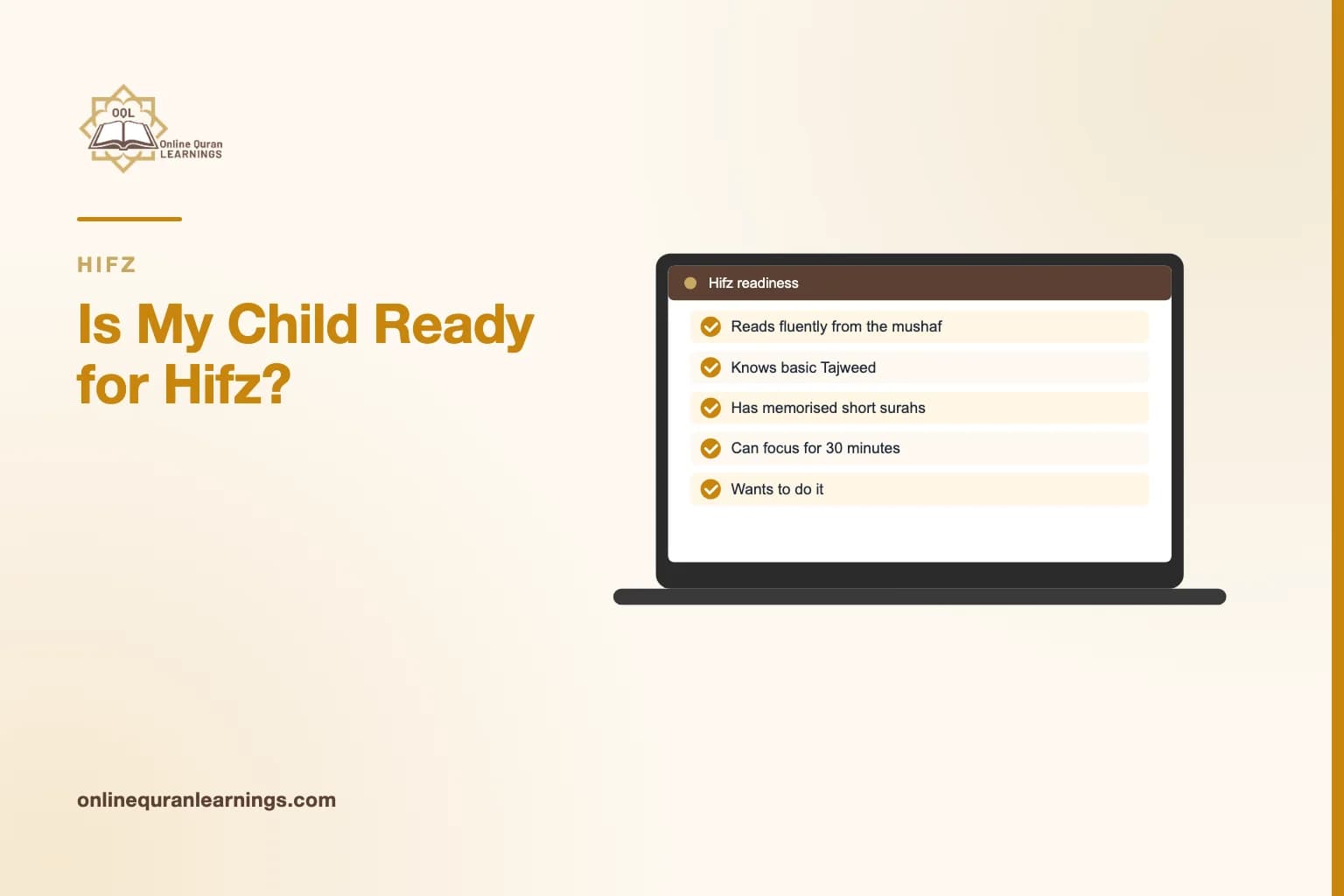
A child is usually ready for Hifz when they can read the Quran from the page slowly but correctly, already know a few short surahs, can stay with a 30-minute lesson, and want to do it themselves. The family also needs ten to twenty minutes a day for home revision, held for years rather than weeks.
Age matters less than those five things. A focused seven-year-old who reads well is more ready than a distracted eleven-year-old who is still guessing at vowels.
A quick readiness checklist
Go through this honestly. Most children will tick some and not others, and that is useful information rather than a verdict.
- They can read a line of the mushaf without spelling out each letter.
- Short vowels, long vowels and sukoon are mostly right without prompting.
- They already know Al-Fatihah and two or three short surahs by heart.
- They can sit through a 30-minute lesson, with you nearby if needed.
- They can repeat a phrase they have just heard, clearly and without rushing.
- They have asked about memorising, or reacted well when you suggested it.
- You can name a fixed daily slot for ten to twenty minutes of revision.
- Someone at home can listen to them recite, even without knowing Tajweed.
Six or more ticks: start, beginning with Juz Amma. Four or five: start gently, or spend a few more months on reading first. Fewer than four: build the foundation now and revisit in a term.
Reading comes first, and here is why
A child who memorises before they read accurately memorises their mistakes. A wrong vowel recited fifty times becomes part of the surah, and unpicking it later takes far longer than learning it correctly would have.
Reading also gives the child a backup. When memory wobbles mid-verse, a reader can glance at the page and self-correct. A child who cannot read has to wait for an adult.
This does not mean full Tajweed mastery. It means reading the Arabic slowly but correctly, with the basic rules a teacher has already corrected a few times. If your child is still in Noorani Qaida, finishing it and spending a few months reading with Tajweed is not a delay. It is the shortest route into Hifz.
The exception is very young children, who can memorise short surahs by listening and repeating without reading at all. That is a valid route for a four- to six-year-old in the shortest surahs, and it can run alongside Qaida. It is not a substitute for reading once the surahs get longer.
Attention: what to watch for
Hifz is repetitive by nature. The question is not whether your child finds repetition fun, but whether they can tolerate it for a few minutes at a time.
A simple test at home: read them one short ayah, ask them to repeat it, and do that five times. Then ask for it once more without help. A child who manages that calmly, even with mistakes, has the attention the work needs. A child who is off the chair by the third repetition probably needs a few more months, or much smaller portions.
Also look at the time of day. A child who seems unready at 7pm after school may be perfectly capable at 8am on a Saturday. Our article on what age to start Quran classes covers attention by age in more detail.
Whose idea is it?
This is the sign parents most often skip, and the one that matters most over years.
A child doing Hifz because the parent wants it can make good progress for a while, especially if young and eager to please. The test comes at ten or twelve, when the work gets harder and the child starts to have opinions. Children who feel some ownership tend to keep going through that stage. Children who were simply enrolled are more likely to stall.
Some ways to find out what your child actually thinks, without leading them:
- "Would you like to learn a surah by heart, so you can read it in Salah without the book?"
- "What do you think it would be like to memorise a whole juz?"
- "If we tried it for a couple of months and you did not like it, what would you want to do instead?"
The answers do not need to be enthusiastic. A child who says "okay, I'll try" is ready. A child who goes quiet or anxious is telling you something worth hearing.
The family's side of readiness
Hifz is a family commitment more than most parents expect. Over time, revision becomes the bigger part of each day, and much of it happens at home.
Before starting, check three things:
- A daily slot. Ten to twenty minutes, at the same time, on most days. Attached to something that already happens, like after Fajr or after dinner, rather than "when we have time".
- A listener. Someone who follows along in the mushaf and notices a skipped word. You do not need to read Arabic fluently for this, only to track the lines.
- A realistic horizon. Full Hifz alongside school usually takes several years. Our guide to how long it takes to memorise the Quran sets out honest ranges by situation.
If any of these is missing, the answer may still be yes, but for Juz Amma rather than full Hifz. That is a worthwhile goal in its own right.
When to wait a little
None of these mean never. They mean not quite yet.
- Reading is still slow and inaccurate, with frequent guessing.
- Your child already finds Quran class stressful or upsetting.
- The family is in a period with no daily slot at all, such as a house move or a new baby.
- Your child is being asked to memorise at the same time as heavy catch-up in reading.
In each case, a few months spent on the underlying issue usually leads to a faster and happier start later.
A low-risk way to test: start with Juz Amma
You do not have to decide on full Hifz up front. Most children begin with the short surahs at the end of the mushaf anyway, and that stage works as a natural trial.
Give it eight to twelve weeks at three classes a week, with daily home revision. By then you will know far more than any checklist can tell you:
- Does your child recite last lesson's portion cleanly most of the time?
- Are the earlier surahs still there when you ask for them?
- Is home revision happening without a fight most days?
- Is your child still willing, or even proud of what they know?
If the answer is mostly yes, moving into full Hifz is a straightforward step. If not, you have lost nothing. Your child has a set of surahs for Salah and you have a clear picture of what to work on. Our Juz Amma memorisation for kids page explains how lessons at this stage are structured, and the weekly Hifz plan shows how three, four or five classes a week can be laid out.
What the first few lessons usually show
A teacher can tell a lot quickly. In the first lesson or two, they will usually hear your child read a line or two, ask for whatever they know by heart, and try a short new phrase to see how it is repeated.
From that, they can suggest a starting surah, a portion size and a sensible number of classes. A free Hifz trial is the simplest way to get that assessment for your own child. Lessons are one-to-one and recorded, and you can choose a male or female teacher. If you are curious about the mechanics behind what the teacher is listening for, our article on how children memorise the Quran explains it.
Readiness is rarely a clean yes or no. It is usually "yes, at this pace, starting here", and a good first few weeks will tell you what that pace is.
Frequently asked questions
My child wants to do Hifz because a cousin is doing it. Is that enough?
It is a fine reason to begin, and many children start that way. Watch whether the interest survives the first two or three months, when the novelty wears off and revision becomes the main work.
Can a child with dyslexia or attention difficulties do Hifz?
Many can, often with smaller portions, more listening and shorter home sessions. Tell the teacher at the start so the pace and method are set for your child rather than adjusted after a frustrating month.
Is it better to wait until after a big school year to start?
If the year will leave no daily time at all, yes. Otherwise a gentle start in Juz Amma with small portions often fits even a busy year, and the habit is easier to build before the pressure peaks.
What does the teacher look at in a Hifz trial?
Usually how the child reads a line from the mushaf, how accurately they repeat a short phrase, what they already know by heart and how they cope across a full lesson. That gives a realistic starting point and portion size.