
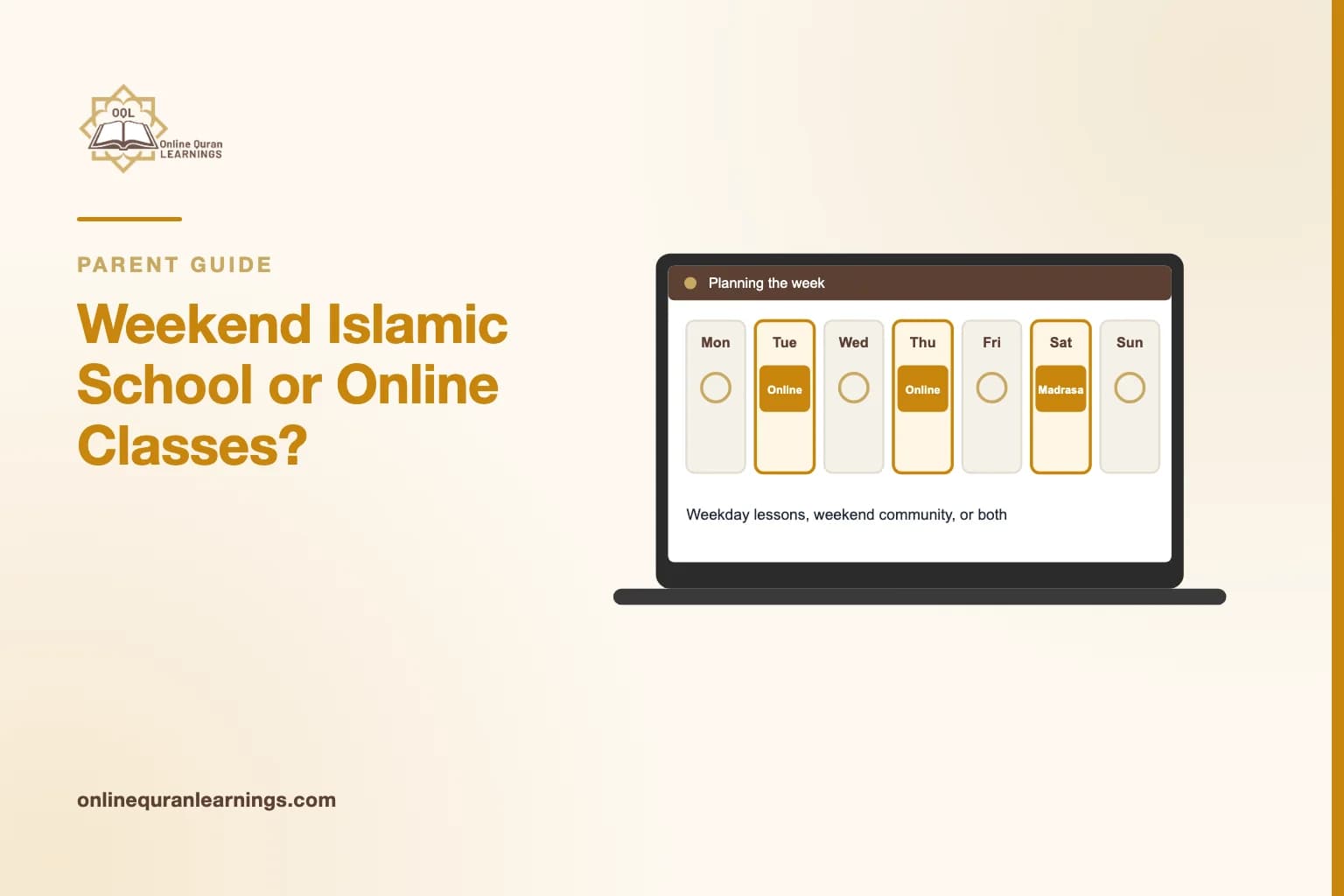
Short answer: weekend Islamic school is better at community, and weekday online classes are better at steady progress. Most children get the most from one of the two as the base, with a light version of the other alongside it, rather than from either alone.
Which should be the base depends on what your child is missing. A child who reads well but has no Muslim friends needs the weekend school more. A child who has been on the same Qaida page since spring, despite never missing a Sunday, needs the weekday lessons more.
This guide compares the two on the things parents actually juggle: learning time, consistency, community, cost structure and travel. If you are only weighing Quran lessons at the mosque against Quran lessons online, our page comparing online Quran classes and mosque classes covers that narrower question. Here we are looking at the whole weekend school model, Quran plus Islamic studies, against a weekday online plan.
How much learning happens in a month
This is where the two differ most, and it is easy to misjudge, because a weekend school morning feels long.
A typical weekend school runs for a few hours on Saturday or Sunday. That time is usually split between Quran, Islamic studies, sometimes Arabic, plus registration, breaks and assemblies. Within the Quran slot, a teacher with a class of children divides their listening time between all of them.
A weekday online plan is shorter on the clock but almost entirely spent on your child.
| Per month (illustrative) | Weekend Islamic school | Online, 3 lessons a week |
|---|---|---|
| Sessions | 3 to 4 (fewer in holiday months) | About 12 |
| Total time at class | 8 to 12 hours | About 6 hours |
| Time your child reads aloud to a teacher | Varies widely; often a small share | Most of each 30-minute lesson |
| Longest gap between sessions | 6 to 7 days | 2 to 3 days |
The numbers in the first column vary a great deal between schools, so treat them as a prompt to ask your own school, not a verdict on it. The useful question is: in a typical session, how many minutes does my child spend reading aloud to a teacher who is correcting them?
The last row matters as much as the totals. Children forget a surprising amount in a week, and a weekly session often spends its first part recovering the previous one. Shorter gaps mean less is lost.
Consistency through the year
Weekend schools tend to follow the school calendar. They close for half-terms, the long summer break and sometimes Eid, and a missed Sunday through illness, a birthday party or a football match means a fortnight between lessons.
Weekday online lessons can carry on through most of that. Because lessons can be scheduled at any hour, seven days a week, families often move them around a holiday rather than stop. If your child's main subject is memorisation, that continuity matters more still.
The flip side: weekend school has a built-in rhythm the whole family expects. Weekday lessons only stay consistent if you protect the slot. Our guide to fitting Quran classes around school covers choosing a time that survives a busy term.
What weekend school gives that a screen cannot
Be honest with yourself about this side, because it is real.
- Friends who share the faith. For children in mostly non-Muslim schools, this can be the main thing.
- Adab in a shared space. Praying together, sitting properly, greeting elders, behaving in the masjid.
- Belonging to a local community. Knowing the imam, the aunties, the older children who were once in their seat.
- Events and milestones. Eid plays, Quran competitions, Ramadan iftars.
An online teacher can teach Salah, manners and Islamic studies for children well, but they cannot give your child a friend to sit with at Jumu'ah.
Cost structure, not just cost
The two are usually paid for differently, which makes them hard to compare at a glance.
| Weekend Islamic school | Weekday online classes | |
|---|---|---|
| How it is charged | Termly or annual fee, sometimes a donation model | Monthly plan per child |
| Hidden costs | Fuel, parking, a parent's whole morning, uniform or books | A device, a quiet corner, decent internet |
| Per-child effect | Often one fee covers the full morning | Each child has their own lessons |
Weekend school is often the cheaper option on paper, and for some families that settles it. If you want to sense-check what online lessons should cost, our guide to what online Quran classes should cost walks through what is reasonable and what is a warning sign.
Travel and the family weekend
The hidden cost of weekend school is often the weekend itself. A round trip, a wait in the car park, a younger sibling dragged along, and the morning is gone for one parent at least.
Online lessons remove the travel, which matters most for families who live far from a good school, have children at different schools, or have one parent working weekends. They also remove the walk into a building full of friends, which for some children is the best part of the week. Neither is automatically better.
Five family situations
The child who loves weekend school but is not progressing. Keep the weekend school. Add two short weekday online lessons focused on reading, and tell the weekend teacher.
The child who dreads weekend school. Find out why first. If it is the social side, switching fully to online may help. If it is the Quran itself, the problem may follow them.
The family with no good school nearby. A weekday online plan can cover Quran and Islamic studies. Look for community elsewhere: Jumu'ah, family gatherings, a local youth group.
The family with weekend commitments. Sport, a parent's shifts, regular family visits. Weekday lessons free the weekend without losing the learning.
The child preparing for Hifz. Weekend school alone will not be enough for memorisation, which needs recitation most days. One-to-one lessons in the week become the main plan.
How to combine the two without overload
If you do both, decide which is the base and keep the other light.
- Pick the base. If progress is the problem, weekday lessons are the base; if belonging is, weekend school is.
- Keep weekday lessons short and fixed, for example two or three 30-minute slots on the same days each week.
- Avoid stacking. A weekday lesson on Sunday evening after a full morning of weekend school is usually one too many.
- Share notes. Tell the online teacher which Qaida or Quran edition the weekend school uses.
- Review after a month. If your child is tired or resentful, trim a session rather than drop both.
If you would rather keep everything at the weekend, weekend one-to-one is possible too: our page on weekend online Quran classes covers Saturday and Sunday slots. For a fuller weekday programme that covers Quran and Islamic subjects together, see our online Islamic school.
Frequently asked questions
Will my child fall behind if we leave weekend Islamic school mid-year?
Not if something regular replaces it straight away. The risk is the gap, not the switch, so book the new lessons before the last Sunday rather than after it.
Can online classes cover the Islamic studies part of weekend school, not just Quran?
Yes. Islamic Studies is taught as its own one-to-one subject, covering topics such as Salah, Seerah, manners and basic beliefs at a level suited to the child.
What if the weekend school and the online teacher teach a letter or rule differently?
Small differences in method are normal. Tell the online teacher which book the weekend school uses, and if a genuine conflict comes up, ask both teachers to agree one approach for your child.
Is it too much for a seven-year-old to do both?
Not usually, if the weekday lessons are short and fixed, and the weekend school is not also setting heavy homework. Watch for tiredness and resistance in the first month and trim one session if needed.