
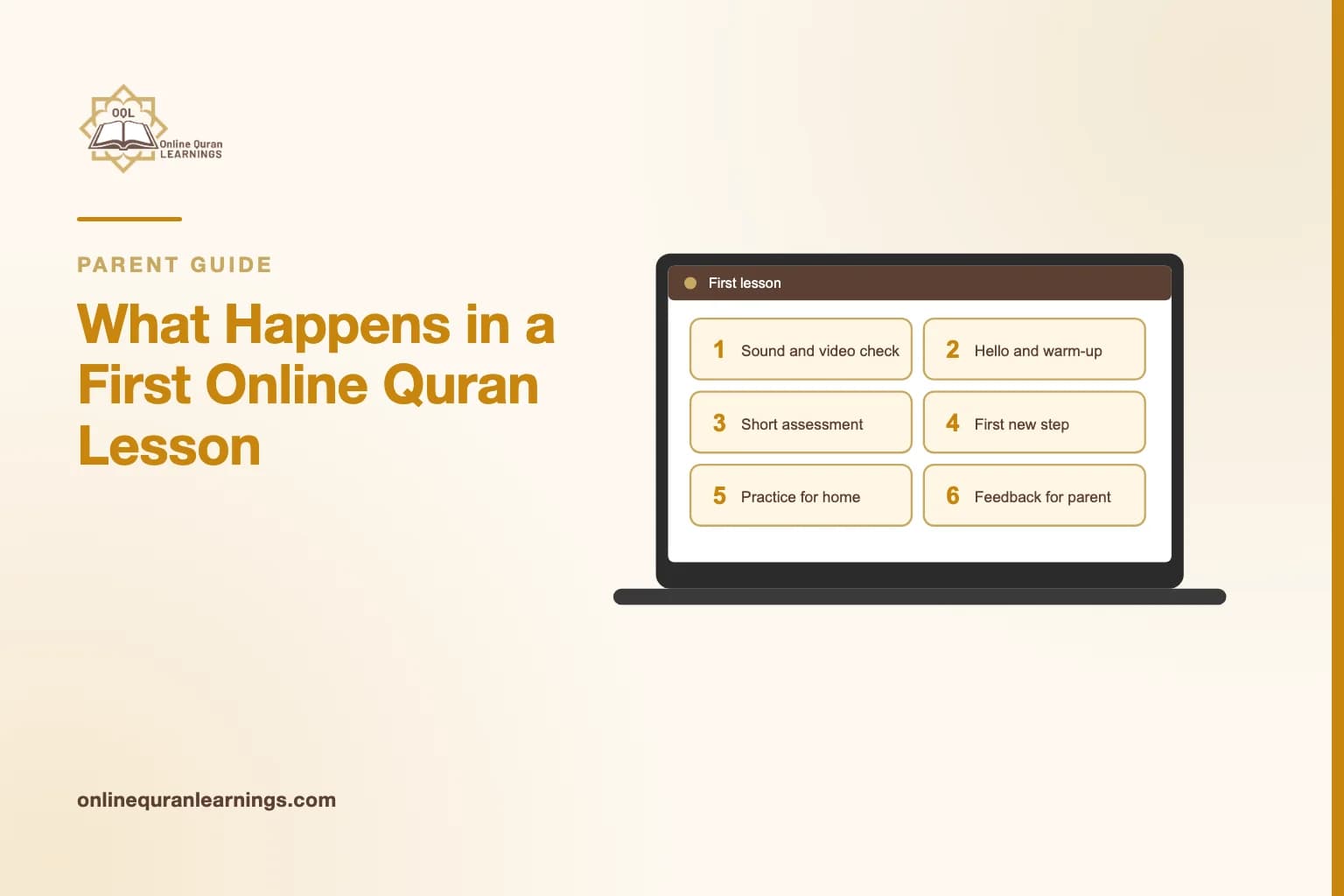
A first online Quran lesson is mostly listening. The teacher spends the first part of the 30 minutes finding out what your child already knows, then teaches one small, achievable thing, so your child ends the class having succeeded at something.
It is not a test and there is nothing to prepare academically. What does need preparing is the room, the device and the ten minutes before the class starts.
Below is how the half hour usually runs, what you are for, and what to do afterwards. If you want the list of questions to put to the teacher at the end, that is a separate guide: what to ask in a free trial class.
The half hour at a glance
| Minutes | What happens | What you do |
|---|---|---|
| Before | Device charged, link open, quiet spot | Sit your child down five minutes early |
| 0 to 3 | Hello, sound and camera check | Help only if the tech fails |
| 3 to 10 | Gentle assessment | Stay quiet, listen |
| 10 to 22 | First new material | Stay out of the eyeline |
| 22 to 27 | Repeat and recap | Notice what your child can now do |
| 27 to 30 | Practice set, next time confirmed | Come in for the last minute |
Every teacher varies this, and a four-year-old's class will look different from a ten-year-old's. The shape is broadly the same.
The ten minutes before
Most first lessons that go badly go badly before they start. A child pulled from a game at 5:59 and plonked in front of a laptop arrives flustered, and the teacher spends the first five minutes calming them down.
A short routine helps:
- Charge the device and open the link early. Test the microphone. A laptop or tablet is better than a phone, because the page needs to be big enough to read.
- Use a table, not a sofa. Upright and still beats comfortable and sliding.
- Kill the background. Television off, younger siblings elsewhere, notifications muted.
- Wudu and a scarf or cap, if that is your family's habit. It also works as a signal that this half hour is different.
- A glass of water and the toilet beforehand. You would be surprised how many lessons pause for both.
Then tell your child, plainly, what is about to happen: "You're going to meet your Quran teacher. She'll ask you to read a little, and then teach you something new."
Minutes 0 to 3: hello and the tech check
The teacher greets your child, often by asking their name, age, or something about school. This is partly warmth and partly a check that sound and video work both ways.
Expect a short pause while the teacher shares their screen with the Qaida page or the Mushaf. If your child cannot see the page clearly, say so now. This is the one moment you should speak up.
Minutes 3 to 10: finding the starting point
This is the assessment, and for a child it should not feel like one. The teacher will ask your child to say or read something, starting easy and getting a little harder until they reach the edge of what your child knows.
What that looks like depends on where your child is:
- Complete beginner. The teacher points to a few letters and asks if any look familiar. Often a child recognises Alif or Ba from home or the mosque.
- Knows some letters. The teacher moves through the alphabet and notices which letters are solid, which are shaky, and which are being confused with each other.
- Reads already. The teacher asks for a short surah from memory and a few lines from the Mushaf, listening for fluency, letter sounds and how the child handles long vowels and stops.
A careful teacher will usually correct one small thing during this stage, partly to see how your child takes correction. You will hear it: the teacher says the sound, your child tries again, the teacher says "good" or tries once more.
If your child freezes, that is normal. A good teacher drops back to something easy rather than pressing on.
Minutes 10 to 22: the first new thing
Now the teacher teaches. For a beginner this is usually the first few letters of the Noorani Qaida, introduced by name and sound, with the child repeating, pointing and finding them on the page. Our guide to the first Noorani Qaida lesson covers that page in detail.
For a child who already reads, it is more often a specific correction to work on, or the next few verses at the right level.
The point of this stretch is not quantity. Three letters learned properly beat a whole row half-learned. Expect plenty of repetition, and expect the teacher to change activity every few minutes for a young child: say it, point to it, find it, say it again.
This is where parents most often interfere. Resist. If your child gets a letter wrong, the teacher will catch it. A parent's voice from across the room makes the child look at the parent instead of the page.
Minutes 22 to 27: recap
The teacher goes back over what was covered, ideally letting your child do most of it. A child who can say three new letters alone at minute 25 has had a good first lesson. Notice which ones they get right without help, because that is what you will practise this week.
Minutes 27 to 30: practice and next time
This is the moment to come back in. The teacher will usually tell you, and your child, what to practise and when the next class is.
Write the practice down. It will be small: point to these letters and say them, five minutes a day. Confirm the next class in your local time, especially if you are in a different time zone from the teacher.
Where you should be during the lesson
Within earshot, out of sight. Close enough to hear the teacher and know what is happening. Far enough that your child is talking to the teacher, not checking your face after every sound.
For a four- or five-year-old, sitting slightly behind them for the first lesson is fine. By the third or fourth class, step back.
At Online Quran Learnings, every class is one-to-one, monitored and recorded, so you do not have to sit through every lesson to know what happened in it. Being nearby for the first one is still worth it. When you are ready, registering your child takes a few minutes and we arrange the first class from there.
After the lesson
Most of what the first lesson achieves depends on the next six days.
- Ask your child to show you one thing. Not "how was it?", which gets "fine". Ask "show me a letter you learned".
- Do the practice the same day if you can. Five minutes, before bed or after Maghrib. The first practice session sets the habit.
- Listen for what your child says about the teacher. "She was funny" or "he said I did well" are good signs. Silence about the teacher entirely is worth a gentle question.
- Keep the slot. Holding the same day and time each week is what turns one good lesson into progress. If you are unsure how many to book, our guide on how many Quran classes a week a child needs gives a sensible default.
What a rough first lesson does and does not mean
Plenty of first lessons are messy. A five-year-old who wanders off camera at minute twelve, or a nine-year-old who mumbles because they are embarrassed about their reading, has not failed and is not unready.
What matters is the trend over two or three classes. If your child is more settled in the third lesson than the first, the match is working. If the third looks exactly like the first, it is worth a conversation, and possibly a different teacher. If attention is the recurring issue, our guide to keeping children focused in an online Quran class has practical fixes.
Frequently asked questions
Does my child need a headset for online Quran classes?
It helps, especially in a busy house. A simple wired headset with a microphone makes your child easier to hear, and the teacher cannot correct a sound they cannot hear clearly.
Is it a bad sign if my child only focuses for ten minutes?
Not in the first lesson, and not for a four or five year old. Focus grows with familiarity. A good teacher changes activity before attention runs out rather than pushing through.
Should a sibling sit in on the first lesson?
It is better if they do not. A brother or sister nearby turns the lesson into a performance or a competition. Let each child have their own first class.
What happens if the internet drops during the lesson?
Rejoin the same link and carry on. Teachers expect the occasional drop. If it happens every lesson, move closer to the router or switch the device before blaming the class.