
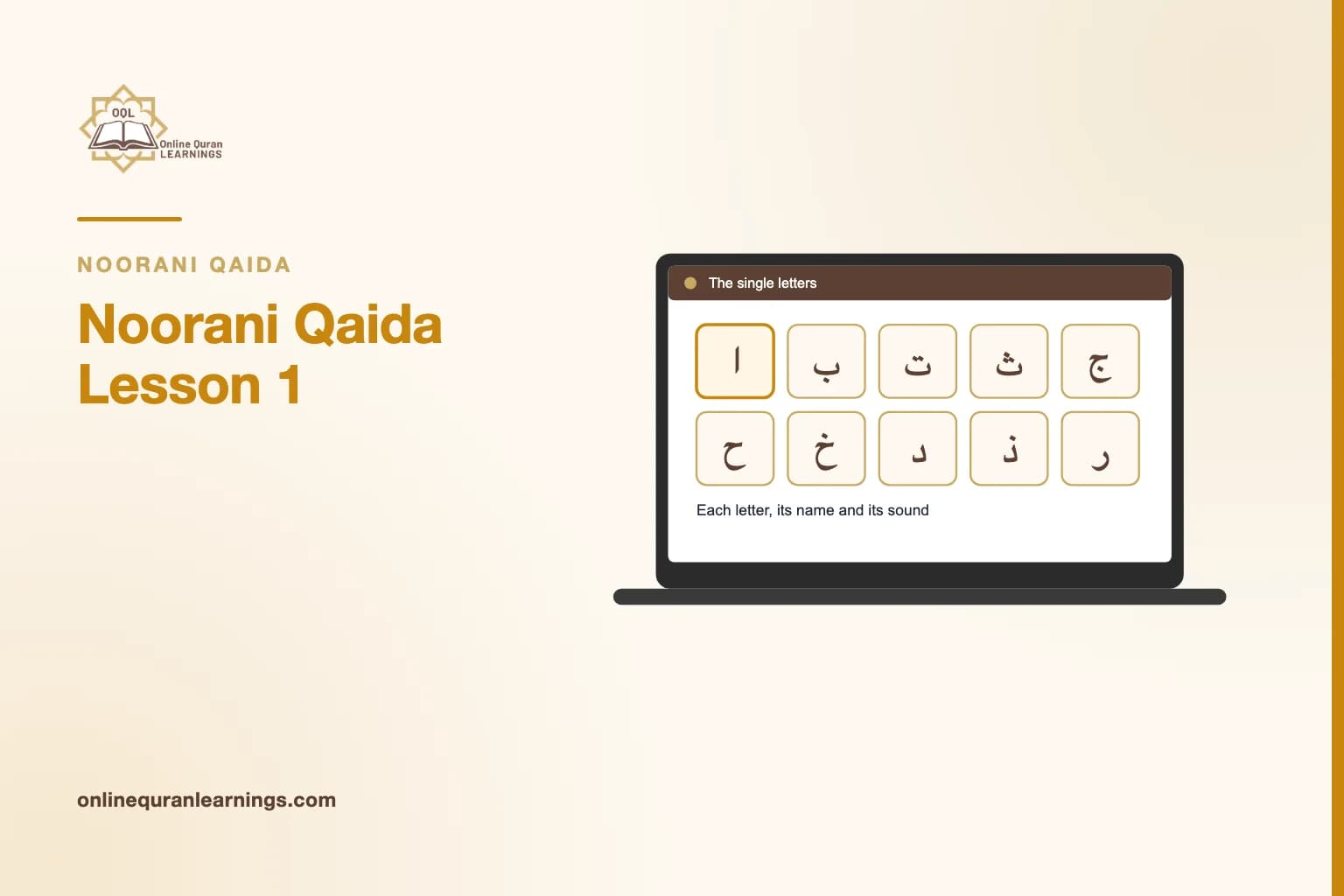
Lesson 1 of Noorani Qaida is the page of single letters, called huroof mufradat: every letter of the Arabic alphabet, from alif to ya, standing alone with no vowel marks. Its job is to teach your child what each letter looks like and, more importantly, exactly where in the mouth or throat its sound is made.
It looks like the easiest page in the book. It is actually the one that decides how well your child will read the Quran years from now, because every later page assumes these sounds are already right.
What the first page shows
The page shows the letters in alphabetical order, usually in rows read from right to left. In most printings you will count 29 boxes, and that number causes some confusion.
Arabic is usually described as having 28 letters. The Qaida often shows 29 because it gives the hamza (ء) its own box alongside alif (ا), to teach that alif on its own carries no sound and hamza is the actual catch in the throat. Some printings also show the joined form لا at the end. Whether your copy says 28 or 29, the letters to learn are the same.
Here they are in order:
ا ب ت ث ج ح خ د ذ ر ز س ش ص ض ط ظ ع غ ف ق ك ل م ن و ه ء ي
On the page each one is just a shape. Your child is not reading words yet, and there are no fatha, kasra or damma marks. That comes a few lessons later.
Where the sounds come from, in child-sized terms
Tajweed scholars describe precise articulation points, called makharij. A young child does not need the technical names. They need five places they can feel, and teachers often describe them like this:
| Place | Letters made there | How a teacher might say it |
|---|---|---|
| The throat | ء ه ع ح غ خ | Deep down, middle, and near the top of your throat |
| The tongue | most letters, including ق ك ج ش ت د ط ل ن ر س ص ز | Different parts of your tongue touching different spots |
| The lips | ب م و ف | Your lips do the work, or your top teeth on your bottom lip for ف |
| The nose | the humming in ن and م | Hold your nose and the hum stops |
| The open mouth | the long vowels | Air flowing out with nothing blocking it |
The nose and open mouth matter more in later lessons. In lesson 1 most of the effort goes on the throat, the back of the tongue, and the difference between light and heavy letters.
The seven heavy letters
Seven letters are always said with a full, rounded mouth and the back of the tongue raised: خ ص ض غ ط ق ظ. Many teachers tell children to make a "big" or "deep" voice for these. Their light cousins are said with a flat, relaxed mouth. Getting this contrast early is one of the main goals of lesson 1.
The pairs English-speaking children mix up
This is where most of the lesson time goes for a child who thinks in English. Each pair below sounds nearly identical to an untrained ear, and swapping them in the Quran can change a word's meaning.
| Pair | The difference | A cue that often helps |
|---|---|---|
| ح and ه | ح is a tight, breathy h from the middle of the throat; ه is a soft h like in hat | For ح, a hand on the throat feels it squeeze, like fogging a mirror hard |
| ع and ا / ء | ع is a squeeze in the middle of the throat; alif is a plain vowel and hamza a short catch | ع should feel like the throat tightening, not just a vowel |
| ق and ك | ق comes from the very back of the tongue, deep and round; ك is an English k | Say ك, then move it as far back as it goes and make the mouth round |
| ص and س | ص is a heavy s with the mouth full; س is a light English s | Same tongue tip, but the back of the tongue lifts for ص |
| ط and ت | ط is a heavy t, full mouth; ت is a light English t | ط should sound darker and hollow |
| ض and د | ض is heavy and made with the side of the tongue; د is an English d | Teachers usually model this one many times |
| ذ, ز and ظ | ذ is th as in this; ز is z; ظ is a heavy th as in this | ذ and ظ need the tongue tip visible between the teeth |
| ث and س | ث is th as in think; س is s | Again, tongue tip out for ث |
| خ and غ | خ is a rough sound like the ch in loch; غ is the voiced version, close to a gargle | Both come from the top of the throat; غ has the voice switched on |
Children from Urdu-speaking homes often say ذ, ز, ض and ظ the same way, and may drop ع, because that is how the words sound in everyday Urdu. Arabic-speaking families may have dialect habits, such as a softened ق. None of this is a problem to worry about. It just tells the teacher where to listen first.
For a wider look at teaching children whose first language is English, see Quran classes for English-speaking kids.
Inside a typical lesson 1 class
In a thirty-minute one-to-one lesson with a young child, a typical sequence is:
- Revise first. Any letters from the last lesson are read again before anything new appears.
- Model the new letter. The teacher says it slowly, two or three times, often with the mouth close to the camera so the child can see the lips and tongue.
- Child repeats. Every sound is said aloud by the child, not just pointed at.
- One correction at a time. If the sound is off, the teacher fixes one thing ("further back", "rounder mouth") rather than three.
- Mix the order. Once a row is done, the teacher points to letters at random, because reading in order hides guessing.
- Pair practice. Close pairs like ح and ه are read side by side until the child can hear the difference themselves.
- End on a win. The last letter of the lesson is one the child knows well.
A four- or five-year-old might learn two to four new letters in a lesson. An eight-year-old may cover a row or two. If you want to know what the very first session feels like for the child, what happens in a first online Quran lesson walks through it.
Practising lesson 1 at home
You do not need to read Arabic to help with this page. What you are doing is giving your child a reason to say the sounds out loud between lessons.
- Five minutes, most days. Ask your child to read the letters they have covered so far.
- Point at random. Use a pencil or finger and jump around the page. If they can only do it in order, they are reciting, not reading.
- Let them teach you. Ask, "Which one is the deep one?" or "Show me the throat letter." Explaining it is a strong test.
- Do not correct sounds you are unsure of. Note it and mention it to the teacher instead. A confident wrong correction is hard to undo.
- Listen to the recording. Our lessons are recorded, so you can hear exactly how the teacher said a letter and play it back.
There are more home ideas, including short games, in our guide to teaching Noorani Qaida to young children.
How to tell lesson 1 is secure before lesson 2
Moving on too early is the most common reason children struggle later in the Qaida. Before the teacher turns the page, these should all be true:
- Your child can name and say every letter when you point at random.
- They can tell you which of two close letters you are pointing at, such as ص or س.
- The seven heavy letters sound heavy without being reminded.
- ع and ح are produced from the throat, not replaced by a vowel or a plain h.
- They can do the whole page in one sitting without tiring or guessing.
- They still know it after a weekend off.
A few slips are fine; perfection is not the bar. Steady, repeatable accuracy is. How long that takes varies a great deal, and our guide on how long Noorani Qaida takes gives realistic ranges by age.
Lesson 2 introduces joined letters, where shapes change depending on position. A child with secure single letters finds it a puzzle. A child without them finds it a wall.
The sounds from this page are also the first layer of Tajweed. When your child later meets the Tajweed rules for kids, the heavy letters and throat letters will already be familiar. You can see how the whole sequence fits together on our Noorani Qaida course page.
Frequently asked questions
Should my child learn the letter names or the sounds first?
Both come together in lesson 1, but the sound is what matters for reading. Teachers say the name, such as Ba, and make sure the child can also produce the clean sound the letter makes on its own.
Is it a problem if my child already learned the alphabet song?
No, it helps with order and names. The teacher will still check each sound one by one, because songs tend to smooth over the difference between pairs like ح and ه.
Why are there no vowel marks on the first page?
So the child focuses only on shape and articulation. Vowel marks arrive a few lessons later, once each letter can be recognised and pronounced on its own.
How many letters does a young child learn in one lesson?
Often two to four new letters for a four or five year old, with the earlier ones revised first. Older children may take a whole row or more, depending on how cleanly the sounds come out.