
A seven-year-old who reads beautifully on Monday spends Thursday's lesson spinning on the chair, waving at the camera and asking for water. Same child, same teacher. What changed was almost certainly something around the lesson rather than the child.
In brief: most focus problems in online Quran classes come from four things you can control: the space, the device and sound, the time of day, and what the adult at home is doing. Fix those first. If focus is still poor after a couple of weeks, look at whether the lesson time, level or teacher suits your child.
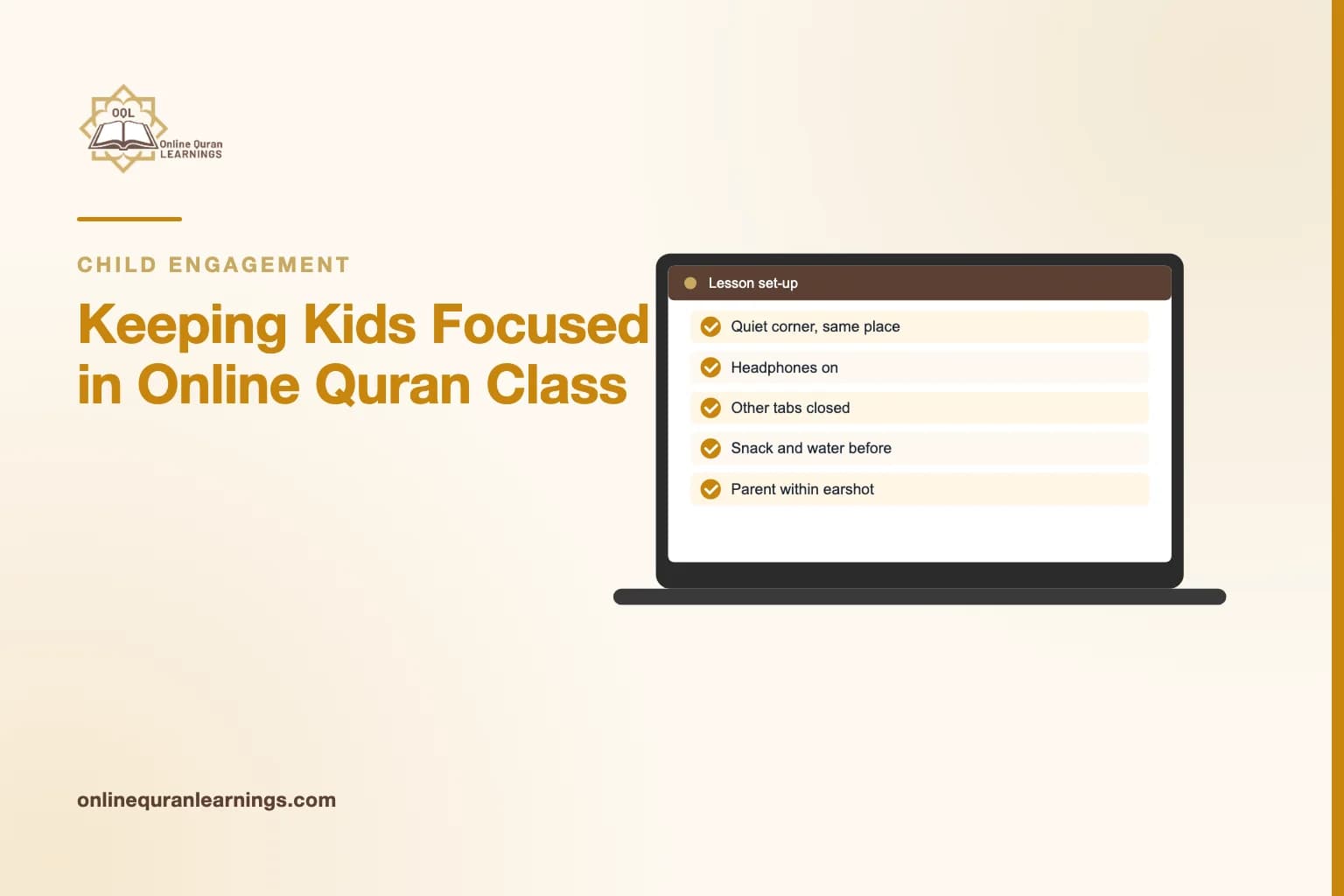
Set up the space before the first minute
A few minutes of set-up before class prevents most of the distractions teachers see.
Choose the same spot every time. A child who does Quran at the same table each lesson settles faster than one who moves from sofa to bed to kitchen.
Face away from the action. Put the child's back to the busy part of the house, not their face. A sibling walking past behind the screen is a constant pull.
Clear the table. The device, the Qaida or mushaf, a pencil if the teacher uses one, and water. Nothing else.
Light in front, not behind. A window behind the child makes their face dark on camera, and the teacher cannot see their mouth for pronunciation.
Agree a quiet rule for the house. Thirty minutes is short enough to ask siblings to play elsewhere and for the TV to stay off.
The device and sound
| Item | What works | What causes trouble |
|---|---|---|
| Screen | Tablet on a stand, or laptop | Phone held in hand; screen flat on the table |
| Height | Camera roughly at eye level | Teacher seeing only the top of the head |
| Sound | Headphones for 6+, speaker for younger children | Laptop speaker in a noisy room |
| Notifications | Do-not-disturb or focus mode on | Messages and game alerts popping up |
| Connection | Near the router, other streaming paused | Video freezing mid-sentence |
Sound matters more than parents expect. Learning Arabic letters depends on hearing small differences, such as between س and ص, or ه and ح. A child straining to hear will drift.
Pick the right time of day
The time of the lesson affects focus more than almost anything else. A good slot is one where your child is fed, rested and not missing something they love.
For most school-age children that means one of: shortly after getting home and having a snack, before homework drains them; early evening after dinner on lighter days; or weekend mornings. Late evening slots work for some older children but rarely for under-eights.
Because lessons can be scheduled at any hour, you can change a slot that is not working. Our guide to fitting Quran classes around school has patterns for different ages and school timetables.
What a 30-minute lesson rhythm looks like
Thirty minutes is long enough to make real progress and short enough for most children to manage, especially when the lesson is broken into parts. A typical rhythm for a child in the Qaida or early reading stage looks something like this.
| Minutes | Part of the lesson | Why it helps focus |
|---|---|---|
| 0-3 | Salam, settling, a quick chat | Gives the child time to arrive |
| 3-8 | Revision of something already known | Starts with success |
| 8-18 | New material in small steps | The hardest part comes while attention is high |
| 18-25 | Practice: reading aloud with correction | Active, not just listening |
| 25-30 | Short surah or dua, praise, homework | Ends on something warm |
Teachers adjust this for the child. A four-year-old's lesson changes activity more often; a ten-year-old's may spend longer on reading. The point is that the lesson has a shape, and your child knows roughly what comes next. If you are new to online lessons, our article on what happens in a first online Quran lesson shows how a teacher usually builds this up from the start.
This is one reason one-to-one Quran classes for kids tend to hold attention well: the teacher can see the moment a child drifts and change what they are doing, instead of waiting for a group to finish.
The parent's role during class
What the adult at home does can make focus better or worse.
For under-sevens, sit beside them. Keep the device steady, point to the right line if needed, and encourage answers. Say as little as possible; let the teacher lead.
For seven to ten, be nearby. Stay in the room or the next one for the first few lessons, then step back. Come in at the end to hear what was covered.
For older children, set up and leave. Check the device and sound, then give them space. Lessons are supervised and recorded, and the monthly progress report tells you how things are going.
Things that break focus, however well meant:
- Correcting your child during the lesson, on top of the teacher.
- Talking to the teacher over your child's head.
- Being on your phone in their line of sight.
- Reacting visibly to mistakes, with sighs or faces.
Fidgety children
Some children simply need to move. Fighting it usually makes things worse.
- Let them sit on a wobble cushion or kneel on the chair if they prefer.
- Give their hands a job: a finger or pencil to follow the line in the Qaida.
- Ask the teacher to build in a ten-second stretch halfway.
- Make sure they have moved around before class, not straight from a screen to a screen.
- Accept some wriggling as long as the reading is happening.
A fidgety child who is still reading accurately is focused enough. The goal is attention, not stillness.
Shy children
A shy child can look unfocused when they are actually anxious. They look away, mumble or stop answering.
Tell the teacher before the lesson. Sit close for longer than you would with a confident child. Let the first few lessons be mostly listening and copying, and accept nods and quiet answers. Shy children often speak up after a few weeks once they know the teacher. Our page on Quran classes for shy kids describes how teachers usually warm up a quiet child.
Signs the lesson time or length is wrong
If you have fixed the set-up and focus is still poor, look for these patterns.
- Focus is good at the weekend but poor on school days: the weekday slot is too late or too tiring.
- Your child is fine for 15 minutes and then falls apart: they may need a lighter structure, or more parent support for now.
- Your child rushes and seems bored: the material may be too easy.
- Your child goes quiet and avoids reading: it may be too hard, or they may feel embarrassed.
- Focus is fine with one teacher and poor with another: it may be about fit.
If focus has turned into resistance, with tears or refusal before class, our guide on what to do when a child refuses Quran class is a better starting point. And if you are still unsure whether the online format suits your child at all, the checklist in is my child ready for online Quran classes can help.
Change one thing at a time
When focus slips, it is tempting to change the time, the teacher, the device and the routine all at once. Try one change for two weeks, then the next. You will learn what actually helps, and your child gets a stable routine to settle into rather than a new arrangement every week.
Frequently asked questions
Should the camera stay on for the whole lesson?
Yes, for most children. The teacher needs to see the mouth to correct pronunciation and to notice when attention drifts. If a child is very shy, the teacher can start with the camera angled away and build up over a few lessons.
Is it okay for my child to have a snack during the lesson?
It is better to eat shortly before. Food during the lesson splits attention and makes reading aloud harder. A glass of water within reach is all most children need.
Can my child do Quran class on the same tablet they use for games?
Yes, but close every other app and turn on a do-not-disturb or focus mode first. Some families keep a separate profile or home screen for lessons so games are not one tap away.
What if my child is focused for the teacher but not for home practice?
That is very common. Keep home practice to five to ten minutes, at a fixed time, and sit with them rather than calling from another room. Short and predictable works better than long and negotiated.