
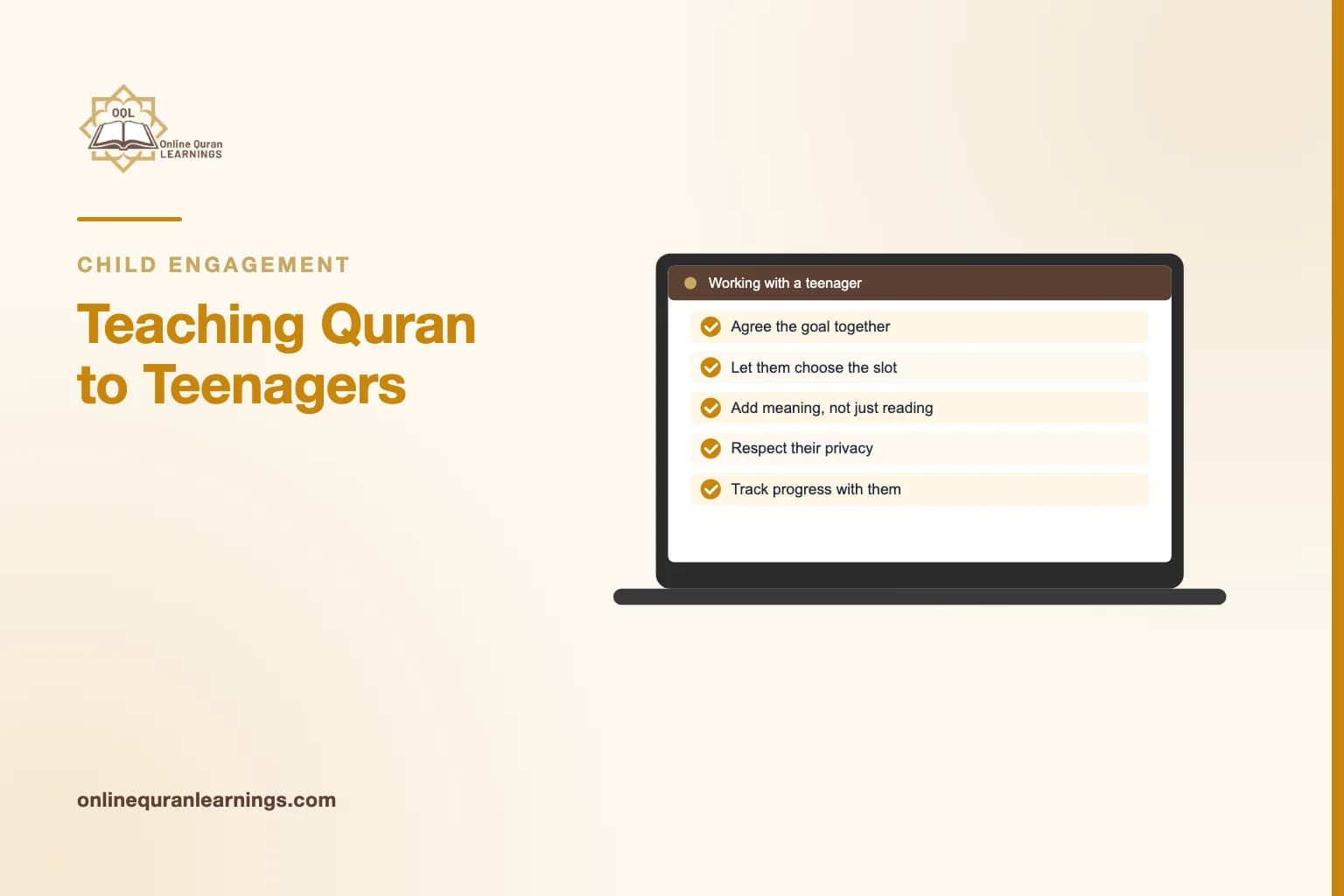
A teenager who sat happily through Qaida at seven may now answer every question about Quran class with a shrug. That is not necessarily a faith problem. Lessons that worked for a young child often stop working at thirteen because the teenager has changed and the lesson has not.
The fix is rarely more pressure. It is a different kind of lesson, built with the teenager rather than for them.
| What worked at 7 | What tends to work at 13-17 |
|---|---|
| Parent chooses everything | Teen helps choose goal, times and teacher |
| Parent sits in | Parent checks in, but stays out of the room |
| Praise for finishing a page | Progress they can measure themselves |
| Recitation only | Recitation plus meaning and questions |
| Fixed routine set by adults | Routine agreed around school, exams and sport |
Why the same class stops working
Three things shift in the teenage years, and each one changes what a good Quran lesson looks like.
They want control over their time. A teen's week is crowded with school, homework, friends, sport and screens. A class dropped into that week without discussion feels like an imposition, however good it is.
They are working out who they are. Teenagers start asking whether they believe things for themselves or because their parents do. A lesson that is only drilling recitation, with no room for "why", can feel irrelevant to the questions they are actually asking.
They are more self-conscious. Reading aloud and being corrected is harder at fifteen than at seven, especially if they feel behind, or if a younger sibling reads better than they do.
None of this means teenagers are less capable. In most ways they are more capable: they concentrate for longer, follow explanations of rules, and can connect what they read to their lives. The lesson just needs to be pitched at that level.
Setting the goal together
Instead of announcing a new class, sit down with your teen and agree what the lessons are for. A conversation along these lines usually goes better than parents expect.
- Start with what they already have: "You can read the Quran. That's a real achievement."
- Offer options rather than one plan: "Some people work on reading it properly, some learn what it means, some memorise. What interests you?"
- Ask about time honestly: "Which two evenings could actually work around school?"
- Agree a short trial period, such as six weeks, with a review at the end.
- Agree what you, the parent, will and will not do: "I'll check in with the teacher once a month. I won't sit in unless you want me to."
The point is ownership. A goal a teenager chose, even a modest one, holds up far better than an ambitious one handed to them.
Goals that suit teenagers
- Read one juz with correct Tajweed by the end of term.
- Understand the meaning of the surahs they already recite in salah.
- Memorise a set of surahs chosen by them, with a date in mind.
- Read a short passage aloud at a family gathering or in Ramadan.
- Finish the Qaida and move onto the mushaf, for a teen starting late.
Meaning is often what brings teenagers back
Many teenagers have been reading the Quran for years without understanding what they are reading. At seven that is normal. At fifteen it can start to feel pointless.
Studying meaning changes that. Learning what Al-Fatihah actually asks for, what the short surahs at the end of the Quran are about, and the context in which passages were revealed gives a teenager something to think about and discuss, not just something to perform. That is where Tafseer courses come in: they suit teenagers who can already read and want to understand, and they give a teacher room to answer real questions.
Questions about faith are healthy at this age. A teacher who welcomes them, and answers within the agreed basics while saying plainly where scholars differ, earns more trust than one who shuts them down.
Tafseer does not replace correct reading. For teenagers whose recitation still needs work, it often makes sense to combine the two: some lessons on Quran reading with Tajweed, some on meaning. A common pattern is two lessons a week split between them, or a term of Tajweed followed by a term of Tafseer.
Choosing the teacher together
With young children, parents choose the teacher. With teenagers, the teacher matters more and the teenager's view matters more.
Let them meet the teacher first. A trial lesson where your teen talks to the teacher, rather than you doing the talking, gives them a real say.
Ask what they want. Some teens prefer a teacher close to them in outlook who can relate to school and friends. Others prefer a more traditional, serious teacher. Neither is wrong.
Think about male or female. Many families have a clear preference here, especially for teenage girls, and you can choose either. Our guide to choosing between a male and female Quran teacher sets out what families usually consider.
Agree in advance how to raise problems. If your teen does not get on with the teacher after a few weeks, they should feel able to say so. Our article on changing your child's Quran teacher covers how to do that without fuss.
Privacy without losing oversight
Teenagers often resist Quran class because they feel watched. Parents, reasonably, want to know lessons are happening and are safe.
Both can be true. Lessons at Online Quran Learnings are one-to-one, supervised and recorded, and parents receive a monthly progress report. That means you do not need to sit in the room to know what is happening, and your teen gets a lesson where they can ask questions without an audience.
A good middle ground for most families:
- Class happens in a shared but quiet room, door open, not behind a locked bedroom door.
- You say salam to the teacher at the start of the first few lessons, then step away.
- You read the monthly report and talk about it with your teen, not about them.
- You raise concerns with the teacher directly, not mid-lesson.
Fitting lessons into a teenage week
Timing breaks more teenage Quran routines than motivation does. A class at a bad hour slowly becomes a class that gets skipped.
Because lessons can be booked at any hour, look for slots that survive a normal week: early evening before homework, a weekday morning before school for early risers, or a weekend morning. Our guide to fitting Quran classes around school has patterns that work for different ages, and Quran classes during exam season covers how to scale down without stopping when GCSEs, finals or other exams are close.
Scaling down is much better than stopping. A teen who drops to one lesson a week for six weeks of exams and comes back afterwards is in a far better place than one who stops entirely and has to restart in the summer.
If your teenager is behind or starting again
Some teenagers arrive at thirteen having stopped lessons years ago, or never having finished the Qaida. They often know they are behind and feel embarrassed about it.
Treat it as a short, focused catch-up rather than starting again. Older learners usually move through early stages quickly, and one-to-one lessons mean nobody else sees them working on Qaida pages. Our article on restarting Quran after a break explains how to find the right re-entry point and plan the first month.
What parents can stop doing
It sometimes helps more to drop habits than to add new ones. With teenagers, consider stopping:
- Reminding them about class several times a day. Agree one reminder, or none.
- Comparing them with siblings, cousins or friends' children.
- Using Quran lessons as a punishment or a bargaining chip for screen time.
- Correcting their reading at home when the teacher has already done so.
- Treating every missed lesson as a crisis. Look at the pattern over a month instead.
The relationship outlasts the lessons
The aim at this age is not just finishing a juz or a course. It is a young adult who has their own relationship with the Quran, who reads it because they want to and understands at least part of what they are reading. Teenagers who are given a real say, real meaning and a bit of privacy are far more likely to keep going after they leave home, when nobody is booking the lessons for them.
Frequently asked questions
My teenager can read the Quran. What should they study next?
Usually one of three directions: improving Tajweed so the reading is correct and confident, studying meaning through Tafseer, or memorising selected surahs. Ask your teen which appeals most, because that choice is what keeps them coming back.
Should a parent sit in on a teenager's Quran class?
Not routinely. Agree with your teen that you will check in with the teacher and read the monthly progress report instead. Sitting in on every lesson tends to make teenagers perform rather than ask real questions.
What if my teenager says they do not see the point of Quran lessons?
Take the question seriously rather than treating it as defiance. Ask what they would want to get out of lessons, and consider a short course on meaning, because many teenagers find the point once they understand what they are reading.
How many Quran lessons a week suit a busy teenager?
Two lessons a week is a realistic floor for most teenagers during school term, with a third added in holidays or quieter months. A steady two is better than an ambitious four that collapses by November.