
Exam season puts parents in an awkward spot. The Quran lessons matter, the exams matter, and a stressed fifteen-year-old has strong views on which one should give.
For most children the answer is neither to stop nor to carry on as normal, but to reduce. A quick way to decide:
- Carry on as normal if the exams are internal end-of-term tests, the child is coping well, and lessons are already only two a week.
- Reduce for major public exams (GCSEs, A-levels, Year 6 SATs, US finals and AP exams, Gulf end-of-year or Grade 12 exams), or whenever revision is heavy for more than a week or two.
- Pause briefly only for the exam weeks themselves, and only with a fixed restart date written down.
The rest of this guide is about making the "reduce" option work.
What a full stop really costs
Stopping feels tidy. The exams end, and lessons start again. In practice two things tend to happen.
First, the restart date drifts. Exams end in late June, then it is the summer, then the new term is busy, and a "six-week break" becomes four months. Teachers see this often enough to be wary of open-ended pauses.
Second, the child loses more than parents expect. Reading fluency, Tajweed habits and memorised surahs all fade without contact, and a Hifz student can lose a noticeable amount of revision in a month. Coming back then means several lessons of recovery before any new progress. Our guide on restarting Quran after a break covers that rebuilding, and it is easier avoided than done.
A lighter plan keeps the thread for a fraction of the time.
A maintenance plan for exam weeks
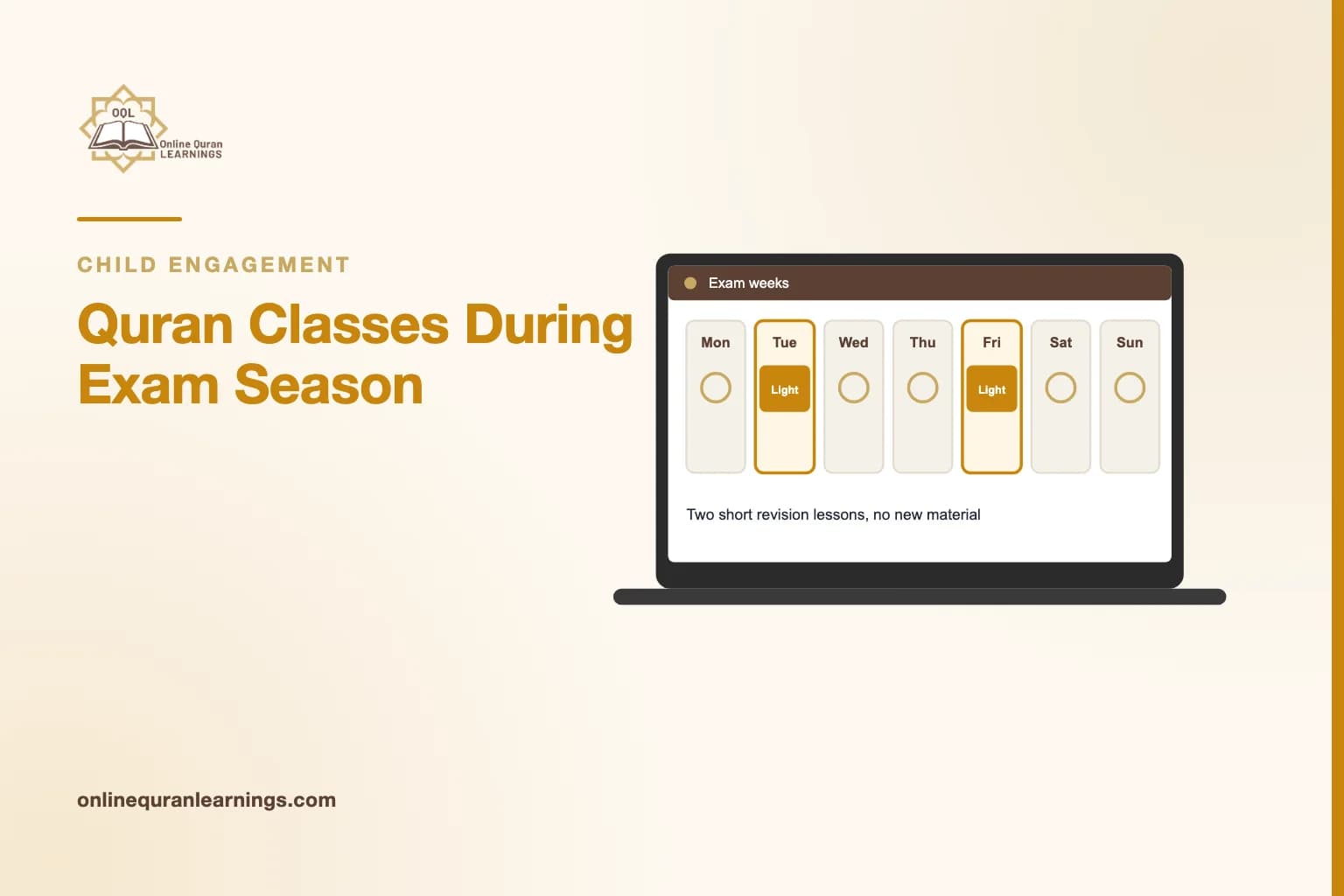
For most students, reduce to one or two 30-minute lessons a week and change what happens in them.
| Normal term | Exam period | |
|---|---|---|
| Lessons a week | 2 to 5 | 1 to 2 |
| New material | Yes | Little or none |
| Lesson content | New lesson plus revision | Revision of recent and older work |
| Home practice | 5 to 10 minutes most days | A few minutes, a few days a week |
| Teacher feedback | Corrections and next steps | Light correction, mostly reading through |
The key change is that lessons become revision-only. No new Qaida stage, no new surah, no new Tajweed rule. The child reads what they already know to the teacher, the teacher catches anything slipping, and that is it. It asks far less of a tired mind than learning something new.
Pick lesson days that are lighter on revision. If maths and science exams cluster on Tuesdays and Thursdays, put the Quran lesson on a Saturday morning. Lessons with us can be scheduled at any hour, so it is usually possible to find a slot away from the heaviest revision days.
For a child doing Hifz
Memorisation is the hardest to pause, because older portions need regular revision to stay solid. During exams, most teachers will suggest stopping new memorisation entirely and keeping a reduced revision schedule: a smaller portion of older surahs or pages per lesson, perhaps two or three lessons a week rather than five. Our page on memorisation with murajaah explains how revision cycles work, and why they are worth protecting.
Agree the revision portion with the teacher in writing so the student knows exactly what is expected, and nothing more.
What to say to the teacher
Teachers plan better with notice. Two to four weeks ahead, send something like this:
Assalamu alaikum. Ibrahim has his GCSEs from 12 May to 20 June. Could we move to one lesson a week on Saturdays from 5 May, revision only, no new surahs? We would like to go back to three lessons a week from 23 June. Please let us know if you would change anything.
That one message covers the dates, the reduced schedule, the content and the restart. A teacher who knows the end date can also plan to finish a section cleanly before exams start rather than leaving something half-taught.
If you are with us, the same message works, and the monthly progress report afterwards will show where things stand when normal lessons resume.
The lesson as a steady point in the week
Some families find that a short, familiar Quran lesson is a welcome break in a week of revision timetables and past papers. Thirty minutes of reading something the child already knows well, with a teacher they are comfortable with, can feel like a pause rather than another task.
That is worth noticing, but it is not a promise. Some teenagers find that any fixed commitment during exams adds pressure, and pushing a lesson they resent will not make it calming. If your child is genuinely anxious or struggling, the school, your GP or another qualified professional is the right place for that, and the Quran lesson should fit around whatever support they need.
What does help most children is keeping lesson length and difficulty low enough that the lesson never becomes the thing they are worried about.
Talking it through with a teenager
Exam-age students are old enough to be part of this decision, and plans they agree to tend to last. Ask what they think is realistic rather than presenting a finished timetable. Some useful questions:
- Which weeks are the heaviest, and which days are lighter?
- Would one lesson a week feel manageable, or does even that feel like too much?
- Would revision-only lessons be easier than stopping and restarting later?
- When do you want to go back to the normal timetable?
If they push for a full stop, a short, clearly dated pause for the exam fortnight itself is a reasonable compromise. The date matters more than the length. Our guide to teaching Quran to teenagers covers more on giving older students ownership of their lessons.
Exam calendars to plan around
Dates vary by school and year, so check your own, but broadly:
- UK. Year 6 SATs fall in May. GCSE and A-level exams run from around May into late June, often with mocks earlier in the year.
- US and Canada. Final exams usually come in December or January and again in May or June; AP exams are in May; SAT and ACT dates are spread through the year.
- Australia. Senior secondary exams such as the HSC and VCE are typically in October and November.
- Gulf countries. School exams commonly fall at the end of each term, with Grade 12 and board exams near the end of the academic year. When exams fall near or during Ramadan, a lighter plan is especially sensible.
After the last paper
Restart on the date you agreed, even if the child wants a week off first. A week off is fine if it is planned; just keep the restart fixed.
For the first two or three lessons back, expect the teacher to revise before moving on. If the summer holidays follow straight after exams, our guide to keeping Quran going in the school holidays has a plan for that stretch, and fitting Quran classes around school covers rebuilding the timetable in September.
If you are looking for a teacher who can adjust lesson frequency around your child's school year, our online Quran academy page explains how one-to-one lessons are set up, with a male or female teacher of your choice.
Frequently asked questions
Will reducing Quran lessons for exams set my child back?
A little, in the sense that new material slows down. Very little is lost if the child keeps one or two lessons a week focused on revision, and most children pick up the normal pace within a few weeks of the exams ending.
Can my child do the Quran lesson on the morning of an exam?
It is usually better not to. Exam mornings are for sleep, breakfast and getting to school calmly. Move that week's lesson to a day without an exam, or to the weekend.
How far ahead should I tell the teacher about exams?
Two to four weeks is ideal. That gives the teacher time to finish a section cleanly, plan revision lessons, and avoid starting something new that would be left half-done.
What if my teenager wants to stop completely during exams?
Take the request seriously and talk it through. Offer a reduced plan with a clear restart date rather than a vague pause. If they still want a full break for a short, defined period, agree the date lessons resume before the break begins.