




The short answer
Yes, two weekend lessons a week is a real start, especially for learning to read. A Saturday and a Sunday lesson of 30 minutes each, one-to-one, keeps steady progress going for children on Noorani Qaida or Quran reading.
It is thinner for memorisation. Hifz needs near-daily contact, so weekend-only students who are memorising should expect slower progress, or add a few minutes of revision on weekdays. Those five minutes midweek make the biggest difference to any weekend-only plan.
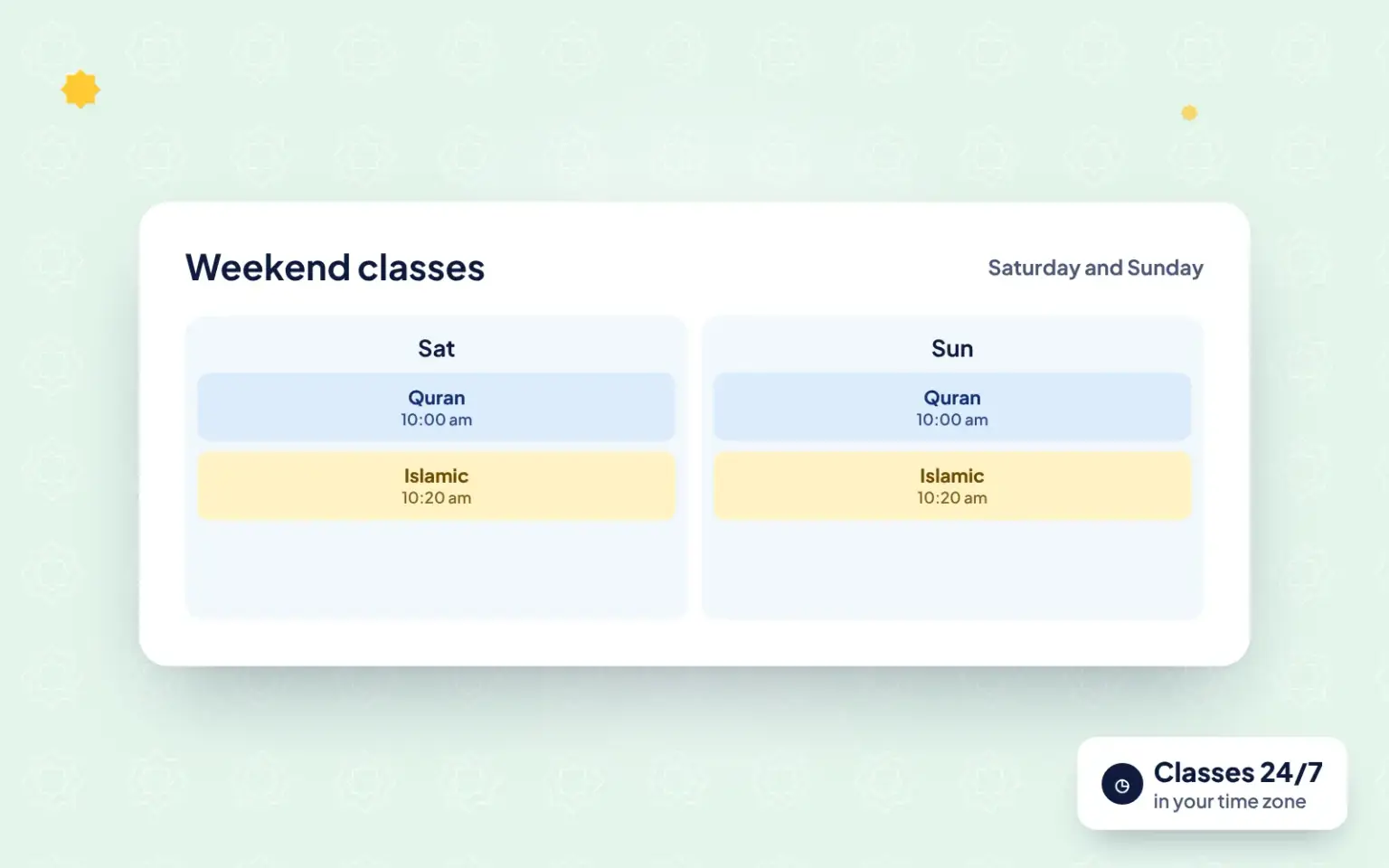
- Lessons
- Saturday and Sunday, 30 minutes each
- Format
- Live, one teacher, one student
- Times
- Any hour of the weekend
- Who for
- Children from 4 and teenagers
- Price
- $39 a month for a Saturday and a Sunday lesson
Jump to a section
The honest answer
Is weekend-only Quran study enough?
For reading, yes. For memorisation, it is a slow start rather than a full plan. The gap from Sunday to Saturday is five days, and that is where letters and verses get lost if nothing happens in between.
Weekend lessons only
- Saturday often starts by relearning last Sunday
- Fine for a young child’s first steps in Qaida
- Slow for Hifz: new verses fade over five days
- Easy to keep up, even in a busy term
Weekend lessons plus five minutes midweek
- Saturday starts where Sunday ended
- Reading speeds up noticeably
- Makes weekend Hifz workable for short surahs
- Asks a little of a parent, two or three evenings
The lessons teach. The midweek minutes stop it slipping away.
| Goal | Weekend-only? | What helps |
|---|---|---|
| Noorani Qaida for a young child | Works well | Point at the week’s letters in a book together |
| Quran reading for an older child | Works well | One page read aloud to a parent midweek |
| Tajweed for a teenager | Works | Listening to a reciter during the week |
| Memorising short surahs | Slower, but possible | Daily recitation of the new verses at home |
| Full Hifz | Too thin on its own | Weekday lessons too; see Hifz classes |
- No card needed
- One-to-one
- Stop any time
Choosing the hour
Is a weekend morning or afternoon better?
A morning slot is usually best for younger children, as long as it is not the first thing after waking. Older children often prefer the afternoon, once chores and lie-ins are out of the way.
Mid-morning
Around 9:30 to 11 am. Breakfast done, energy high, nothing else planned yet. Good for ages 4 to 8.
Early afternoon
After lunch and before family visits or outings. Suits children who sleep in or have a morning club.
Evening
After Maghrib, when the house is quieter. Often the easiest time for a parent to sit in on the class.
Keep Saturday and Sunday at the same hour if you can. A weekend that already changes week to week needs one fixed point.
- No card needed
- One-to-one
- Stop any time
Fitting it in
Can my child do online lessons alongside weekend madrasa or sport?
Yes. Plenty of families use a one-to-one lesson to sit next to a weekend madrasa, not replace it. The madrasa gives friends and community; the online lesson gives your child a teacher who hears every letter.
- MonNo lesson
- Tue5 min: read Saturday’s page
- WedNo lesson
- Thu5 min: read Sunday’s page
- FriNo lesson
- Sat10 am football2:00 pm Quran lesson
- Sun10 am madrasa4:00 pm Quran lesson
No lesson: Mon, Wed, Fri
An example only. Any weekend hour can be booked, and we fix your times together on WhatsApp.
Leave a gap after sport. A child straight off the pitch, still in muddy socks, will not settle into Tajweed. Lunch and a shower first.
- No card needed
- One-to-one
- Stop any time
Try a Saturday or Sunday lesson
Book the trial at the weekend hour you are thinking of, and see how it sits with the rest of the day.
Book a weekend trial class
Up to 3 Days Free Trial. No credit card, no obligation.
Inside the 30 minutes
How is a weekend lesson different?
It starts with more revision, because there is a longer gap to cover. The Saturday teacher spends the first minutes finding out what survived the week before adding anything new.
- What stuck (8 min) Your child reads last Sunday’s page. The teacher notes what was forgotten.
- New reading (12 min) The next few lines, with each mistake corrected as it happens.
- Repeat the hard bits (6 min) The two or three words that tripped them up, read again until smooth.
- Set the midweek task (4 min) One small thing to practise before next Saturday.
- No card needed
- One-to-one
- Stop any time
Between weekends
What should my child practise during the week?
Five minutes, two or three times between Monday and Friday, is enough to keep the weekend’s work alive. It doesn’t need a teacher or a laptop.
- Read the last lesson’s page or Qaida lesson aloud to a parent, once.
- Recite a surah your child already knows in Salah, or before bed.
- Listen to the surah they are learning on the way to school.
- Point out one Arabic letter or word on a calendar, a book or a mosque sign.
- Ask your child to teach you one thing from the weekend lesson.
If your child is memorising, the midweek minutes should go on the new verses. Our guide to why children forget Quran lessons explains why the gap matters so much.
- No card needed
- One-to-one
- Stop any time
When to add a weekday lesson
If Saturday keeps starting with last week’s mistakes, or your child has moved on to memorising, it may be time for a third lesson. Even one short weekday slot breaks the five-day gap in half. Three lessons a week is $49 a month; all plans are on the fees and schedules page.
For families who can manage a weekday slot, our page on Quran classes after school shows how others fit it around homework and clubs.
- No card needed
- One-to-one
- Stop any time