




Hooked in first session
“I just tried one session with my son, and I was honestly amazed by how much he enjoyed the class! The teacher was so sweet, encouraging, and engaging.”
Live one-to-one classes in the USA
Correct recitation, rule by rule, in one-to-one 30-minute lessons at Online Quran Learnings, with a teacher who hears every letter your child reads. For families across the United States, on your own clock.
Give your child a positive start with a 1-on-1 live Quran class. No payment needed.Up to 3 Days Free Trial · No card needed
Tajweed classes for kids
Online Tajweed classes for kids in the USA are live, one-to-one, 30-minute lessons in your own time zone, from $30 a month. Your child learns makharij, heavy and light letters, the noon and meem saakin rules, qalqalah, madd and where to stop, one rule at a time while reading, with a teacher who corrects every word and a female supervisor in every class. Lessons are explained in English or Urdu. Below: the sounds American children most often find hard, one rule taught start to finish, and what a week looks like.
The points in the mouth and throat where each letter is pronounced.
Tafkheem and tarqeeq: which letters are full-mouthed and which are thin.
A male or female teacher, your choice, so your child feels at ease and keeps moving forward.
She listens to the whole class, so it stays safe, kind and on track.
Kind, checked teachersID, certificates and a watched demo before they teach a child.
“My kids have learnt so much within such a short space of time. Very impressed would definitely recommend.”
ر
American English makes r with the tongue pulled back. The Arabic ر is a quick tap of the tongue tip behind the top teeth: heavy with a fatha or damma, as in رَبِّ, and light with a kasra.
ت ط
Between vowels, American English often turns t into a quick d (say "water"). In the Quran ت stays a clear t every time, and ط is its heavy partner, said with the back of the tongue raised.
ق ط ب ج د
English often swallows a final d or b ("good", "job"). The five qalqalah letters need a small bounce when they carry a sukoon, as in يَلِدْ, so the sound is heard, not swallowed.
ح ع
English has no sound from the middle of the throat. ح is a breathy h from there (the h of "hat" is ه), and ع is a tight throat sound English does not have at all.
ق ك
ق is made further back than k, at the very back of the tongue. Children often say every ق as a k, so قُلْ comes out as "kul"; the teacher separates the two from the first lesson.
More on the sounds English does not have: Quran classes for English-speaking kids.
قُلْ هُوَ اللَّهُ أَحَدٌ
Ayah 1 ends on أَحَد. When your child stops there, the final د loses its vowel and gets a clear bounce.
اللَّهُ الصَّمَدُ
Ayah 2: the same strong bounce on the final د of الصَّمَد when stopping.
لَمْ يَلِدْ وَلَمْ يُولَدْ
Ayah 3: the د in يَلِدْ and يُولَدْ already carries a sukoon, so it bounces too.
Quran text: Surah Al-Ikhlas (112), ayahs 1 to 3.
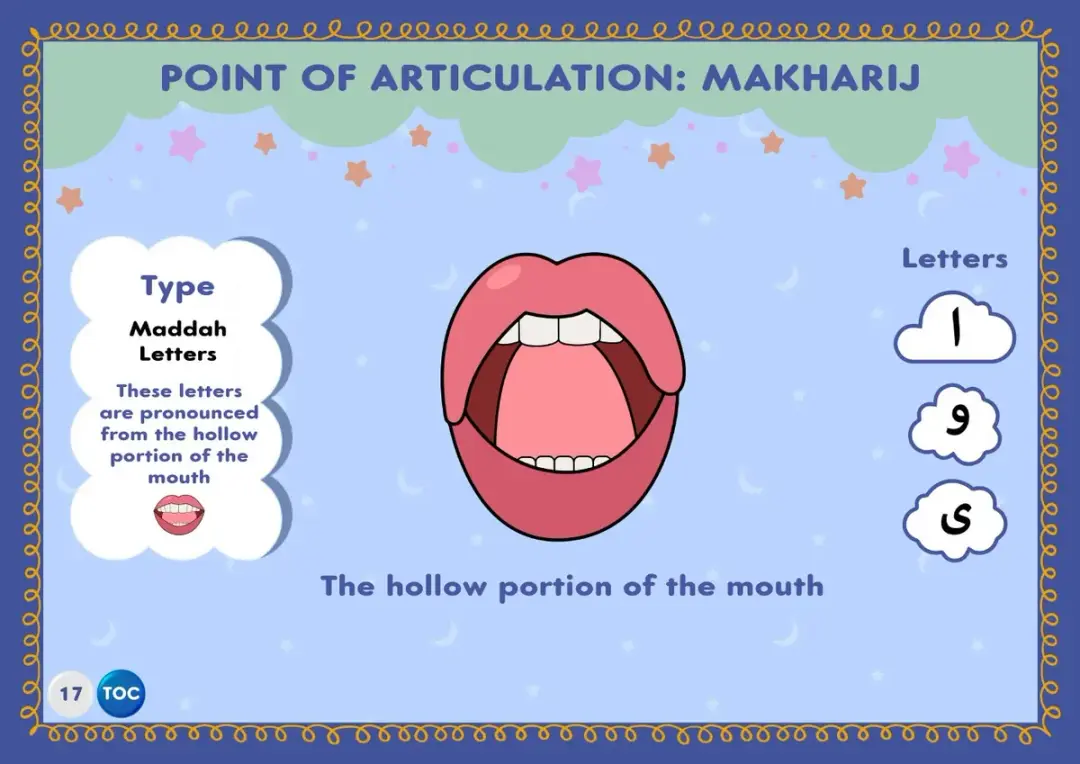
Where each letter is said from: the throat, the tongue, the lips or the nose.
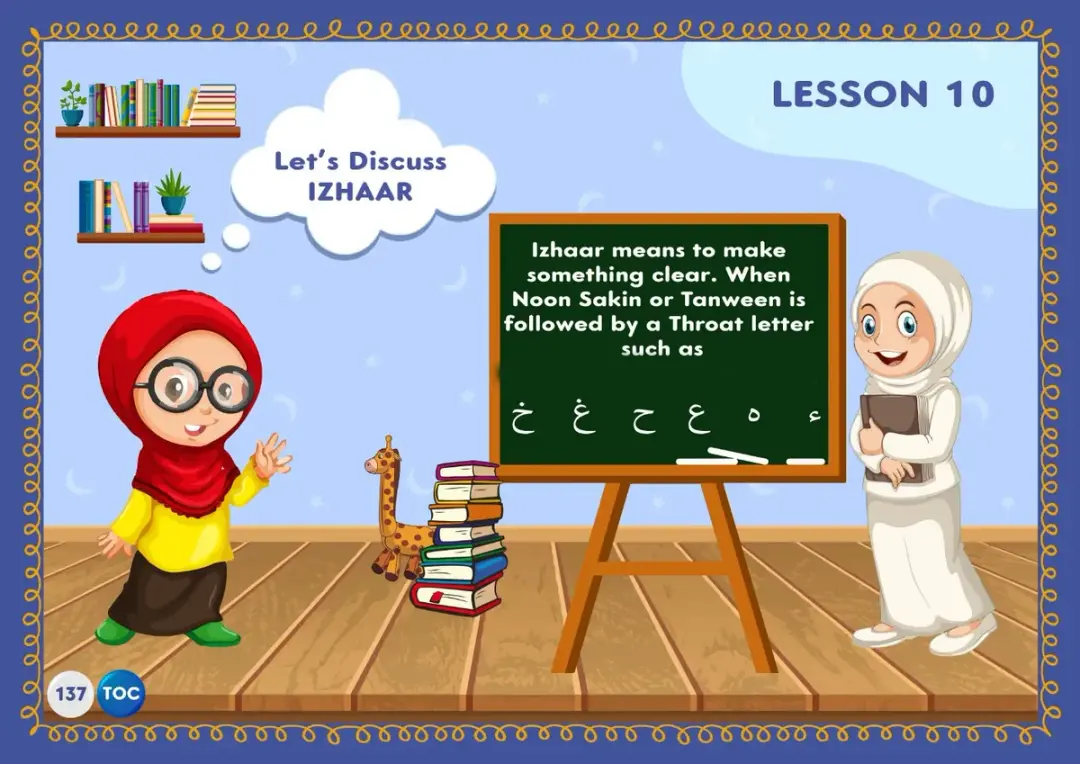
When noon saakin or tanween is said clearly, with no nasal sound.
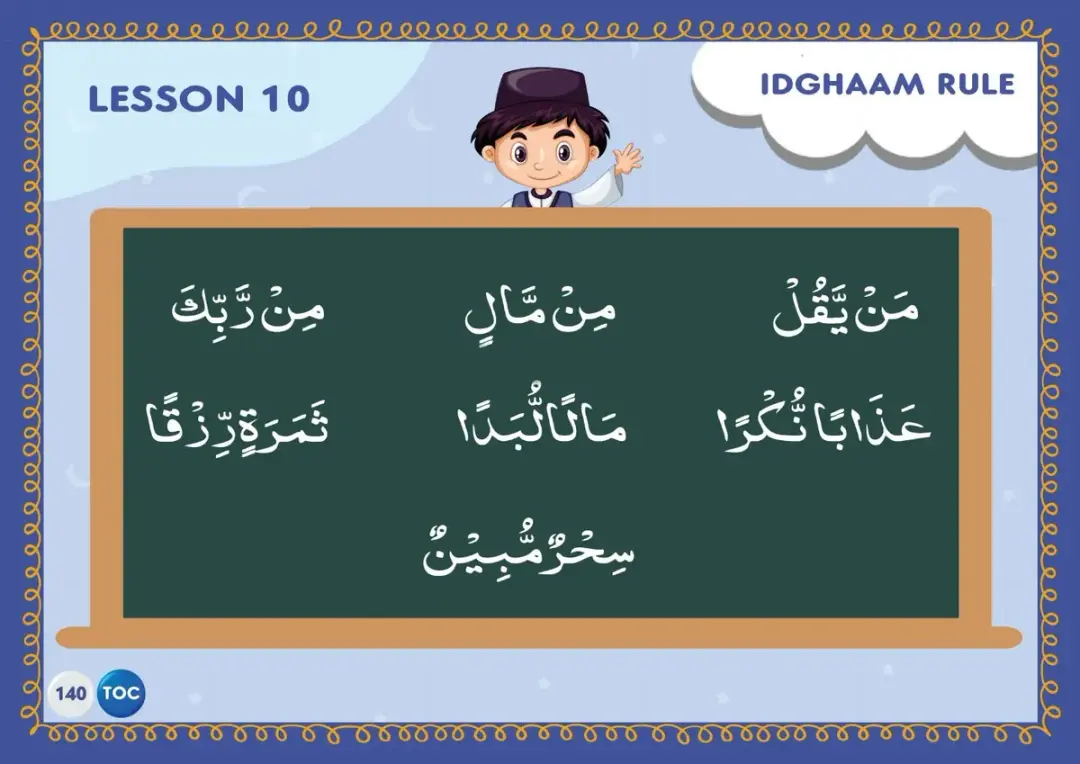
When noon saakin blends into the next letter, with examples to read.
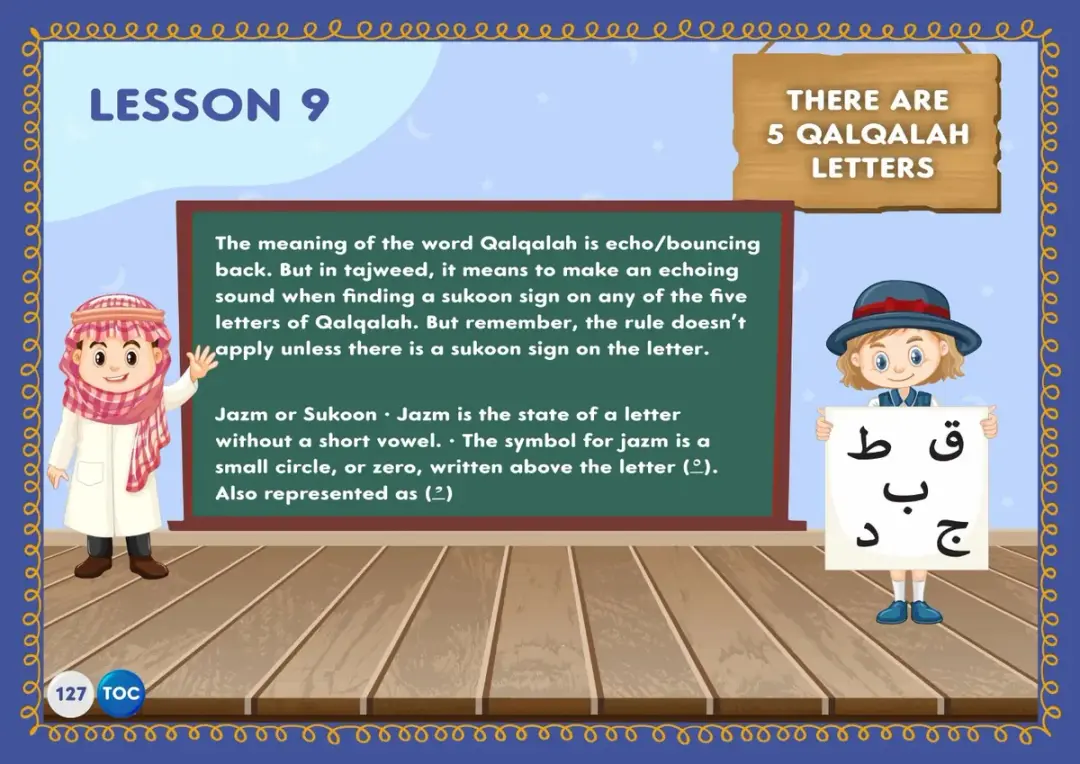
The small bounce on five letters when they carry a sukoon.
The points in the mouth and throat where each letter is pronounced.
Tafkheem and tarqeeq: which letters are full-mouthed and which are thin.
Izhar, idgham, iqlab and ikhfa, with examples from short surahs.
The three rules of meem saakin and the nasal sound of ghunnah.
The echoing letters and the different lengths of madd.
Rules of waqf so the meaning of an ayah is not broken.
Practice between classes: Reading the passage from class out loud once or twice before the next lesson.
The teacher tells you after the first week what pace to expect. You can also hear the change for yourself: ask for a recording of any class.
Our suggestion: 4 classes a week. Four classes a week gives enough reading time to turn each rule into habit. Every class is 30 minutes and one-to-one, and the fee is the same for every course and for a male or female teacher.
Prices in US dollars for the USA. Paid monthly. No enrolment fee, no contract. Every plan starts with the free trial, and you choose the number of classes after it.
| Day | Time | What the lesson covers |
|---|---|---|
| Monday | 5:00pm ET | Revision, then where the throat letters come from |
| Tuesday | 5:00pm ET | Noon saakin: izhar and idgham, with short surahs |
| Thursday | 5:30pm ET | A new passage, checking each rule learned so far |
| Saturday | 10:00am ET | Qalqalah in Surah Al-Ikhlas, and a passage to practice |
You choose the days and times, and keep the same teacher. On Pacific time, after-school lessons start from 3:30pm. Weekends only? See weekend Quran classes. Every plan and price: fees.
Who it suits:
Tajweed for kids at a glance in the USA
| Age | Age 7 to 16 |
|---|---|
| Starts from | After Noorani Qaida, or reading with mistakes |
| Each lesson | 30 minutes, live and one-to-one |
| Teacher | Male or female, your choice, the same one every class |
| In every class | A female supervisor listening |
| Islamic studies | In the same class as Quran, or on its own |
| The book | The Quran, shared on screen, with rule pages from the OQLS Qaida |
| Progress | A report every month |
| Fees | From $30 a month, after a free trial of up to 3 days |
A female supervisor joins every lesson live and listens to the whole class, from salaam to the last ayah.
Our teachers are mostly based in Egypt, the UAE, India and Pakistan. Every teacher holds a government police check, we check their ID and certificates before they teach, and a female supervisor joins every class. Read our child safety rules
Classes run 24/7. These after-school and weekend windows fit around the school day, shown in your own time.
| Time zone | School days | Weekends |
|---|---|---|
| Eastern (ET)New York, New Jersey, Florida, Georgia, Virginia, Michigan, Ohio, Massachusetts | 4:30–8pm | 9am–12pm |
| Central (CT)Texas, Illinois, Minnesota, Missouri, Tennessee, Wisconsin | 4–7:30pm | 9am–12pm |
| Mountain (MT)Colorado, Arizona, Utah, New Mexico, Idaho | 4–7pm | 9–11am |
| Pacific (PT)California, Washington, Oregon, Nevada | 3:30–7pm | 8:30–11am |
| Alaska & HawaiiAnchorage, Honolulu | 3–6:30pm | 8–11am |
Most states change their clocks in March and November (not Arizona or Hawaii). We move your slot with them, so the lesson stays at the same local time. After-school slots fill first, so book those early.
 Age 6 to 16
Memorisation with the daily rhythm of a madrasah — sabaq, sabqi and manzil — and a teacher who listens to every line.
 Age 4 to 16
Live one-to-one lessons with a teacher your child keeps, from the first Arabic letter to fluent reading and Hifz.
 Age 9 to 16
The surahs your child recites in salah, understood word by word.
Course finder
Answer the two questions and we will suggest a course and how many classes a week.
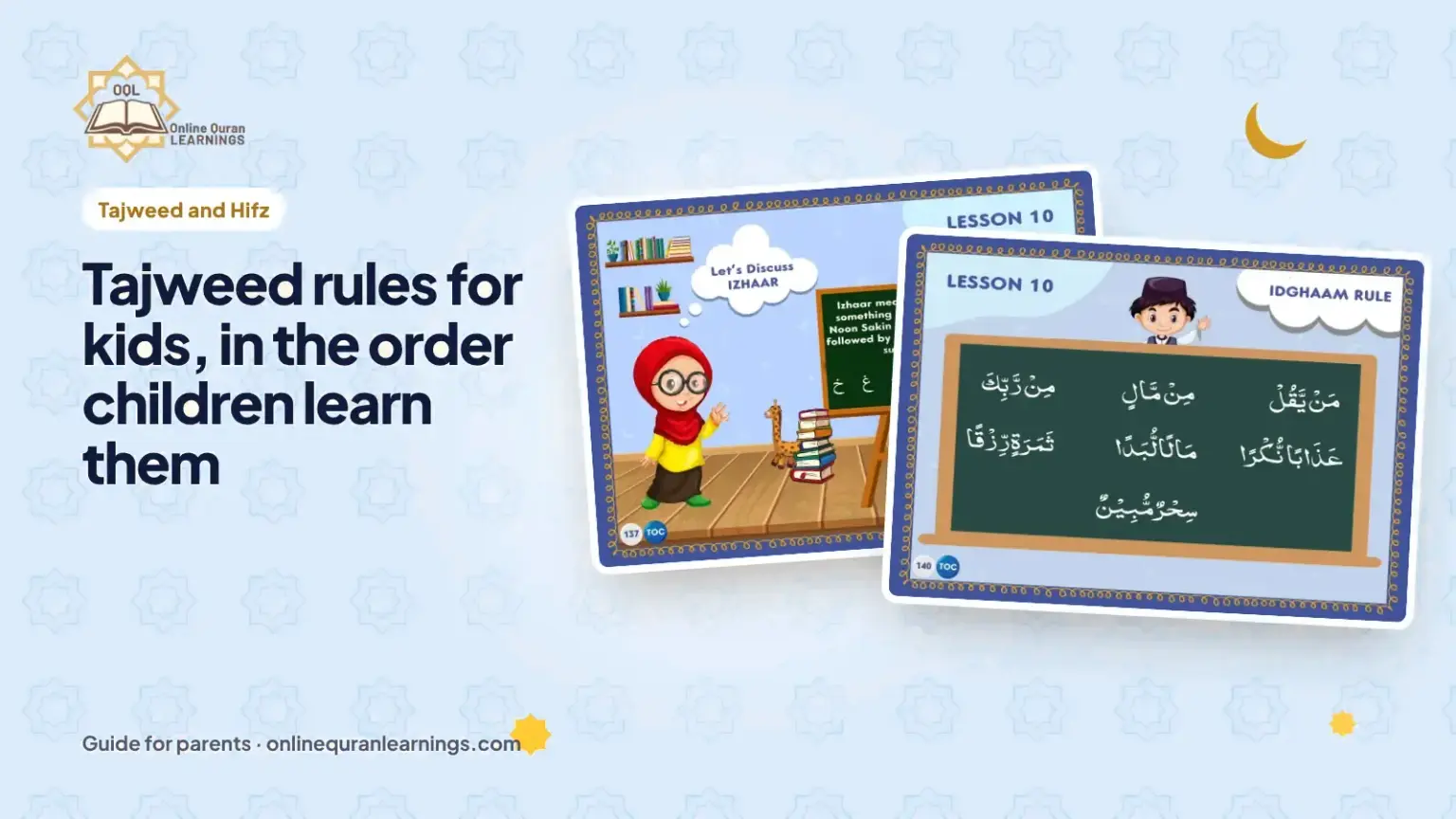
Children learn Tajweed in stages. First the correct sound of each letter, then short and long vowels, then the rules of noon sakinah and tanween, meem…
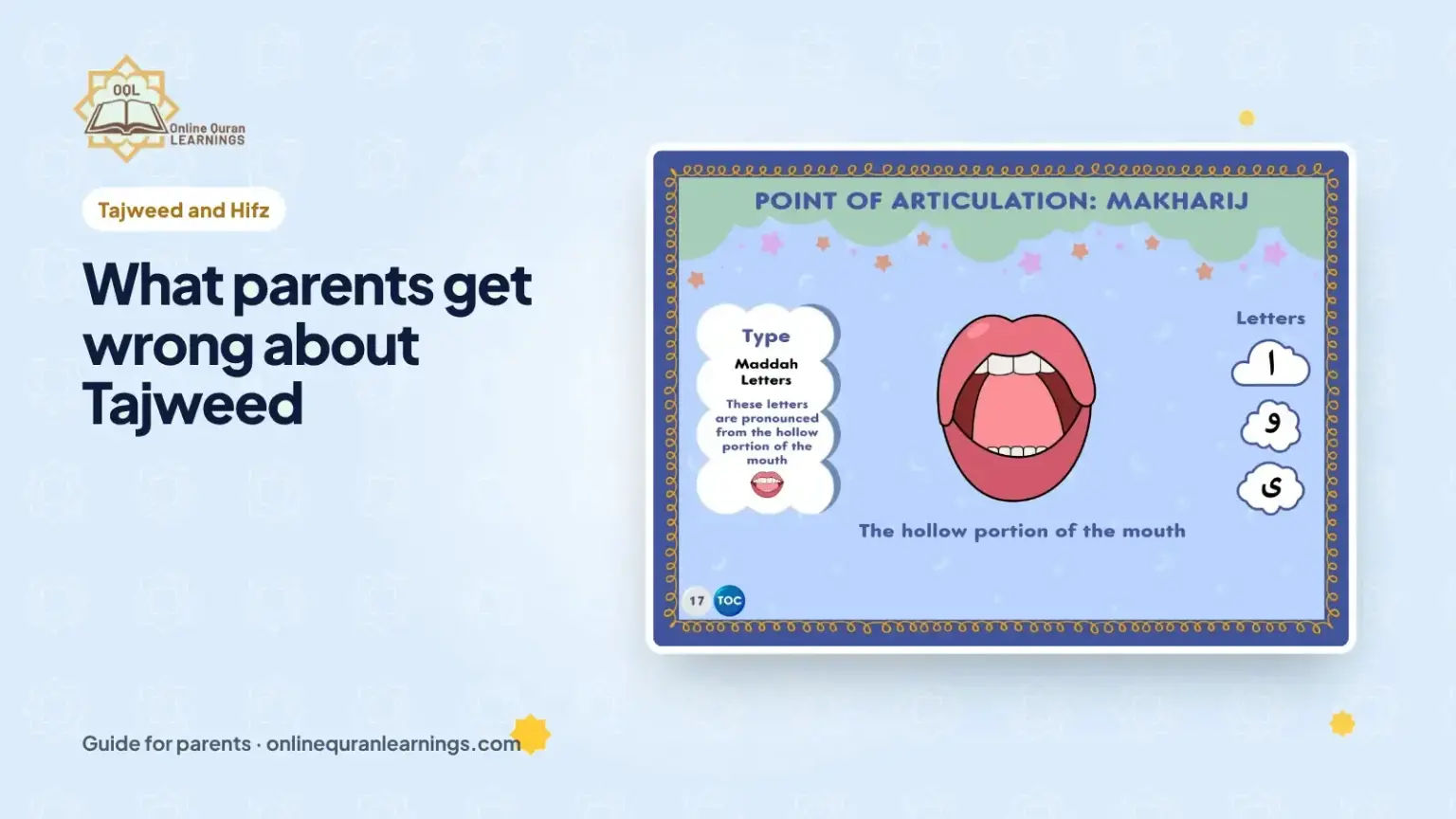
The biggest mistake is thinking Tajweed is an extra, added later. Tajweed is simply reading the Quran correctly, and it starts with the first letter.…
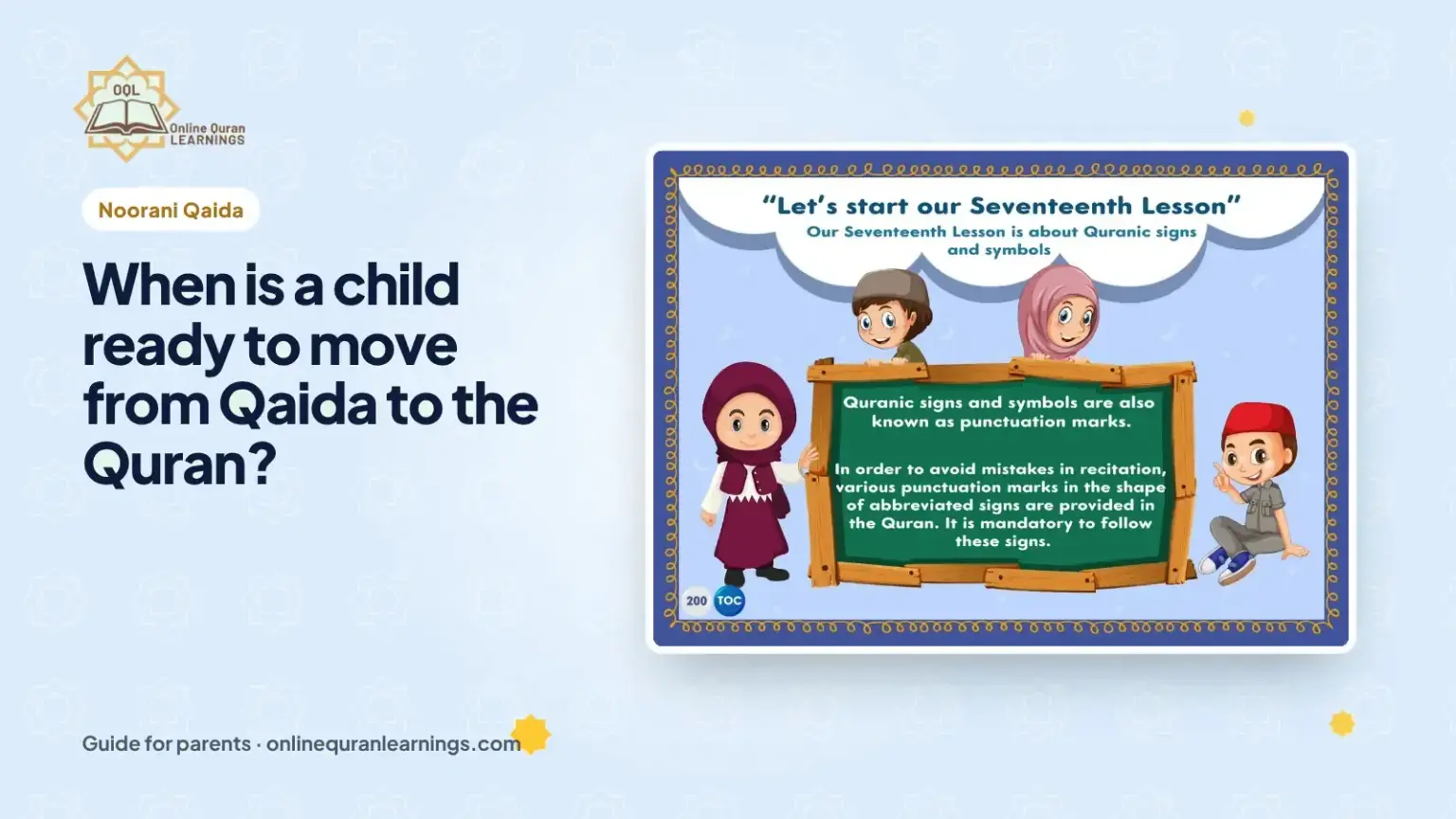
A child is ready to move from Noorani Qaida to the Quran when they can read a line they have not seen before, steadily and without guessing, and apply…
4.8out of 5 from 72 reviews on Trustpilot · 5.0 on Google
“I just tried one session with my son, and I was honestly amazed by how much he enjoyed the class! The teacher was so sweet, encouraging, and engaging.”
“Class is flexible… Supervisor is in the class for safety of both the sides.”
“Happy for my kids that they are studying in an organised structure where both teacher and students are under supervision… Receiving the progress status of kids after the class.”
“My kids have learnt so much within such a short space of time. Very impressed would definitely recommend.”
Anything else? Ask us — we answer on WhatsApp.
From $30 a month for one 30-minute class a week, in US dollars. For Tajweed we suggest 4 classes a week, $55 a month. Your child starts with a free trial of up to 3 days, no card needed.
Yes. Weekend school gives your child a community and a class. A one-to-one lesson adds what a group cannot: a teacher listening to every letter your child reads. Book school-day evenings and keep Sunday for the masjid, or the other way round.
We teach 24/7. After school usually means 4:30–8pm Eastern, 4–7:30pm Central, 4–7pm Mountain, 3:30–7pm Pacific or 3–6:30pm Alaska, or a weekend morning. Most states change their clocks in March and November, and we move your slot with them.
Your child should be able to read the Quran, even slowly. Formal Tajweed rules usually start once a child reads the Quran, often around age 7 to 9. If your child cannot read yet, the free trial shows where to start, often with Noorani Qaida, where the right sounds are taught from the first lesson.
Children absorb correct pronunciation from the very first Qaida lesson. Formal Tajweed rules usually start once a child reads the Quran, often around 7 to 9.
Yes. In a one-to-one video lesson the teacher hears every letter and can show mouth positions on camera. It is often easier than in a busy class because no mistake is missed.
Your child should be able to read joined Arabic words. If not, the teacher starts with Noorani Qaida, which already builds correct pronunciation.
Many children find it easier to see where a rule applies when the letters are colour-coded. We share free colour-coded Quran PDFs you can use at home between classes.
Yes. Lessons are recorded and you can ask for any recording. You also receive a monthly progress report.
Yes. A female supervisor joins every class live, you can join any lesson without telling us, lessons are recorded, and teachers never contact your child outside class. Every teacher has their ID and certificates checked before teaching.
Your child can learn Quran and Islamic studies together in the same 30-minute class, or take just one subject. You choose, and the teacher shapes each lesson around your child.
Live, always. Your child reads with a real teacher on a video call, never a recorded course. Lessons are also recorded, so you can ask for the recording any time.
Your child, the teacher and a female supervisor who listens to the whole lesson. You are welcome to join too, any time.
Yes. You can join any class live, without telling us first.
Every teacher passes five checks before a first student: ID verified, a government criminal-record (police) check from their own country, Quran and Tajweed certificates checked, an interview and a demo class our team watches, then training in how we teach children.
Yes, at any time. Just ask. You do not need to give a reason.
No. Teachers never message a child outside class. Every message goes through our team to you.
English or Urdu, so your child understands every correction. The reading itself is always in Arabic.
A laptop, tablet or phone, a steady internet connection and headphones with a mic. A quiet spot at a table helps.
From one to five a week. Three or four suit most children; five suits Hifz.
Yes. Message us on WhatsApp as early as you can and we will find another time, with the same teacher where possible.
Tell us before the class. You can then have a make-up class or the fee adjusted next month. Classes missed without telling us cannot be made up.
Yes. Up to 3 Days Free Trial: one to three free 30-minute classes on up to 3 days, as many as your child needs to find their level. No card, no obligation. You only pay if you decide to continue.
Ask within 5 calendar days of the first paid class for a full refund. After that, we charge only for the classes your child attended and return the rest.
The trial has no obligation. After that, ask within 5 calendar days of the first paid class for a full refund. After that, attended classes are deducted and the rest is refunded.
From $30 a month in the US, £25 in the UK, C$53 in Canada, A$30 in Australia, NZ$53 in New Zealand and AED 120 in the UAE, depending on how many classes a week you choose.
Up to 3 Days Free Trial
Meet the teacher and watch a real lesson before you pay anything. No card, nothing to cancel.
No card · Nothing to cancel · Confirmed on WhatsApp
Book your child’s free trial
No card needed. We message you on WhatsApp to agree a time.