
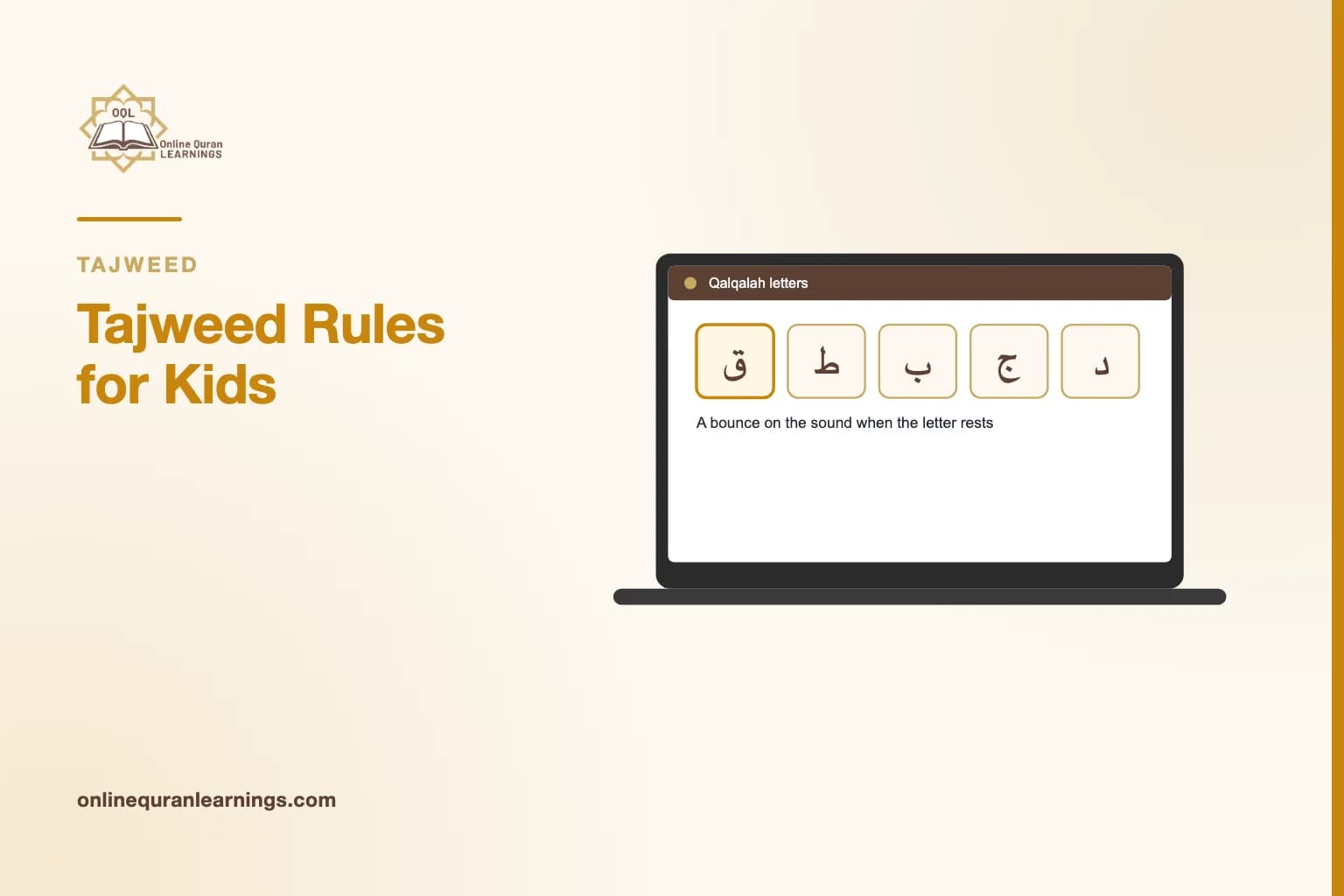
Tajweed is the set of rules for reciting the Quran correctly: how each letter sounds, when a sound is stretched, when it hums, when it bounces and when two sounds blend. For a child, these rules are not grammar to memorise. They are things the mouth does, and they can almost all be explained with an everyday picture.
Here are the core rules most children meet, with the names a teacher might use with them:
| Rule | Child-friendly name | The letters involved |
|---|---|---|
| Noon sakinah and tanween | Four ways to say a sleeping noon | ن with sukoon, or the doubled vowel marks |
| Meem sakinah | Three ways to say a sleeping meem | م with sukoon |
| Ghunnah | The hum | ن and م with shaddah |
| Qalqalah | The bounce | ق ط ب ج د |
| Madd | The stretch | ا و ي as long vowels |
| Heavy and light letters | Full mouth, flat mouth | خ ص ض غ ط ق ظ are always heavy |
The examples below use the Hafs recitation, which is what most children learn. Each one is a short word or phrase your child is likely to meet in Juz Amma or Surah Al-Fatiha.
Before any rules: the letters themselves
Every rule here sits on top of correct letter sounds. A child who says ق like ك cannot do qalqalah properly on it, and a child who has not learned the throat letters will struggle with the first noon rule. That is why the single-letter work in Noorani Qaida lesson 1 counts as Tajweed too, even though nobody calls it that at the time.
The sleeping noon: four rules
A noon with a sukoon (نْ) is "sleeping", because it has no vowel of its own. Tanween, the doubled vowel marks ً ٍ ٌ, ends in the same hidden noon sound. What happens to that noon depends on the letter that comes next.
Say it clearly (izhar)
Before the six throat letters ء ه ع ح غ خ, the noon is said clearly with no extra hum. A child can remember it as: the throat letters are too far back for the noon to reach, so it just says itself.
Example: أَنْعَمْتَ in Surah Al-Fatiha, where نْ is followed by ع.
Melt into the next letter (idgham)
Before ي ر م ل و ن, the noon melts into the next letter. Many children learn these six with the memory word yarmaloon.
- With a hum, into ي ن م و: فَمَن يَعْمَلْ in Surah Az-Zalzalah.
- Without a hum, into ل and ر: مِن رَّبِّهِمْ.
Switch to a meem (iqlab)
Before ب, the noon turns into a meem sound with a hum. Many Qurans print a small meem above the noon as a reminder. Children like this one because it is a single letter and a single change.
Example: لَيُنۢبَذَنَّ in Surah Al-Humazah.
Hide it with a hum (ikhfa)
Before the remaining fifteen letters, the noon is neither said fully nor dropped. It is hidden in a light hum through the nose while the tongue gets ready for the next letter.
Example: مِن شَرِّ in Surah Al-Falaq.
These four only make sense as a set, so most teachers introduce them together and then practise them on real verses until the child stops having to think.
The sleeping meem: three rules
A meem with a sukoon (مْ) has a simpler set of three:
- Hide with a hum before ب (ikhfa shafawi): تَرْمِيهِم بِحِجَارَةٍ in Surah Al-Fil.
- Merge into another meem (idgham): عَلَيْهِم مُّؤْصَدَةٌ in Surah Al-Humazah.
- Say it clearly before every other letter (izhar shafawi): أَلَمْ تَرَ at the start of Surah Al-Fil.
A useful picture for children: the lips close for م and close for ب, so they can hide one inside the other.
The hum
Whenever ن or م carries a shaddah, the sound is held in the nose for about two counts. Teachers often get children to pinch their nose for a moment: if the sound stops, they are humming in the right place.
Examples: إِنَّ, ثُمَّ, and النَّاسِ, which comes again and again in Surah An-Nas and makes good practice.
The bounce
Five letters get a small bounce or echo when they have a sukoon, or when you stop on them: ق ط ب ج د. Children often remember them with the phrase qutbu jad.
- Inside a word: اقْرَأْ, the first word revealed, has a bounce on the ق.
- When stopping: أَحَدْ at the end of the first verse of Surah Al-Ikhlas, and الْفَلَقْ in Surah Al-Falaq.
The bounce is a quick release, not an extra vowel. A child who says "aHada" instead of "aHad" with a small echo has overdone it, which is one of the errors covered in our article on common Tajweed mistakes.
The stretch
Madd means lengthening a vowel. The three stretch letters are ا, و and ي.
The natural stretch
When ا follows a fatha, و follows a damma, or ي follows a kasra, the vowel is held for two counts. This is the first madd a child learns and the one they use most.
Examples from Surah Al-Fatiha: مَالِكِ, الرَّحِيمِ, نَسْتَعِينُ.
Longer stretches
Later, children learn that a stretch letter followed by a hamza or a sukoon is held longer, usually four to six counts depending on the type. Two examples they will hear often:
- السَّمَاءِ, where the alif is followed by a hamza in the same word.
- وَلَا الضَّالِّينَ at the end of Surah Al-Fatiha, held for six counts.
Tapping a finger on the table for each count is a simple way to keep the lengths honest.
Full mouth and flat mouth
Seven letters are always heavy: خ ص ض غ ط ق ظ. They are said with the back of the tongue raised and a full, rounded sound. The rest are mostly light. Two letters change depending on the vowel around them:
- ر is usually heavy with a fatha or damma, as in الرَّحْمَٰنِ, and light with a kasra.
- The ل in the name Allah is heavy after a fatha or damma, as in قُلْ هُوَ اللَّهُ, and light after a kasra, as in بِسْمِ اللَّهِ.
Comparing a pair like ص in الصِّرَاطَ with a plain س is how teachers make the difference audible.
The order children usually learn them in
Children do not learn Tajweed as a separate subject after reading. It is built into reading from the start, roughly in this order:
- Correct letter sounds and heavy versus light, during the single-letter pages of the Qaida.
- Natural madd, as soon as long vowels appear.
- Ghunnah, with the shaddah pages.
- Qalqalah, once sukoon is introduced.
- Noon sakinah and tanween, then meem sakinah, near the end of the Qaida and in early Quran reading.
- Longer madd, stopping signs and finer points, during reading from the mushaf.
Young children apply most of this by copying long before they know the names. Older children and teenagers usually want the rule and the reason. Our Tajweed curriculum sets out the stages in full, and if the terms Qaida, Nazra and Tajweed are still blurring together, Tajweed vs Quran reading explains how they relate.
Helping at home when you do not know Tajweed yourself
Plenty of parents never learned these rules formally. You can still support your child well:
- Ask them to teach you one rule. "Show me a bounce letter in this line" turns them into the expert and tells you whether they really understand it.
- Listen together to a slow recitation of the surah they are working on. A teaching recitation, such as the well-known one by Sheikh Mahmoud Khalil Al-Husary, is slow enough to hear the hums and stretches.
- Play spot the rule. Pick one rule a week and have your child find every example on a page.
- Do not correct the rules yourself unless you are sure. Mention what you heard to the teacher instead.
- Keep revising short surahs. Our list of short surahs for kids to memorize is full of examples of every rule on this page.
Children who learn Tajweed early rarely find it hard. The rules become part of how they read, and later lessons with a teacher in our Quran with Tajweed course refine what is already there rather than correcting old habits.
Frequently asked questions
At what age can a child learn the names of Tajweed rules?
Many children can start using names like qalqalah or ikhfa from around seven or eight, once they read joined text. Younger children apply the rules by copying the teacher long before they learn what they are called.
Do colour-coded Tajweed Qurans help children?
They can, especially for spotting ghunnah and madd on the page. The colour schemes differ between publishers, so use the same edition your child's teacher uses to avoid confusion.
Are there different ways of applying these rules?
Yes. The examples here follow the Hafs recitation, which most children learn, and even within it some lengths, such as certain madd counts, have more than one accepted option. Follow your child's teacher on the details.
Should my child memorise the rule lists by heart?
Short lists like the qalqalah letters are worth learning, and many children enjoy the memory phrases. Being able to apply a rule while reading matters far more than reciting its definition.