
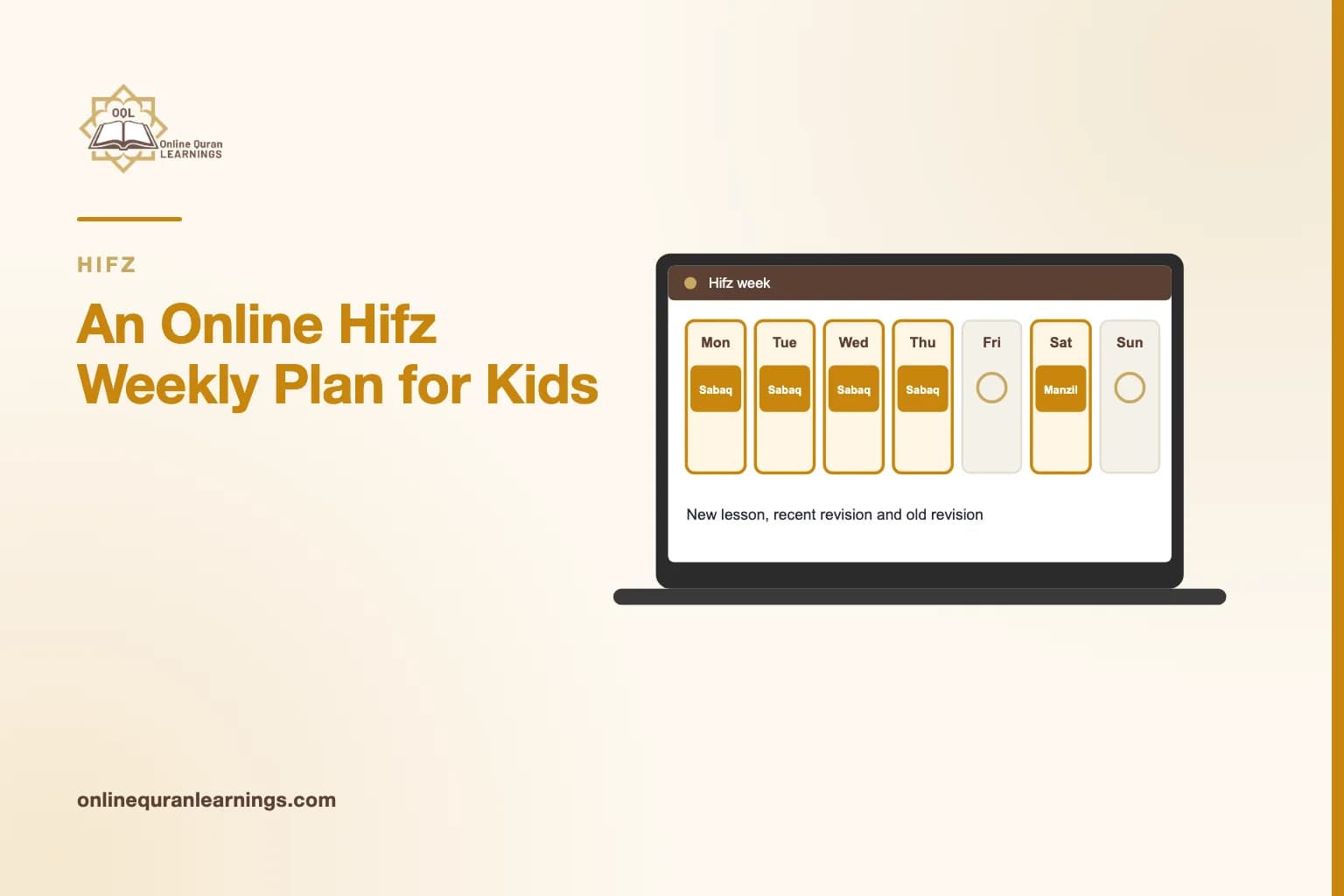
Most parents who start online Hifz for a child have the same question by week three: what is my child supposed to be doing on the days in between? The class is thirty minutes. The rest of the week is where the memorisation either holds or slips.
Here is the plan we would sketch for a school-age child, by number of classes. The details move with age and stage, but the shape is reliable.
| Classes a week | New memorisation (sabaq) | Home practice on class days | Home practice on other days |
|---|---|---|---|
| 3 | 3 small portions a week | 10-15 min | 15-20 min, mostly revision |
| 4 | 4 portions a week | 10-15 min | 15-20 min, revision only |
| 5 | 5 portions a week | 15-20 min | 20-30 min at the weekend, revision only |
The numbers that matter are in the last two columns. A child on five classes and no home revision will do worse, over a year, than a child on three classes who recites to a parent every day.
The three parts every week has to cover
If the terms are new: sabaq is the new lesson, sabqi is the recent portion (roughly the last one to three weeks), and manzil is everything older, taken in turns. Our page on memorisation with murajaah explains the system in full. This article is about fitting it into a real week.
The one rule that holds at every frequency: sabqi and manzil happen every week, whatever else is dropped. New lines are the first thing to cut when a week goes badly, never the revision.
What thirty minutes of class time is actually for
A thirty-minute one-to-one lesson cannot hear everything, and it should not try. It is best spent on the jobs that need a teacher's ear.
| Part of the lesson | Rough minutes | Why it needs the teacher |
|---|---|---|
| Last lesson's sabaq, from memory | 5-7 | Catches a wrong vowel before it sets |
| New sabaq: heard, read, corrected | 10-12 | The child must hear it right before repeating it fifty times |
| Sabqi | 6-8 | Shows whether recent work is holding |
| A slice of manzil | 4-6 | Spot-checks older surahs or pages |
Notice what is missing: long, uninterrupted manzil. That is home work. The teacher samples it in class and tells you where it is weak.
Plan A: three classes a week
This suits a younger child in Juz Amma, or a child whose school week is heavy. With lessons on, say, Monday, Wednesday and Friday:
| Day | In the lesson | At home |
|---|---|---|
| Monday | Recite Friday's sabaq, new sabaq, sabqi check | 10 min: repeat today's new lines |
| Tuesday | No class | 15 min: Monday's lines plus sabqi |
| Wednesday | Recite Monday's sabaq, new sabaq, manzil slice | 10 min: today's new lines |
| Thursday | No class | 15 min: Wednesday's lines plus one older surah |
| Friday | Recite Wednesday's sabaq, new sabaq, sabqi check | 10 min: today's new lines |
| Saturday | No class | 20 min: the week's sabaq straight through |
| Sunday | No class | 15-20 min: manzil only, no new lines |
The weak point of this plan is the gap between Friday and Monday. If the weekend practice does not happen, Monday's lesson becomes a repair session.
Plan B: four classes a week
Four classes is where full Hifz starts to feel steady, because the teacher hears the child often enough to catch drift early. A common pattern is Monday to Thursday.
| Day | In the lesson | At home |
|---|---|---|
| Monday | Weekend revision check, new sabaq | 10-15 min: new lines |
| Tuesday | Recite Monday's sabaq, new sabaq, sabqi | 10-15 min: new lines plus sabqi |
| Wednesday | Recite Tuesday's sabaq, new sabaq, manzil slice | 10-15 min: new lines |
| Thursday | Recite Wednesday's sabaq, new sabaq, sabqi | 10-15 min: new lines |
| Friday | No class | 15-20 min: the whole week's sabaq |
| Saturday | No class | 20 min: manzil, first half |
| Sunday | No class | 20 min: manzil, second half |
Taking Friday off gives a natural consolidation day before the weekend. Families who prefer Saturday lessons can swap a weekday for it; weekend Quran classes work well for children whose evenings are full.
Plan C: five classes a week
Five classes suits an older child who reads fluently and has a few juz behind them, or a family that has chosen to prioritise Hifz for a period. Lessons run Monday to Friday.
| Day | In the lesson | At home |
|---|---|---|
| Monday to Friday | Yesterday's sabaq, new sabaq, then sabqi or manzil in alternation | 15-20 min: new lines, then a fixed manzil portion |
| Saturday | No class | 25-30 min: the week's sabaq plus sabqi |
| Sunday | No class | 25-30 min: manzil |
At this frequency the danger is a different one. The sabaq moves fast and feels like progress, so revision quietly shrinks. Ask the teacher at the start how the manzil is divided, for example the total memorised split into a set number of daily portions, so it comes round on a cycle you can check.
Sizing the new portion
The plans above say "portion" on purpose, because the right size changes a lot.
- A five- or six-year-old in the short surahs: one or two short ayahs per lesson, learned largely by listening.
- A seven- to nine-year-old in Juz Amma: two to four ayahs, or a few lines.
- A ten- to twelve-year-old reading fluently: often a third of a page to half a page.
- A teenager with several juz done: sometimes more, if revision is holding.
The test is not whether the child can memorise the portion in the lesson. It is whether they can recite it cleanly at the next lesson, and again two weeks later. If they can, the size is right.
What the weekend is for
In every plan, the weekend carries the revision the lessons cannot. It is also where most plans break, because weekends are irregular.
Two things help. Fix the time rather than the day's activities, for example twenty minutes straight after breakfast. And keep weekends free of new lines, so the child is never memorising something the teacher has not heard.
A useful weekend check: on Sunday, ask your child to recite the week's sabaq from start to finish without the mushaf while you follow along. Mark any place they stop. Send those places to the teacher, or simply mention them at the start of Monday's lesson.
When your child falls behind
Every child falls behind at some point. School exams, a cold, a holiday or a hard surah will do it. The useful thing is knowing which part has slipped.
| What you notice | Likely cause | What to change |
|---|---|---|
| Last lesson's sabaq is shaky every time | Portion too big, or home repetition too short | Halve the sabaq for two weeks |
| New lines fine, recent pages patchy | Sabqi being skipped at home | Add sabqi to every home session, even five minutes |
| Older surahs need prompting | Manzil not coming round often enough | Pause new lines, give a week or two to manzil |
| Child resists every session | Sessions too long, or at a tired time | Split home practice into two short slots |
| Same verse breaks in the same place | A weak join between two ayahs | Ask the teacher to drill that join specifically |
The honest default when things go wrong: stop new memorisation for a week and revise. It feels like losing time. It is cheaper than losing a juz.
Choosing between three, four and five
If your child is in Juz Amma and under nine, three classes a week with daily home revision is usually plenty. If they are starting full Hifz from a fluent reading base, four is a sensible default. Five is worth it when the child is motivated, the family can protect the home time, and the manzil is already large enough to need the extra listening.
Our article on how many Quran classes a week covers frequency in general. If you are not yet sure Hifz is the right next step, read whether your child is ready for Hifz first, and for what happens in the memory itself, see how children memorise the Quran.
Whatever the frequency, lessons in our Hifz classes are one-to-one and recorded, and you get a monthly progress report, so you can see whether the plan on paper matches what is happening.
Frequently asked questions
Can a child do Hifz with only two classes a week?
For Juz Amma, yes, if home revision happens daily. For full Hifz it is usually too thin, because two lessons cannot hear enough of the growing manzil and the teacher loses track of what is holding.
Should the sabaq be memorised in class or at home?
Most teachers introduce and correct the new lines in class, then the child secures them at home and recites them from memory at the next lesson. A new portion that has never been heard by the teacher should not be memorised alone, because errors set quickly.
What if we miss a whole week for travel or illness?
Skip the new lines when you come back, not the revision. Spend the first two or three lessons on sabqi and manzil only, then restart the sabaq at a slightly smaller size.
Does the plan change in Ramadan?
Many families keep the lesson slot and shrink or pause new memorisation, using the month for revision and for reciting memorised surahs in prayer. Agree the change with the teacher before the month starts rather than letting lessons drift.