
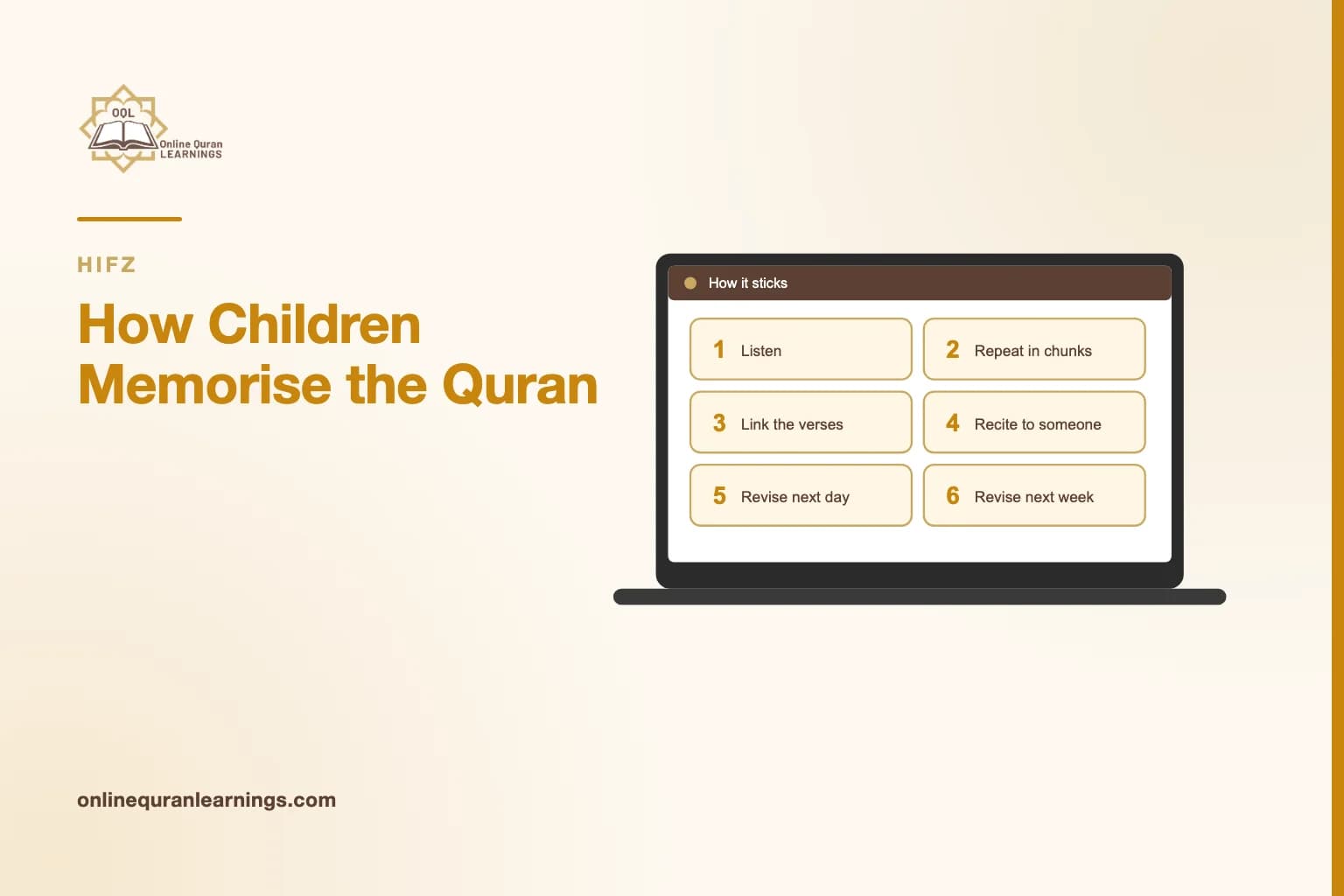
Short answer: children memorise the Quran by hearing a small piece many times, repeating it aloud until it comes without the page, joining it to the piece before, and then hearing it again on a schedule for months and years. The first part is quick. The last part is what decides whether it lasts.
Most of what parents worry about, such as a child who memorises fast and forgets fast, or one who knows a surah but freezes in the middle, comes from that last part being thin.
Ears first, then eyes
Young children memorise mainly by sound. A five-year-old who knows Al-Ikhlas has usually heard it hundreds of times before anyone asked them to learn it, in Salah, at bedtime, in the car.
That is why teachers often start the youngest children by listening and repeating rather than reading. The teacher says a short phrase, the child echoes it, and they go round several times. By seven or eight, once reading is secure, the eyes join in: the child reads the ayah, then recites it, then reads it again to check.
Two practical points follow:
- Keep to one reciter at home. Different reciters pause, stretch and pitch differently, and a young child's memory holds the melody along with the words. Switching voices makes the tune unfamiliar every time.
- Choose a slow, clear recitation. A fast recitation is beautiful to listen to and hard to copy. Your child needs to hear every letter.
Small pieces, sized to the child
Nobody memorises a page at once. They memorise a phrase, then another, then put them together. Teachers call this the portion, and getting its size right is most of the skill.
| Child | Typical piece to repeat | Rough number of repetitions |
|---|---|---|
| Age 4 to 6, short surahs | Half an ayah or a short phrase | Many, by echoing the teacher |
| Age 7 to 9, Juz Amma | One short ayah | 10 to 20, reading then from memory |
| Age 10 to 12, reading fluently | One or two lines of the mushaf | 10 to 20 per line, then the joined lines |
| Teenagers | Several lines at a time | Fewer per line, more on the joins |
These are ranges, not targets. If a piece needs far more repetitions than this to hold, it is too big. If it holds after three, it can grow.
The joins between ayahs
Here is something parents often do not notice. A child can know every ayah of a surah and still stall when reciting it, because they do not know which ayah comes next.
The weak spots are the joins. A child who has drilled ayah 4 and ayah 5 separately has not yet drilled the move from 4 into 5.
The fix is simple and teachers use it constantly:
- Memorise ayah one.
- Memorise ayah two.
- Recite one and two together, several times.
- Memorise ayah three.
- Recite two and three together, then one to three.
Each new piece is always tied to the piece before it. When a child repeatedly breaks at the same spot, it is nearly always a join, and drilling just those two ayahs together for a few days usually repairs it.
Why the same mushaf matters
Children who memorise from a printed mushaf build a picture of the page alongside the sound: where the ayah starts, which side of the page it sits on, what comes at the top of the next page. Many huffaz describe "seeing" the page as they recite.
That picture only forms if the page stays the same. Mushafs differ: the widely used Madani print has 15 lines a page, while many South Asian prints have 13 or 16 lines and a different script style. Switching between them means the visual memory starts again.
Pick one printed mushaf for memorisation and keep it. If your child uses an app or a second copy at a grandparent's house, try to match the layout. This matters less for the youngest listeners and more from about age eight onwards.
Revision on a schedule, not by feel
Memory fades when it is not used, for children and adults alike. A surah recited perfectly this week will be patchy in two months if nobody asks for it.
Hifz deals with this through three strands: the new lesson, recent revision and older revision, often called sabaq, sabqi and manzil. The detail is on our murajaah page, and the weekly Hifz plan shows how they fit around school.
The principle is spacing. New material is revisited the next day, then a few days later, then weekly, then on a longer rotation. Each successful recall, after a gap, makes the next one easier.
Sleep and timing
It is widely accepted that sleep helps the day's learning settle. In Hifz this has a practical side: a portion repeated before bed and recited again in the morning often holds better than one crammed in a single sitting.
Timing in the day matters too. A child who is tired, hungry or wound up from a screen will repeat lines without taking them in. A short session when they are fresh, even ten minutes, usually beats a long one at the wrong time.
Fast to memorise, fast to forget
Every teacher has met this child. They pick up a new surah in one lesson, recite it beautifully, and a month later it is half gone.
There are usually three things going on:
- Recognition, not recall. The child knows the flow from the start but cannot begin from the middle. Ask them to start at ayah five. If they cannot, the surah is held as one sequence rather than as known parts.
- Tune over text. A good ear can hold the melody of a recitation with small words missing or swapped. It sounds right and is not quite right.
- No revision, because it seemed unnecessary. Fast memorisers often get less revision, because they seem not to need it. They need it just as much.
Slower memorisers often retain better, partly because they did more repetitions to get there. Speed at the start says little about how much a child will hold in two years. Our article on why children forget Quran lessons covers forgetting more broadly.
Techniques parents can use at home
You do not need to read Arabic fluently for most of these. You need to follow along in the mushaf and listen.
- Ask for the middle. "Start from the ayah about the birds." This tests real recall.
- Play the next-ayah game. Recite the end of one ayah and let your child carry on.
- Recite the newest lines first, while they are fresh, then one older surah.
- Use Salah. Encourage your child to recite memorised surahs in prayer, rotating through them.
- Mark the breaks. Put a small pencil dot beside any place they stop, and tell the teacher.
- Keep sessions short and daily. Ten minutes most days beats an hour on Sunday.
- Swap roles occasionally. Let your child test you. Children enjoy catching a parent's slip, and they listen hard to do it.
What a teacher adds
Memorisation is the one area of Quran study where it is very hard to correct yourself, because an error that has been repeated feels right. A teacher listening live catches the swapped vowel, the skipped word and the wobbly join the same day.
In our one-to-one Quran memorisation classes, lessons are recorded and parents receive a monthly progress report, so you can see where the memory is strong and where it needs work. If your child has not started yet, our guide on whether your child is ready for Hifz is a good next read, and the list of short surahs for kids to memorise is a sensible place to begin.
Frequently asked questions
Should my child listen to the surah on audio before the lesson?
A few listens to the coming portion, from one clear reciter, usually helps because the sounds are already familiar when the teacher introduces them. Listening should support the lesson, not replace hearing it corrected by the teacher.
Is it a problem if my child memorises with their eyes closed?
Not at all. Many children recite better without visual distractions. The thing to check is that they can also start from the middle of a surah, not only from the beginning.
Can a child memorise from a phone or tablet app?
They can, but screens reflow text and change layout, which weakens the page memory a printed mushaf builds. If you use an app, choose one that shows fixed mushaf pages matching the printed copy your child uses.
Do boys and girls memorise differently?
Individual differences between children are far larger than any general difference we see between boys and girls. Pace depends much more on reading, attention, home practice and the fit with the teacher.