
You do not have to be the teacher to make a real difference to a young child's Qaida. Your part is smaller and, in some ways, more powerful: short daily contact with the letters, at home, with someone they love listening.
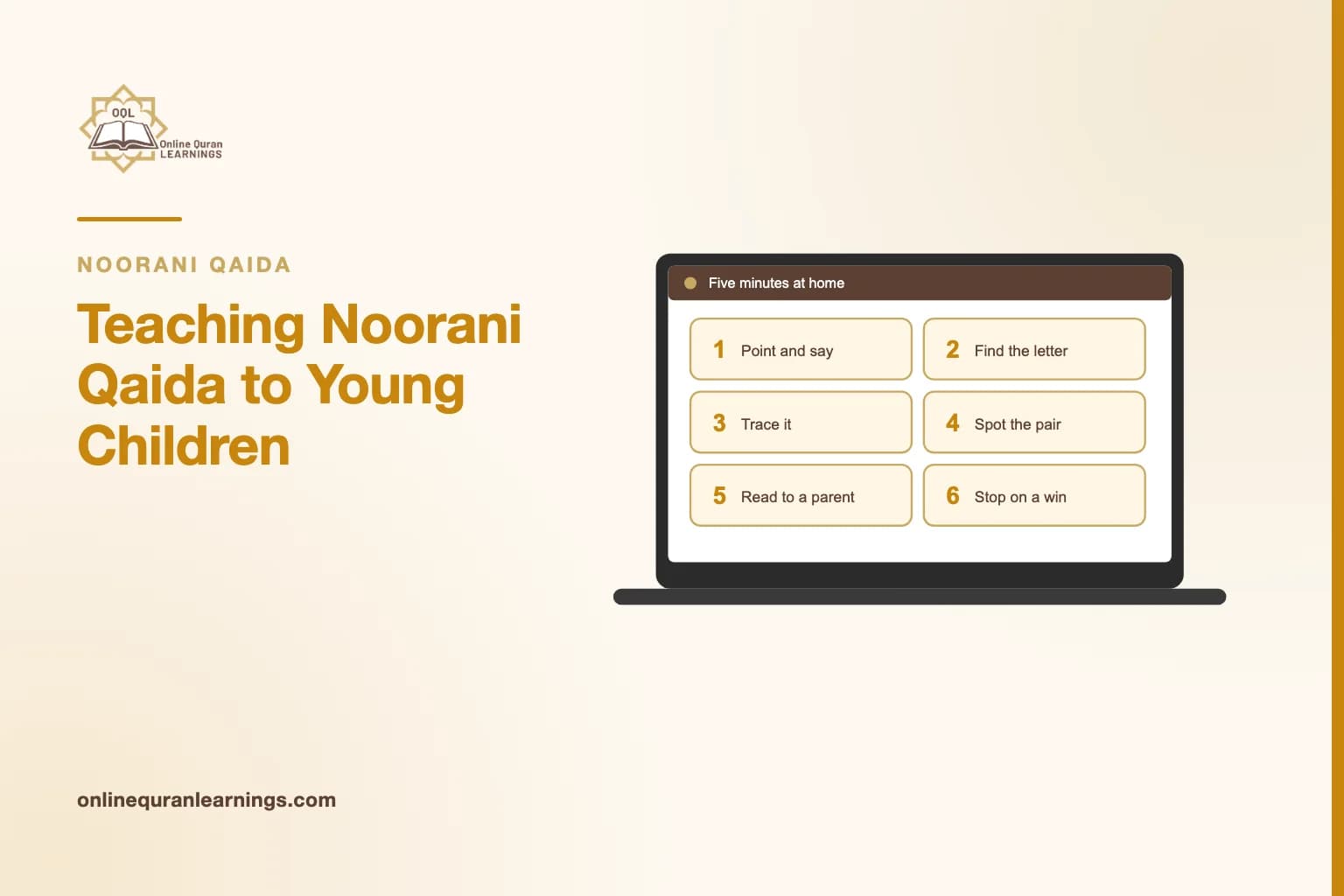
Here is the whole approach on one screen:
- Ten minutes or less, most days, at the same point in the routine.
- Out loud, every time. Your child says each sound; you listen.
- Revise before anything new, and only practise what the teacher has already taught.
- Play counts as practice for a four- or five-year-old.
- Praise effort and specifics, not speed or page numbers.
- Leave pronunciation fixes to the teacher unless you are sure.
The rest of this guide shows what those six lines look like on an ordinary Tuesday.
A ten-minute session, minute by minute
For a child aged four to seven, this shape works well. Adjust the times; keep the order.
| Minutes | What you do | Why |
|---|---|---|
| 0 to 1 | Sit together, open the Qaida, say Bismillah | A small ritual tells the child what is starting |
| 1 to 4 | Child reads the letters from the last lesson | Revision first, while attention is fresh |
| 4 to 7 | A quick game with the same letters | Keeps the sounds coming out without it feeling like a test |
| 7 to 9 | Child reads the newest letters once more | The last thing practised sticks best |
| 9 to 10 | Say what went well, close the book | Ending on a win makes tomorrow easier |
For a four-year-old, five minutes of this is plenty. For a seven-year-old, ten to fifteen is fine. The point is that it happens on most days, not that it is long.
Games that keep the sounds coming
At this age, a game is not a break from learning. It is the learning, provided your child is saying the sounds aloud. A few that need nothing but the Qaida and paper:
Find it
Say a letter the teacher has taught, and your child points to it on the page. Then swap: they say one, you find it. Make a few deliberate mistakes so they get to correct you. Children love catching a parent out.
The letter detective
Cover the page with a sheet of paper that has a small window cut in it. Slide it around and let your child read whatever letter appears. This stops them reading from memory of the row.
Big voice, little voice
Once the teacher has introduced heavy letters, play a game where your child uses a "big" deep voice for the heavy ones and a "little" voice for the light ones. It is a fun way to keep ص and س apart without you needing to know the technical rule.
Letters on the fridge
Write three or four taught letters on sticky notes and put them somewhere the child passes every day. Each time they pass, they say one. It adds a few seconds of practice to the day without anyone sitting down.
Tracing and shaping
Trace the letter with a finger on the page, then in the air, then on a tray of sand or salt, saying the sound each time. For fours and fives, shaping a letter from play dough while saying it is surprisingly effective. Tracing helps recognition; it is the sound said aloud that does the real work, so keep that part in.
Pointing, and why it matters so much
Teach your child to follow every letter with a finger or a pencil. It slows them down, keeps their eyes on the right letter, and shows you instantly when they have lost their place. A child who reads without pointing at this age is often reciting from memory. Once joining starts, pointing under each letter in a word becomes even more useful.
Rewards without turning it into a deal
Young children respond well to recognition. They respond less well, over time, to payment.
What tends to work:
- A sticker chart for showing up, not for getting things right. Seven days in a row earns a small treat or an outing.
- Specific praise: "You made ق really deep today" means more than "Good job."
- Telling someone else, in the child's hearing, what they did well.
- Letting them show a grandparent on a video call.
What tends to backfire:
- Paying per page, which teaches that the Qaida is a chore worth money.
- Withholding screen time or treats as punishment for a bad session.
- Praising speed, which encourages guessing.
The distinction is between celebrating the habit and buying the outcome. Children who are paid per page tend to rush, and rushing is the most common way a Qaida gets finished on paper but not in practice.
When your child keeps confusing letters
Every child mixes up letters. Some of it is shapes, some of it is sounds, and the response is different.
Shape mix-ups
ب ت ث differ only in their dots, as do ج ح خ. If your child calls ت "ba", try this:
- Point to the dots and ask, "How many? Where are they?"
- Let them say the right letter themselves.
- Move on without making a fuss.
Count the dots together a few times and it usually settles within a week or two.
Sound mix-ups
If ح comes out like ه, or ق like ك, that is a pronunciation question, and it belongs with the teacher. Say something like:
"That's a tricky one. Let's ask your teacher about it on Thursday."
Then send a short note to the teacher or mention it at the start of the next lesson. Our guide to Noorani Qaida lesson 1 lists the pairs that trip up English-speaking children, so you know which ones to listen for.
When it is the same mistake every day
If a mix-up has not improved after two weeks of practice, it is a sign the child needs more time on that stage, not more drilling at home. Tell the teacher and ask them to revise before moving on.
A sample week alongside two or three lessons
| Day | At home |
|---|---|
| Lesson day | Two minutes after class: "Show me what you learned" |
| Day after | Full ten-minute session |
| Next day | Ten minutes, or a game only if it has been a long day |
| Lesson day | Two minutes after class |
| Day after | Full session |
| Weekend day | Letters on the fridge, a game, no formal session |
| Rest day | Nothing, or read to a grandparent |
One day off a week is healthy. Several days off in a row is where children start to lose ground, which is why children forget Quran lessons between classes more often than during them.
When to leave it to the teacher
You are the practice partner, not the second teacher. Step back in these situations:
- New letters. Do not teach ahead of the lesson, even if your child asks. Introducing a sound wrongly is harder to fix than introducing it late.
- Pronunciation you are unsure of. Note it, do not correct it.
- Tears or refusal. Stop the session, keep the routine light for a few days, and talk to the teacher. Our guide for when a child refuses Quran class covers what to do if it persists.
- Long stalls. If the same page has not moved for a month, ask the teacher for a plan rather than adding more practice.
Our lessons are recorded and parents receive a monthly progress report, so you always have something concrete to work from. If you can sit in on the occasional live lesson, you will pick up the teacher's cues and use the same words at home, which helps children enormously. Tips for keeping a young child settled during the class itself are in keeping kids focused in online Quran class.
Patience about the pace
Some weeks your child will race ahead. Some weeks the same row will feel stuck. Both are part of learning to read at four, five or six. If you want a sense of what is normal over months rather than days, our guide to how long Noorani Qaida takes gives honest ranges by age. And if your child has not started yet, our Noorani Qaida course page explains how lessons are structured from the first page, and you can book free trial Quran classes for your child to see the routine in action before committing.
Frequently asked questions
What time of day is best for Qaida practice?
Whenever your child is fed, rested and not in the middle of something they love. For many families that is straight after breakfast or just before the bedtime story, attached to a routine that already happens every day.
Should siblings practise together?
Short shared games can work, but keep reading practice separate if one child is ahead. Young children notice comparisons quickly, and the younger one often stops trying.
Can I use a Qaida app for home practice?
As a way to hear the sounds, yes, if the recitation is clear. An app cannot hear your child, so use it for listening and keep the reading-aloud part with you and the teacher.
My child wants to do more than ten minutes. Should I let them?
Let them, as long as it stays fun and you stop before they tire. Ending while they still want more is what brings them back the next day.