
Parents ask this in the first conversation, often before the child has said a single letter. It is a fair question. You are planning a school year, a budget and a routine, and you want to know roughly what you are signing up for.
Short answer: most children aged five to eight finish Noorani Qaida in roughly six to fifteen months at two or three lessons a week. Four-year-olds usually take longer, older children and adults usually take less, and daily practice at home moves a child further than an extra lesson does.
Those are ranges we see, not deadlines. The rest of this page explains what sits inside them, so you can place your own child somewhere sensible.
Rough timelines by age and lessons per week
The table assumes thirty-minute one-to-one lessons, a few minutes of practice on most other days, and no long breaks. Change any of those and the numbers move.
| Starting age | 2 lessons a week | 3 lessons a week | 4 to 5 lessons a week |
|---|---|---|---|
| 4 to 5 | 12 to 20 months | 9 to 15 months | 7 to 12 months |
| 6 to 8 | 9 to 15 months | 6 to 12 months | 5 to 9 months |
| 9 to 12 | 6 to 10 months | 4 to 8 months | 3 to 6 months |
| Teens and adults | 4 to 8 months | 3 to 6 months | 2 to 4 months |
Notice that going from two to three lessons a week makes a bigger difference than going from three to five. The second lesson in a week is mostly holding on to the first. The third is where new ground gets covered. Our guide to how many Quran classes a week a child needs goes into that pattern in more detail.
What speeds it up and what slows it down
Age, and what it really stands for
Age is a shorthand for three things: attention span, fine motor control for following the text with a finger, and whether the child can already read in some other language. A seven-year-old who reads English chapter books understands the idea of a letter making a sound and sounds joining into a word. A four-year-old is learning that idea for the first time, in Arabic. That alone accounts for most of the gap in the table. If you are still deciding when to begin, what age to start Quran classes covers the trade-offs.
Lessons per week
Frequency matters more than lesson length. Two days between lessons is fine. Five or six days between them means the first ten minutes of every lesson are recovery.
Practice between lessons
This is the variable parents control most directly, and it is often the biggest. Five minutes of reading the current page aloud on non-lesson days keeps the sounds warm. A child with no practice at all tends to sit in the slowest part of their row, or below it.
Prior exposure
A child who has heard the Quran recited at home, knows Surah Al-Fatiha by ear, or has done some letters at a weekend Islamic school starts with an ear for the sounds. They will not skip stages, but the early pages move faster.
Home language
This one surprises people. A child who speaks Arabic at home usually finds the throat letters easier. A child from an Urdu-speaking home may already know many letter names but carry the everyday Urdu habit of saying ز, ذ, ض and ظ the same way, which takes time to untangle. A child who hears only English has the most new sounds to build. None of these is a disadvantage that lasts; they just shape where the teacher spends the early weeks.
A stage-by-stage timeline for one typical child
Here is what the months often look like for a six-year-old at three lessons a week with light practice at home. It is one illustration, not a schedule.
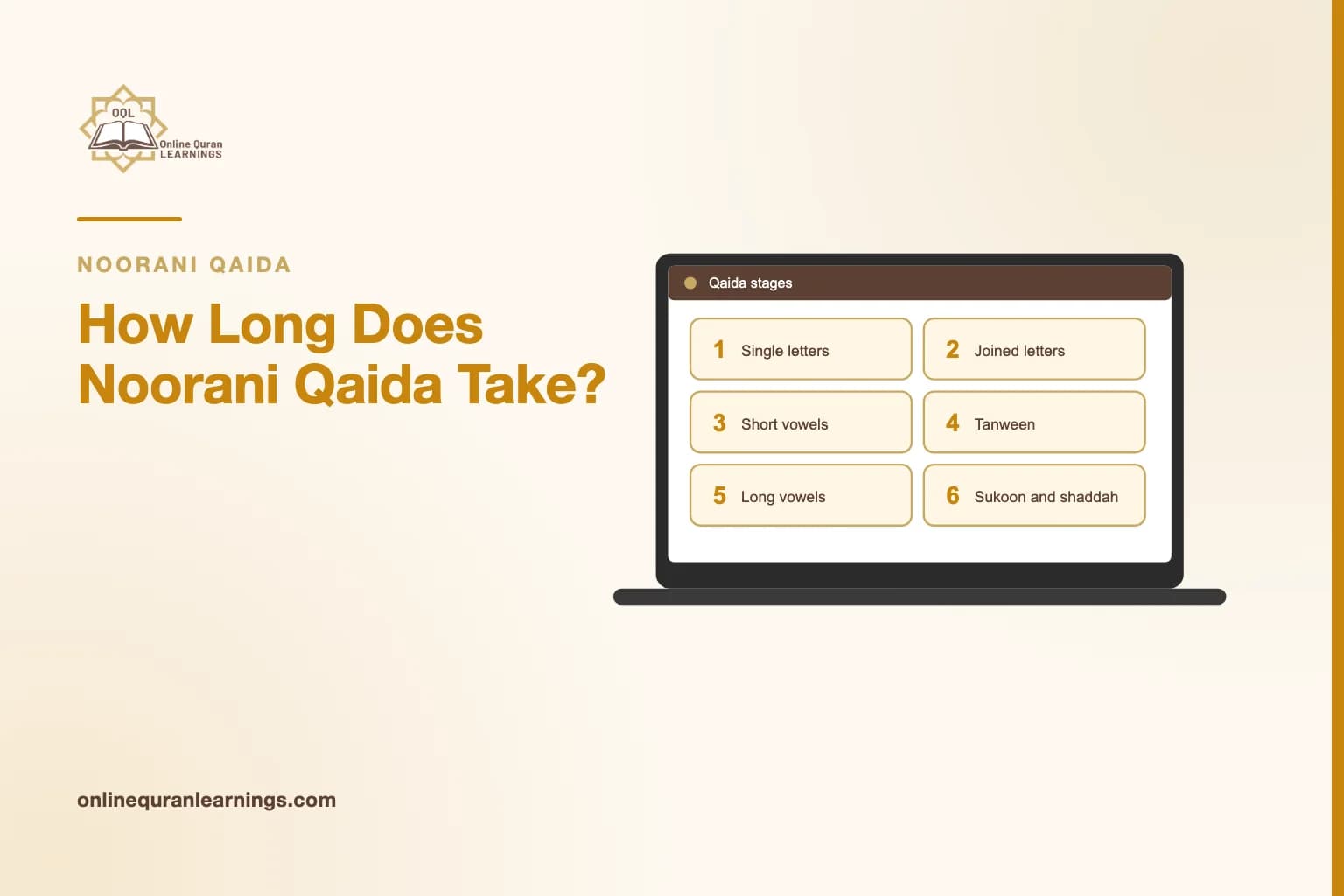
- Months 1 to 2: single letters. The sounds of each letter, the shapes, and the difference between close pairs. Lesson 1 of the Qaida is where this starts.
- Month 3: joined letters. Recognising that a letter changes shape at the start, middle and end of a word. Many children slow down here, and that is expected.
- Months 3 to 5: short vowels and tanween. Fatha, kasra and damma, then the doubled forms. Reading starts to sound like syllables.
- Months 5 to 6: long vowels and sukoon. Holding a sound for two counts, and stopping a letter cleanly.
- Months 6 to 8: shaddah and combinations. Doubled letters, then mixed exercises that pull everything together.
- Months 8 to 10: rules and practice text. Basic noon and meem rules, short words from the Quran, and reading whole lines without spelling them out.
Some children fly through months 1 to 2 and stall in month 3. Others are slow on the letters and then speed up once joining clicks. Both are normal. The detail of what is taught at each stage is set out in our Noorani Qaida curriculum, and our parent's guide to the Qaida explains why the order matters.
Signs a child is being rushed
A fast Qaida is not the same as a good one. These are the signs that the pages are moving faster than the skill:
- They read the current page smoothly but stumble when you point to a line from three pages back.
- They recognise letters in the order they appear on the page but not when you point to them at random.
- Close pairs blur together: ح sounds like ه, ق like ك, ص like س.
- They read by memory of the page rather than by looking, which shows when you cover half a line.
- Long vowels are all the same length, or none of them are held.
- They are anxious about lessons, or keep asking how many pages are left.
If you see two or three of these, ask the teacher to slow down and revise. It costs a few weeks now and saves months later, because a gap in the Qaida resurfaces as hesitant, error-prone Quran reading.
Signs it is going slower than it needs to
The opposite problem is real too. A child who is ready but not being moved on usually shows it:
- They read the current page well, and earlier pages well, but still get the same page lesson after lesson.
- They are bored rather than stuck, and finish the practice in two minutes.
- Missed lessons, not difficulty, are the main reason for slow progress.
In the first two cases, ask the teacher directly whether the child is ready for the next stage. In the third, the fix is the routine rather than the teaching. Our monthly progress report to parents is a good moment to raise either.
What to do with the answer
Use the table to set expectations, not goals. Pick the row and column that match your child and plan for the middle of the range. Then watch the signs above rather than the page count.
If your child is four or five, the most useful thing you can do is protect the daily five minutes. Our guide on teaching Noorani Qaida to young children at home shows what those five minutes can look like.
Finishing the Qaida means your child can decode Quranic text. Reading it fluently and correctly is the next stage, and the difference between Quran reading and Tajweed explains how the two fit together after the last page.
Frequently asked questions
Can a child finish Noorani Qaida in one month?
Very rarely, and usually not well. An older child or adult with daily lessons can cover the pages quickly, but a young child who races through in a month almost always has to go back over the joining and the vowel stages later.
Does it take longer if we started with another primer?
Not much. A child who has done some Iqra or Ahsanul Qawaid usually moves quickly through the early Noorani Qaida pages, and the teacher simply checks each stage rather than teaching it from scratch.
What should my child read straight after the Qaida?
Most teachers move on to the short surahs of Juz Amma, read from the mushaf, because the text is familiar from prayer. The Qaida rules keep being applied and refined there.
We took a long break. Will my child have to start again?
Usually not from page one. The teacher checks where the reading is still secure, revises the stage just before it, and carries on. A few weeks of revision is normal after a break of several months.