
A ten-year-old reads Surah Al-Mulk fluently, with good Tajweed, and then asks what it was about. They have no idea. Many parents meet this moment and feel something has gone wrong.
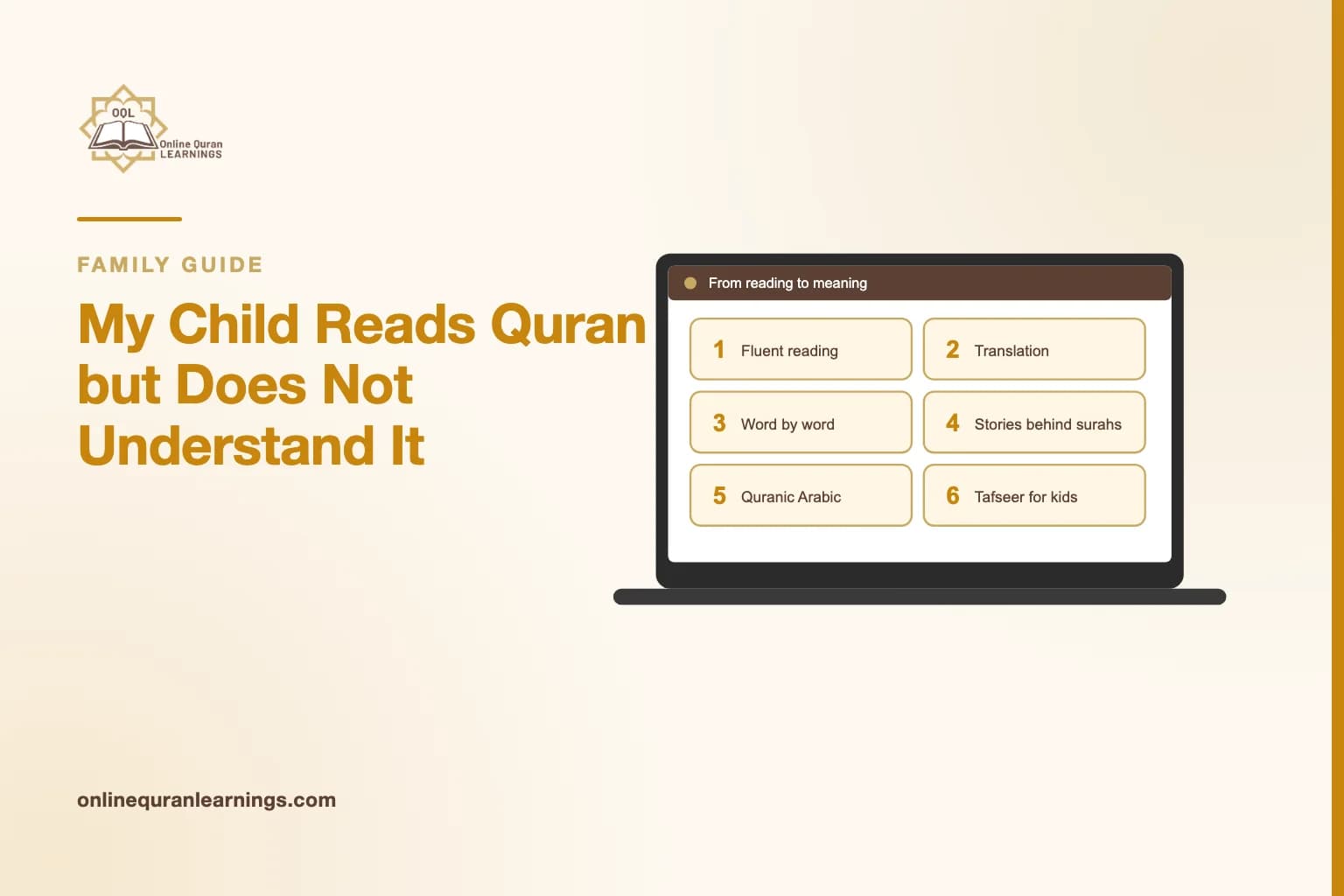
It has not. Reading and understanding are two different skills, and most children outside the Arab world are taught only the first, on purpose, because it comes first. The gap closes when meaning is added deliberately, in one of four ways:
- Translation alongside what they already read, for the gist.
- Word-by-word meaning, so the Arabic itself starts to make sense.
- Tafseer for children, for the story and context behind a surah.
- Quranic Arabic, for real understanding over a few years.
Most families combine the first two at home and add the others with a teacher when the child is ready.
Why reading comes without meaning
Arabic script is very regular once the vowel marks are learned. A child who has finished Noorani Qaida can sound out almost any word in the mushaf correctly, without knowing what it means. That is the whole aim of Qaida: correct sounds, not vocabulary.
For a child in an English-speaking home, there is nothing in daily life that supplies the meaning. An Arabic-speaking child picks up a good deal from family and school. An English-speaking child hears Quranic Arabic only in recitation.
So the gap is not a teaching failure. It is the natural result of learning to read first, and it is the right order. Reading correctly is a foundation that understanding is built on, and reciting the Quran is worship in itself. Most scholars agree a child is rewarded for reciting before they understand. The Quran also asks its readers to reflect on its verses (38:29), and that is the reason to keep going.
The four routes compared
| Route | What your child gets | Good starting age | Who leads it |
|---|---|---|---|
| Translation alongside | The overall message of a surah | 5 and up, read to them | A parent can |
| Word-by-word meaning | Understanding of common words in the Arabic | 7 and up, once reading | Parent at first, then a teacher |
| Tafseer for kids | Stories, context, lessons from each surah | 7 and up | Usually a teacher |
| Quranic Arabic | Grammar and vocabulary to understand directly | 9 or 10 and up | A teacher |
These are not stages to finish in order. A seven-year-old can hear the story of Al-Fil, learn that rabb means Lord, and read a translation of Al-Fatihah, all in the same month.
Translation: quick, but it stays in English
Reading a translation alongside the Arabic gives a child the meaning fast. It is the easiest place to start and needs nothing but a good translation in the language your child reads best.
Its limit is that the understanding stays in English. A child who has read the translation of Al-Asr can tell you what it says, but while reciting it in Salah they are still hearing sounds. That is where word-by-word comes in.
Word-by-word: where the Arabic starts to speak
Word-by-word study links each Arabic word to its meaning. Take Al-Ikhlas: qul means say, huwa means He, Allah, ahad means One. A child who knows those four words understands the first ayah while reciting it, not afterwards.
The encouraging part is that a relatively small set of words comes up again and again: rabb (Lord), nas (people), qul (say), yawm (day), alladhina (those who), amanu (believed). A child who learns the common words in the surahs they already know will start recognising them everywhere.
Tafseer for children: the story behind the surah
Tafseer explains what a surah is about, why it was revealed and what it teaches. For children, this works best as stories: the people of the elephant, the Quraysh and their trade caravans, the Prophet's distress and the comfort of Ad-Duha.
Children who know the story behind a surah often recite it differently, with more attention. Our Tafseer courses are one-to-one, so the teacher can pitch each lesson to your child's age.
Quranic Arabic: the long route to real understanding
For a child who wants to understand directly, Quranic Arabic is the route: vocabulary, word patterns and enough grammar to follow a verse. It is a multi-year subject, and it usually suits children from about nine or ten who already read well.
It is different from the Arabic taught in most schools, which is usually Modern Standard Arabic for conversation and media. Our article on Quranic Arabic vs Modern Arabic sets out the difference, and our one-to-one Arabic language course is the place to start with a teacher.
A ten-minute routine to start this week
You do not need to plan a course. Start with the surahs your child already recites in Salah, because meaning there pays off five times a day.
- Pick one short surah your child knows well, such as Al-Ikhlas or Al-Asr.
- Read a simple translation together, one ayah at a time, in English.
- Ask one open question: "What do you think this ayah is telling us?"
- Choose two Arabic words from it and their meanings. Write them on a card.
- Ask your child to recite the surah, pausing at the two words to say what they mean.
- Keep the cards in a pile and revisit them at the start of next week's session.
After a month, your child knows the meaning of four or five surahs and twenty or so common words. That is a real beginning.
Some families find this harder because the child's strongest language is English and the family's is not. If that sounds like your home, our guide to teaching Quran to a child who only speaks English covers it in detail.
What to expect at each age
| Age | Realistic aim for meaning |
|---|---|
| 4 to 6 | Simple stories and a sentence-long meaning of each surah they know |
| 7 to 9 | Translation of their Salah surahs and a growing bank of common words |
| 10 to 12 | Word-by-word for Juz Amma, children's tafseer, possibly starting Quranic Arabic |
| Teenagers | Quranic Arabic or structured tafseer, with real discussion of what verses say |
These are ranges, not deadlines. A child who starts at twelve can move quickly, and a six-year-old who loves stories may know more about the surahs than an older sibling.
Keeping meaning and memorisation together
If your child is memorising, meaning can help it hold. A child who knows that Al-Fil moves from the army to the birds to the stones has a story to follow, which makes the order of the ayahs easier to keep. Our list of short surahs for kids to memorise includes a one-line meaning for each, which is an easy place to begin.
The goal is not a child who can translate every verse by twelve. It is a child who grows up knowing that the words they recite are speaking to them, and wants to know what they say.
Frequently asked questions
Which translation should I use with my child?
Pick one clear, modern translation in the language your child reads best and stay with it, so the wording becomes familiar. For younger children, an illustrated children's book of selected surahs is often easier than a full translation.
Will learning meaning slow down my child's reading or Hifz?
A few minutes of meaning a week rarely slows anything, and many children find that knowing what a surah says helps them remember it. If time is very tight, keep meaning to the surahs they already recite in Salah.
Can I teach meaning if I do not understand Arabic myself?
Yes, at the start. Reading a translation together and talking about it needs no Arabic. Once your child wants to know what individual words mean, a teacher becomes more useful than a parent learning alongside.
My teenager says reciting without understanding is pointless. How should I respond?
Take the question seriously, because it is a good one. Agree that understanding matters, and offer a concrete way to get it, such as a tafseer class or Quranic Arabic, rather than defending recitation alone.