
A father in Toronto sits beside his eight-year-old during Quran practice. She reads a line, pauses, and asks, "Is that right?" He has no idea. He grew up here too, learned a few surahs by ear, and never learned to read the script. He feels like he is failing her.
He is not. A child who only speaks English can learn to read the Quran accurately, and a parent who cannot read Arabic can still be the most useful person in that process. What the child needs is a teacher who explains in English and listens closely to every sound. What they need from you is routine, attention and a few things to avoid.
Three separate skills, not one
Parents often think of "learning the Quran" as one big task. For an English-speaking child it is really three, and they move at different speeds:
| Skill | What it means | Who mainly teaches it |
|---|---|---|
| Reading the script | Recognising letters, vowel marks and joined words | The teacher, through the Noorani Qaida |
| Making the sounds | Producing letters English does not have | The teacher, with lots of listening and correction |
| Understanding the meaning | Knowing what a verse or surah says | Teacher and family, through English translation |
The first two have to be learned from someone who can hear your child. The third is where you can help most, even without any Arabic. Keeping them apart in your head also stops you worrying that your child is "not understanding" when they are, quite correctly, still at the reading stage.
The sounds English simply does not have
An English mouth has never had to make some Arabic sounds, so it quietly swaps in the nearest familiar one. You do not need to make these sounds yourself, but it helps to know which ones the teacher will spend time on.
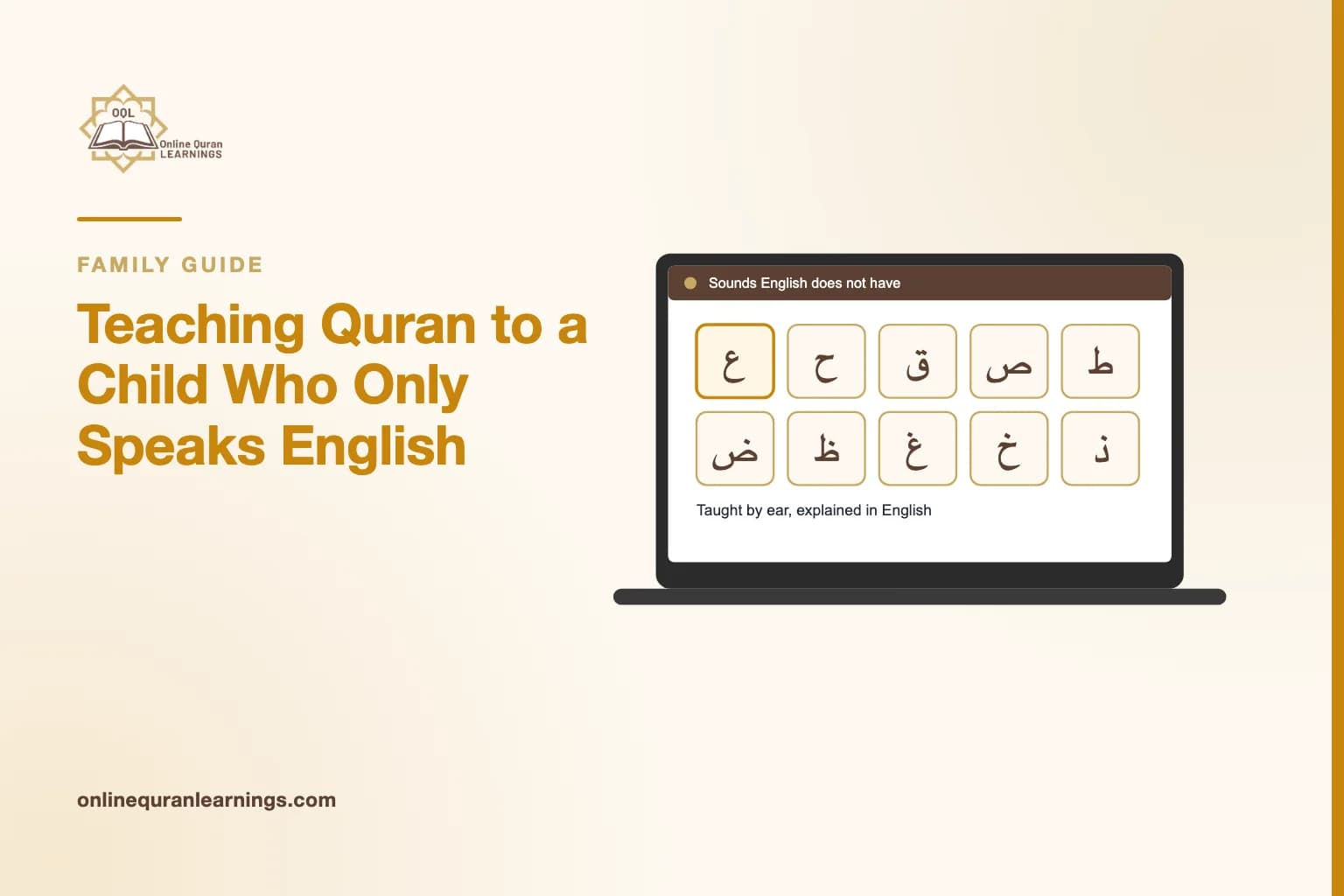
- Throat sounds. ع, ح, خ and غ are made further back than anything in English. Children often turn ع into a plain vowel and ح into an ordinary h.
- Heavy letters. ص, ض, ط, ظ and ق have light partners that sound like English letters: س, د, ت, ذ and ك. The heavy versions use a fuller, deeper mouth.
- The two "th" sounds. ث is the th in think and ذ is the th in this. English speakers know both, but children often turn them into s and z when reading Arabic.
These are not fussy details. In Arabic, swapping sounds can change the word entirely. قَلْب (qalb) means heart; كَلْب (kalb) means dog. عَلِيم, with ع, means all-knowing; أَلِيم, with a plain hamza, means painful. A child who hears this kind of example usually starts taking the sounds seriously.
The full list of pairs and how teachers cue them is in our guide to Noorani Qaida lesson 1, the page where all of this is first taught.
Why transliteration is a trap
Transliteration means Arabic written in English letters: Alhamdulillah, Qul huwa Allahu ahad. It feels like a shortcut, especially to a parent who cannot read the script either. It is a trap for three reasons.
English letters merge sounds Arabic keeps apart
Look at Alhamdulillah and Qul huwa. Both have an "h". In Arabic they are different letters: الْحَمْدُ uses the throat letter ح, and هُوَ uses the soft ه. In transliteration they look identical, so the child says them identically. The same thing happens with Ahad (ح again), and with every heavy letter, which English spelling has no way to show.
It only works for what someone has written out
A child who reads transliteration can read only the pages someone has transliterated. A child who reads Arabic can open any page of the Quran.
It becomes a habit that has to be undone
The longer a child reads Arabic through English spelling, the more firmly the English sounds settle in. Teachers regularly meet children of eleven or twelve who recite several surahs fluently and inaccurately, learned this way, and the unlearning takes longer than learning them fresh would have.
Transliteration has a small place: a dua for a five-year-old in the first week, or a parent following along with a surah they cannot yet read. It should not be what the child learns from.
What English-medium teaching should look like
An English-speaking child does not need a teacher who speaks only Arabic, or one who switches into Urdu when things get hard. They need lessons explained in the language they think in. In practice that means:
- Instructions such as "look at the dots" or "hold it for two counts" in English.
- Corrections that say what to change: "further back in your throat", "make your mouth round", not just the right sound repeated louder.
- The meaning of short surahs and duas given in simple English as they are learned.
- Patience with questions, because English-speaking children ask a lot of them.
Our Quran classes for English-speaking kids are built around exactly this, with one-to-one lessons explained in English so the teacher hears every sound your child makes.
Meaning comes through translation, and that is fine
Reading the Arabic and understanding it are separate. Most non-Arab Muslims, including many who recite beautifully, understand the Quran mainly through translation, and that is a normal place to be.
You can give your child meaning without reading a word of Arabic:
- Read the English translation of the surah they are learning, a few verses at a time. One clear modern translation, used consistently, is better than switching between several.
- Tell the story behind it. Surah Al-Fil is about an army and an elephant; Surah Al-Kawthar is a gift to the Prophet ﷺ at a hard time. Children remember stories.
- Ask what it means to them. "What do you think Allah is telling us here?" opens real conversations.
If your child reads well but seems disconnected from what they read, our guide to what to do when a child reads Quran but doesn't understand goes further. Families who want their children to understand Quranic Arabic directly can look at how Quranic Arabic differs from modern Arabic before choosing a course.
Supporting at home when you cannot read it yourself
This is the part that matters most for parents like the father in Toronto. You are not the checker. You are the listener, the timekeeper and the encourager.
What to do
- Keep a fixed daily slot. Five to ten minutes, same time each day, attached to something that already happens.
- Ask for one line, out loud. You are listening for confidence and effort, not checking every sound.
- Play the lesson recording. Our lessons are recorded, so you can both hear exactly how the teacher said it.
- Play a slow recitation of the surah your child is learning and listen together.
- Read the monthly progress report and ask the teacher about anything you do not understand.
What to say when they ask "Is that right?"
You do not have to bluff. Something like this works:
"I'm still learning these sounds myself. Did it sound like your teacher? Let's play the recording and check together."
It is honest, it sends them back to the right source, and it shows them that learning the Quran is something adults keep doing.
Things you can let go of
- Teach letters ahead of the teacher.
- Correct pronunciation you are not sure about.
- Pretend to know more than you do.
- Wait until you can read before your child starts.
Learning alongside your child
Many parents find that their child's lessons are the push they needed. Starting your own Quran classes for adults means you begin to hear the sounds your child is working on, you understand the teacher's cues, and your child sees that the Quran is not something you outgrow.
Even if you never take a lesson, though, your child can learn to read the Quran accurately with an English-speaking teacher and your steady support at home. The father in Toronto does not need to know the answer to "Is that right?" He needs to be sitting there when she asks.
Frequently asked questions
Is it too late if my child is already ten and has never read Arabic?
No. Older beginners usually move through the letters faster than young children because they already read fluently in English. The sounds take practice at any age, but ten is a very common starting point.
Will learning Arabic letters confuse my child's English reading?
Children who are reading English confidently rarely get confused, because the scripts look and run so differently. If your child is still in the very early stages of English phonics, mention it to the teacher so the pace suits them.
Which English translation should we read with a child?
Choose one in clear modern English and stick with it for a while. Many families use The Clear Quran or Sahih International for children; ask your child's teacher or local imam if you would like a recommendation for your family.
Should I start my own lessons at the same time?
If you can, it helps a great deal. Children notice when a parent is learning too, and you will understand the teacher's cues much better. Adult beginners have their own one-to-one classes, separate from your child's.