
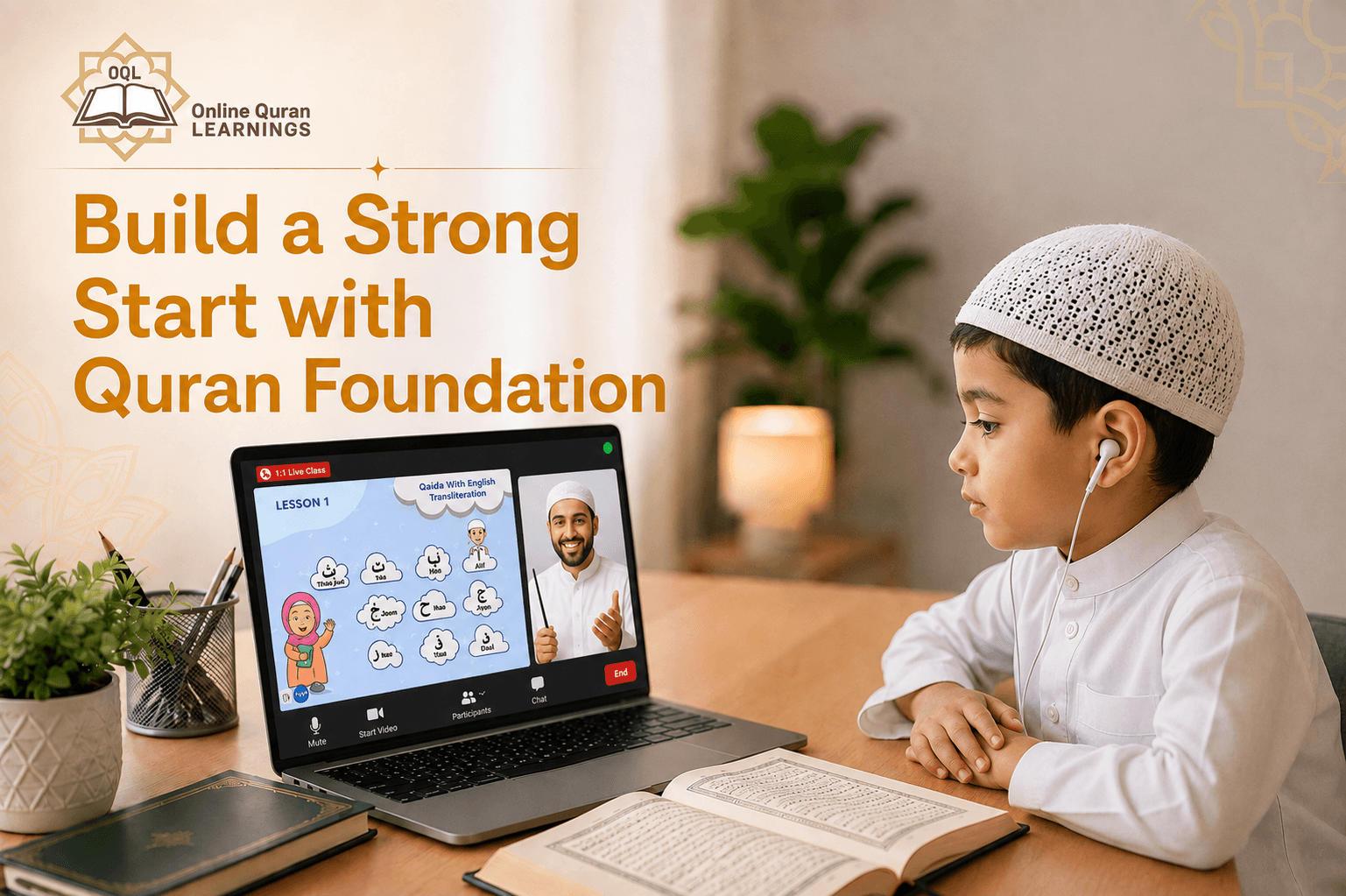
Noorani Qaida is the primer almost every child uses to learn to read the Quran. If your child is starting, this is where they will start, and understanding what it does explains a great deal about why some months feel like fast progress and others feel like nothing is happening.
What it is
Noorani Qaida is not a book about the Quran. It is a phonics book for Quranic Arabic, built to take someone from not recognising a single letter to reading Quranic text accurately.
It teaches four things, in this order, and the order is the whole point:
- Individual letters — the shapes and, more importantly, the sounds.
- Vowel marks — how the same letter changes with fatha, kasra and damma.
- Joining — how letters change shape depending on their position in a word.
- Rules of recitation — elongation, nasalisation, stopping, and the basic Tajweed rules that reading requires.
Nothing later works if an earlier stage was rushed. That is the most useful thing for a parent to know, and it is why our Noorani Qaida course is paced by the child rather than by a fixed number of weeks.
The stages, and how long each takes
These are the ranges we see for a child of five to seven taking two or three thirty-minute classes a week. An older beginner will usually be at the faster end or beyond it.
| Stage | What it covers | Typical time |
|---|---|---|
| Letters, isolated | Recognising and pronouncing all 28 letters | 4–10 weeks |
| Vowel marks | Fatha, kasra, damma, then tanween | 4–8 weeks |
| Joined letters | Letters in initial, medial and final forms | 6–12 weeks |
| Sukoon and shaddah | Silent letters and doubling | 3–6 weeks |
| Madd and rules | Elongation, nasalisation, stopping | 6–12 weeks |
| Reading practice | Applying all of it to real Quranic text | ongoing |
Total: roughly six to eighteen months. The range is wide because attendance and daily practice affect it more than aptitude does.
Where children actually get stuck
The heavy letters
ص، ض، ط، ظ، ق and غ have no English equivalent. A child who is not corrected precisely will substitute the nearest familiar sound — س for ص, ت for ط, ك for ق — and because the substitution is close, it often goes unnoticed for months.
This is the strongest argument for a teacher rather than an app. An app can show the letter; it cannot hear that your child said the wrong one.
The throat letters
ع، ح، خ، غ and ء are produced further back than any English sound. They usually need physical description — where the constriction is, what the airflow does — not just repetition.
Similar shapes
ب ت ث, and ج ح خ, differ only by dots. Early on, children read the shape and guess the dots. The fix is slow, deliberate reading rather than more speed.
Losing the thread when joining
A child who reads individual letters confidently can stall completely on a joined word, because they are trying to identify four letters and hold four sounds simultaneously. Breaking the word apart and rebuilding it is the standard remedy, and it needs patience more than technique.
Free Qaida resources
We keep our teaching materials freely downloadable, with no email required, because a parent who wants to practise with their child at home should not have to trade contact details for a PDF:
- Noorani Qaida (PDF) — the standard primer.
- OQLS Qaida (PDF) — our own edition, used in our classes.
- Ahsanul Qawaid (PDF) — the main alternative primer.
- Articulation points of Quranic letters (PDF) — a diagram of where each letter is produced in the mouth and throat. Genuinely useful for the heavy and throat letters.
- Your Tajweed Made Easy (PDF) — for the rules stage at the end.
More are on our resources page.
How parents can help without teaching
You do not need to know Arabic to make a large difference.
- Five minutes a day beats thirty minutes on Sunday. Ask your child to read the current page aloud to you. You are providing an audience, not corrections.
- Do not correct pronunciation unless you are certain. A well-meant correction that is wrong is harder to undo than the original error.
- Ask them to teach you a letter. Explaining it is the single best test of whether they actually know it.
- Let the teacher set the pace. Asking for the next page before the current one is secure is the most common way a Qaida gets finished on paper and not in practice.
- Mark the stages. Finishing the letters, or reading the first joined word unaided, are real milestones and worth noticing.
After the Qaida
Finishing the Qaida means a child can decode Quranic text. It does not yet mean fluent, beautiful recitation — that comes from reading the Quran itself with a teacher, applying Tajweed rules until they stop requiring thought.
The usual next step is Juz Amma, the short surahs at the end of the Quran, which are familiar from prayer and therefore encouraging to read. From there, some children continue to Hifz, some to Tafseer and understanding, and some simply to reading the whole Quran through.
If you are choosing where to start, our guides on what age to begin and choosing a teacher cover the two decisions that come before this one.
Frequently asked questions
How long does Noorani Qaida take to finish?
For a child of five to seven taking two or three classes a week, six to eighteen months is the usual range. Older beginners typically finish in three to eight months because they already read fluently in another language.
Can I teach Noorani Qaida to my child myself?
You can teach the letter shapes and the order. The part that is difficult without a teacher is articulation — the heavy letters and the throat letters have to be heard and corrected, and a parent who learned them imprecisely will pass that on.
What is the difference between Noorani Qaida and Ahsanul Qawaid?
They are two different primers teaching the same foundation. Noorani Qaida is more widely used and moves in smaller steps; Ahsanul Qawaid covers similar ground with a different sequence and layout. Either works, and consistency matters more than the choice.
Is Noorani Qaida only for children?
No. Adults who never learned to read Arabic start in exactly the same place, usually one-to-one so there is no comparison with anyone else. Older beginners generally move through it considerably faster.