
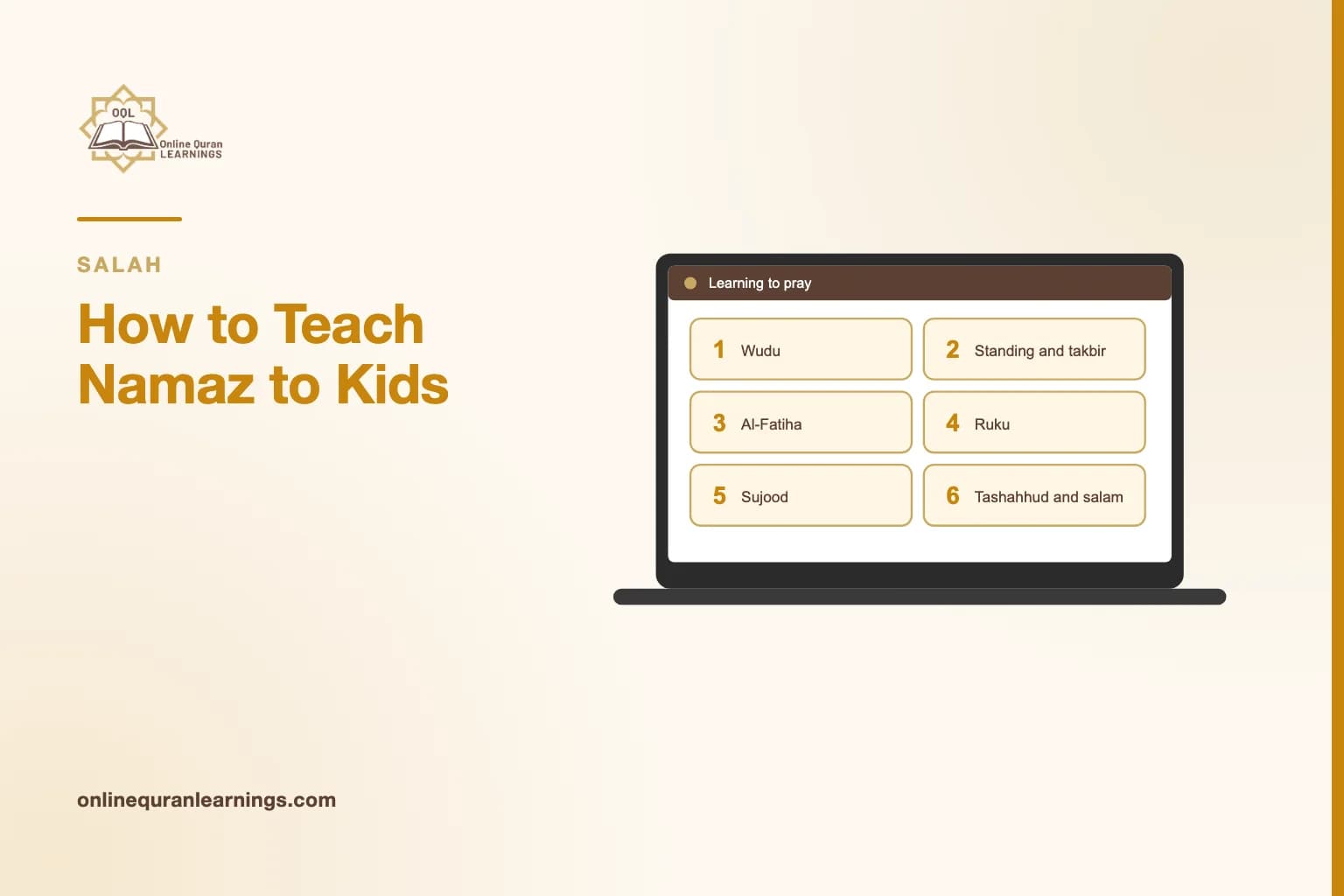
Children learn to pray the way they learn to speak: by watching, copying, and slowly filling in the words. A parent who prays where the child can see, and lets them join in, has already done half the teaching.
The rest is a matter of order. In short:
- From toddlerhood, let them watch and copy.
- Teach wudu before salah, so the prayer starts properly.
- Teach the positions first, as a sequence of movements.
- Add the words one position at a time, starting with Al-Fatiha.
- Build from one prayer a day towards all five, ideally around age seven onward.
This guide is for parents doing that at home. If you would rather have a teacher guide your child through it, our salah classes for kids page explains how lessons work.
What age to start, and what each stage looks like
A well-known hadith, recorded in Sunan Abi Dawud and other collections, instructs parents to tell their children to pray when they reach seven, with a firmer expectation by ten. Scholars generally understand this as the age at which regular teaching begins, not the age at which a child first meets the prayer. Most also stress that the approach should be patient and gentle.
In practice, it looks something like this:
| Age | What to aim for | What not to worry about yet |
|---|---|---|
| 2 to 4 | Watching, copying the movements, saying Allahu Akbar | Words, order, finishing a prayer |
| 4 to 6 | Basic wudu, the full sequence of positions, Al-Fatiha and a short surah | Praying all five, exact counts of rakahs |
| 7 to 9 | Praying regularly with you, knowing the words in each position | Perfect Tajweed, longer surahs |
| 10 plus | Praying the five daily prayers, mostly independently | Nothing big; this is about consistency and sincerity |
Every child moves at their own speed. A five-year-old who loves joining in might be ahead of this table; an eight-year-old who started late might be behind it. Either is fine.
Modelling comes first
Before any teaching, children need to see prayer as a normal part of the day. A few things that help:
- Pray where your child can see you, at least some of the time, rather than always behind a closed door.
- Say out loud what you are doing: "It is Maghrib, I am going to make wudu and pray."
- Invite, rather than order. "Come and pray next to me" lands better than "Go and pray."
- Let siblings and parents pray together sometimes, so the child sees it as a family thing.
Children who grow up seeing salah as something the adults they love do every day tend to treat it as normal. That matters more than any chart.
Wudu before anything else
Wudu is the first practical step, and it is easier to teach than salah because it is short, physical and done with water, which most children enjoy.
Teach it at the sink, side by side, in the same order every time. Name each step as you do it. Children most often miss the heels and the gaps between the fingers, so point to them each time. For young children, getting the order right and doing each part properly matters more than knowing which parts are obligatory and which are recommended.
Positions first, then the words
The most common mistake parents make is starting with the Arabic. A child trying to remember Al-Fatiha while also working out when to bow tends to lose both.
Start with the movements as a sequence: standing, raising the hands for the takbir, bowing, standing up, two prostrations, sitting, and turning the head right and left at the end. Practise it with no words at all, perhaps with you calling out "now bow" and "now down". Children often learn this in a week or two.
Then add the words in the order they are said, one position at a time:
- Takbir: Allahu Akbar, when the hands are raised.
- Standing: Al-Fatiha, then a short surah.
- Bowing: Subhana Rabbiyal Azeem.
- Rising: Sami Allahu liman hamidah, then Rabbana lakal hamd.
- Prostration: Subhana Rabbiyal Ala.
- Sitting: the tashahhud, and in the final sitting the salawat on the Prophet.
- Ending: Assalamu alaikum wa rahmatullah, to the right and then the left.
Each of these can take days or weeks. The tashahhud is usually the last to settle, and that is fine.
Which surahs to teach first
Al-Fatiha comes first, because it is recited in every rakah. After that, choose one or two very short surahs for the second part of the standing. Al-Ikhlas and Al-Kawthar are common first choices because they are short and easy to pronounce. Al-Asr, An-Nas and Al-Falaq often follow.
Our guide to short surahs for kids to memorise suggests an order and explains how to help them stick.
Correct pronunciation matters, especially for Al-Fatiha. If you are not confident in your own recitation, or the child is mixing sounds, a teacher can help. That is one of the main reasons families book salah lessons.
A four-week home plan
This is for a child of around six or seven who knows wudu and some of Al-Fatiha. Keep each session short: five to ten minutes.
| Week | Focus | Daily practice |
|---|---|---|
| 1 | The positions, no words | Walk through two rakahs with you calling out each move |
| 2 | Al-Fatiha and one short surah in the standing | Practise the standing part, then the full movements |
| 3 | The words for bowing, rising and prostration | Pray one full two-rakah prayer with you, saying the words |
| 4 | Tashahhud and ending | Pray one prayer a day with you, usually Maghrib or Fajr at the weekend |
After week four, keep praying one prayer together daily and add a second when the child is comfortable. Moving from one to five daily prayers can take months, and for many children it happens gradually between seven and ten. Ramadan, when the whole household is more focused on prayer, is a good time to add another; our Ramadan plan for kids covers that month.
Mistakes that make it harder
- Correcting everything at once. Pick one thing per day. A child corrected on five things in one prayer learns that prayer is where they get told off.
- Using prayer as a punishment or bargaining chip. "No screen until you pray" can work for some families, but used carelessly it turns salah into a chore that stands between the child and something they want.
- Expecting adult concentration. Young children fidget, look around and lose count. That improves with age.
- Starting with long surahs. Short surahs, said correctly, are better than long ones rushed.
- Only teaching, never praying together. Lessons without shared prayer do not build the habit.
Differences between families
Families following different schools of thought, such as Hanafi, Shafi'i, Maliki or Hanbali, pray in the same basic way but differ in some details: where the hands are placed in standing, whether the hands are raised at other points in the prayer, how one sits in the tashahhud, and whether Ameen is said aloud. Some schools also describe small differences in posture for women and girls.
These differences are long-standing and accepted. Teach your child the way your family prays, and if you are unsure about a detail, ask your local imam or a scholar you trust. A teacher working with your child should follow your family's practice; it is worth telling them which school you follow at the start.
Frequently asked questions
Should a young child pray on a full-size prayer mat beside me?
Yes, if they want to. A mat of their own, placed next to yours, gives them a clear spot and makes joining in feel natural. Some children like choosing their own mat, which helps them feel it belongs to them.
Is it a problem if my child joins in for a few rakahs and then wanders off?
Not for a young child. Before seven, joining in for part of a prayer is a normal stage of learning. Let them leave quietly and praise the part they did, rather than calling them back mid-prayer.
Do girls and boys learn salah differently?
The core of the prayer is the same. Some schools of thought describe small differences in posture for women and girls, so follow what your family practises or ask your local scholar or teacher.
What should my child do about prayers during the school day?
For younger children, focus on the prayers at home first. As they get older, talk to the school about a quiet space for Dhuhr if it falls in school hours, and make up the habit gradually rather than all at once.